

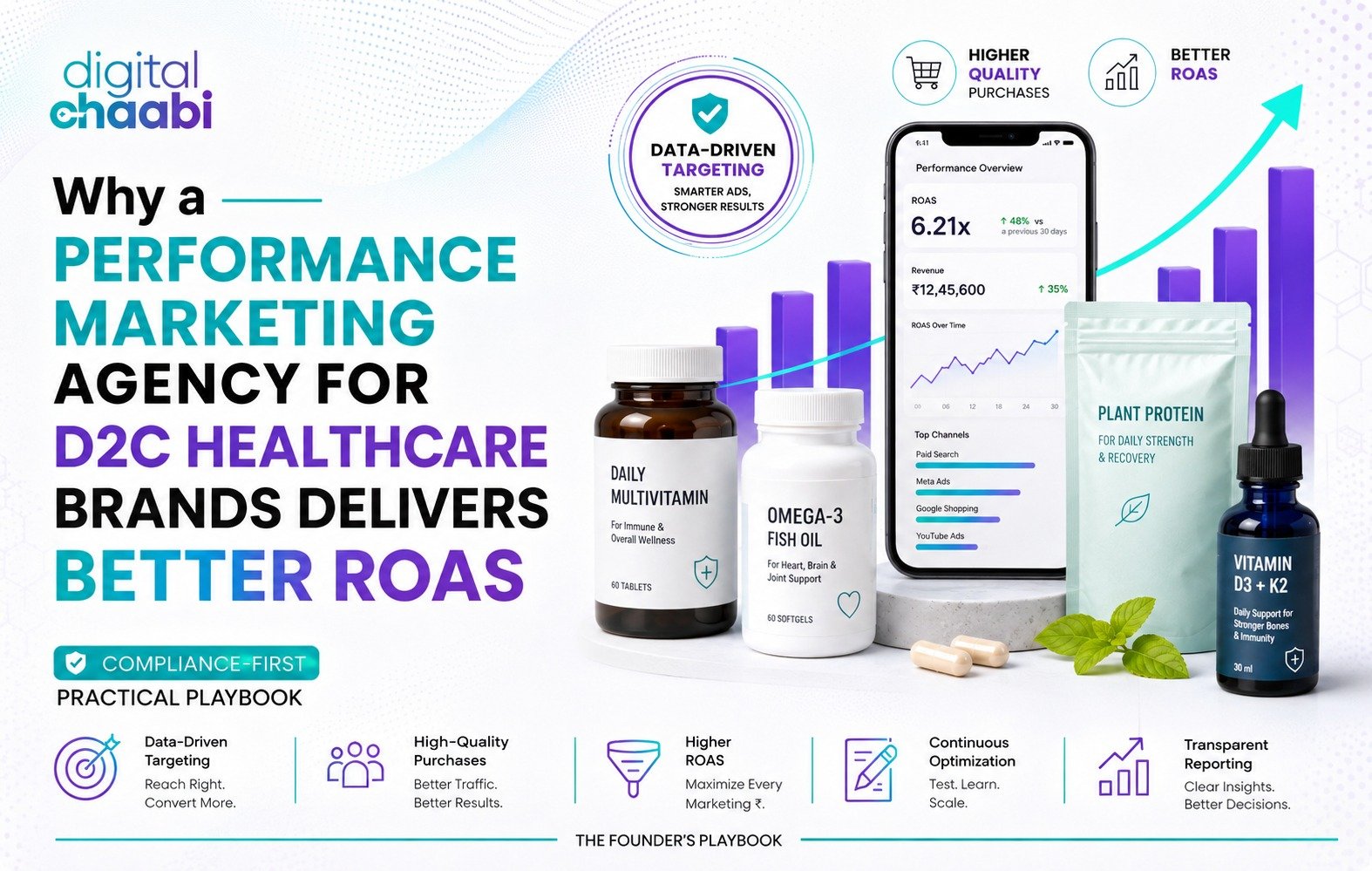
ROAS isn’t a vanity metric. It’s the number that tells you whether your marketing is a cost or an investment.
And for most healthcare D2C brands, it’s somewhere in between — not terrible enough to stop, not good enough to confidently scale. That’s the uncomfortable middle ground where a lot of health brands live. Spending ₹5L a month on ads, seeing ₹12–15L in attributed revenue, and wondering why the bank account doesn’t reflect it.
A performance marketing agency for D2C healthcare brands solves this. Not by spending more — by spending smarter. Better targeting, tighter creative, cleaner attribution, and a full-funnel system where every rupee has a job. ROAS improves when the whole machine works together, not just the ad account.
The brands hitting 5x, 6x, 7x ROAS consistently aren’t lucky. They built the right infrastructure with the right partner.
What Is D2C in Performance Marketing?
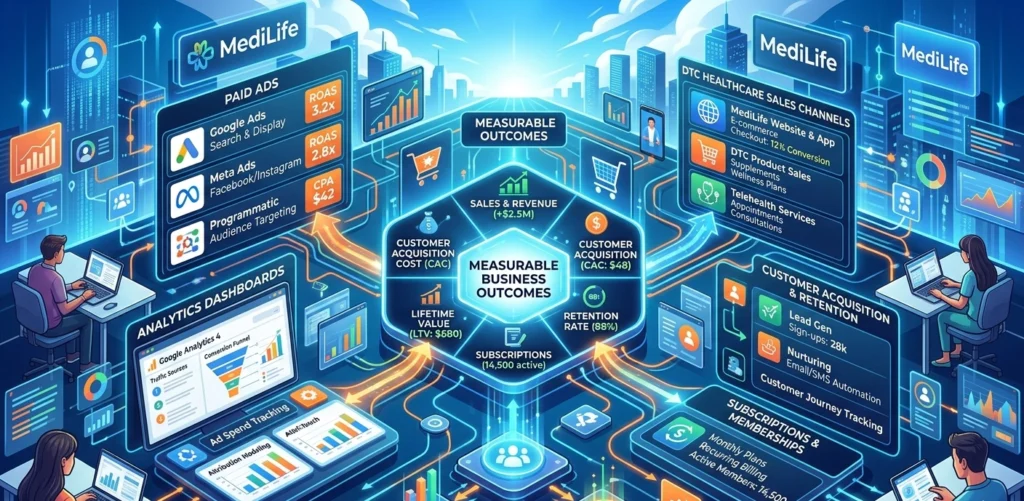
D2C performance marketing means every channel, every creative, every rupee spent is tied directly to a measurable business outcome — a purchase, a subscription, a lead that converts.
No brand awareness budgets that disappear into impressions. No “trust the process” campaigns with no attribution. In D2C performance marketing, if it can’t be measured, it either gets measured better or gets cut.
Why This Model Works Differently for Healthcare
Healthcare D2C has a longer consideration cycle than most categories. Someone buying a protein supplement isn’t impulse-purchasing — they’re researching, comparing, hesitating, and then buying when trust tips over the threshold. Performance marketing in this context isn’t just about the click. It’s about the entire sequence that earns the click worth having.
A performance marketing agency for D2C healthcare brands builds for this:
- Top-of-funnel content ads that educate rather than sell — building the trust bank early
- Mid-funnel retargeting that answers objections rather than repeating the product pitch
- Bottom-funnel conversion ads with strong trust signals — reviews, guarantees, clinical backing
- Post-purchase flows that turn a single transaction into a subscription relationship
Each layer feeds the next. That’s what separates a D2C marketing strategy built for healthcare from a generic ad campaign.
Attribution Is the Hidden Problem
Most healthcare D2C brands are measuring ROAS wrong. Post-iOS 14, Meta’s attribution is partial at best. Google’s last-click model ignores six touchpoints that happened before. The customer who bought after seeing three Instagram reels, reading a blog post, and clicking a Google Search ad — which channel gets credit?
A serious performance marketing agency for D2C healthcare brands fixes attribution first. Server-side tracking, UTM architecture, first-party data collection, cross-channel view. Boring infrastructure work that makes every subsequent decision more accurate — and more profitable.
What Are the 5 P’s of Healthcare Marketing?
The 5 P’s — Product, Price, Place, Promotion, People — take on specific meaning in healthcare D2C. Each one is a lever. Pull the wrong one at the wrong time and the whole system underperforms.
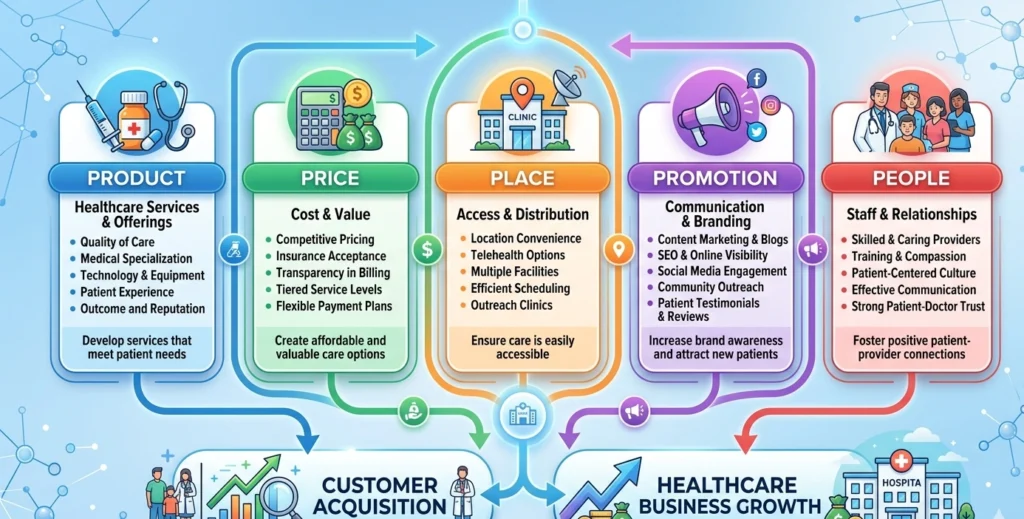
Applying the 5 P’s to Better ROAS
Product
In healthcare, the product story is the ad. Ingredient transparency, clinical backing, certifications — these aren’t just packaging decisions. They’re conversion levers. A healthcare digital marketing strategy that doesn’t communicate product credibility at every touchpoint is leaving ROAS on the table.
A well-told product story in an ad reduces the work the landing page has to do. Which reduces bounce rate. Which improves conversion rate. Which improves ROAS. It all connects.
Price
Price architecture matters more than the price point itself. A ₹999 product with a starter pack at ₹499 has a completely different CAC than the same product sold only at full price. Digital Chaabi works with brands to build pricing structures that lower first-purchase friction while protecting LTV — because the goal isn’t the first sale, it’s the lifetime.
Place
Where the brand shows up in the purchase journey. Own website, Amazon, quick-commerce, WhatsApp commerce. Each channel has different margin profiles and different customer quality. A performance marketing agency for D2C healthcare brands allocates spend based on where the best LTV customers actually come from — not just where conversion is easiest.
Promotion
The full channel mix working together. Meta for awareness and retargeting. Google for high-intent search. SEO for compounding organic. WhatsApp for retention. Influencers for borrowed trust. When these channels are coordinated — same message, different format, right stage — ROAS across the board improves.
People
The humans in the brand story. Founder credibility, nutritionist endorsements, real customer journeys. In healthcare especially, people trust people before they trust products. A D2C healthcare brand that puts real faces and real stories at the centre of its performance creative consistently outperforms one that relies on product shots alone.
Read More: How the 5 P’s of Marketing Apply to D2C Health Brand Growth
Why Generic Agencies Underdeliver on ROAS for Healthcare Brands
This is worth saying plainly. A general digital marketing agency can run healthcare ads. They can set up campaigns, write copy, hit publish. But there’s a gap between technically running ads and actually understanding the category.
The Compliance Blind Spot
Healthcare ad policies are strict — and getting stricter. Before/after claims, disease treatment language, ingredient efficacy statements — all of it sits in a grey zone that a healthcare performance marketing specialist navigates daily. A generic agency gets it wrong, gets ads rejected or accounts flagged, and costs the brand time and momentum it can’t get back.
The Trust Problem in Creative
Generic agencies write ads like they’re selling electronics. Features, specs, price. Healthcare buyers don’t respond to that. They respond to empathy — someone who understands their problem before pitching the solution. D2C healthcare brand creatives that lead with “we know what you’re going through” consistently outperform creatives that lead with “here’s what our product does.”
That insight comes from category experience. It’s not something you improvise.
The Metric Disconnect
A generic agency optimises for CTR and CPL. A performance marketing agency for D2C healthcare brands optimises for CAC, LTV, and repeat purchase rate — because those are the numbers that determine whether the business is actually working.
According to Think with Google, brands that align their marketing metrics to business outcomes rather than campaign metrics see 20–30% better revenue efficiency. In healthcare D2C, where margins are tight and trust is everything, that alignment is the difference between scaling and plateauing.
Read More: Why Your D2C Brand Needs a Specialist Agency, Not a Generalist
How a Performance Marketing Agency Builds Sustainable ROAS
Sustainable ROAS isn’t a number you hit once. It’s a floor you keep raising.
The way a performance marketing agency for D2C healthcare brands builds this:
- Creative velocity — constant testing of new angles, formats, and hooks so performance doesn’t decay as audiences fatigue
- Audience architecture — structured cold, warm, and hot tiers with distinct messaging for each, not one audience seeing the same ad repeatedly
- Landing page iteration — conversion rate optimisation running parallel to media buying so traffic quality and conversion rate improve simultaneously
- Retention layer — email and WhatsApp flows that improve blended ROAS by increasing LTV without increasing acquisition spend
- Weekly learning loops — structured review of what worked, what didn’t, and what to test next — not just reporting on the past
Digital Chaabi builds this infrastructure for every healthcare D2C engagement. Because ROAS without a system behind it is just a lucky week.
Conclusion
Better ROAS isn’t about spending more or finding a magic creative. It’s about building the whole system correctly — attribution, creative, audience, funnel, retention — and tightening every layer with data. A performance marketing agency for D2C healthcare brands does exactly this. They bring category expertise, compliance knowledge, and a metrics framework built around real business outcomes, not vanity numbers.
If your ROAS feels like it should be higher — it probably should be. And there’s usually a specific reason why it isn’t.
Ready to Fix Your ROAS?
Digital Chaabi specialises in performance marketing for D2C healthcare brands — building the systems, creative, and data infrastructure that turn ad spend into profitable, scalable revenue. Start the conversation at crm@digitalchaabi.com or visit digitalchaabi.com.
Frequently Asked Questions
What is a D2C marketing agency?
A D2C marketing agency specialises in brands that sell directly to consumers — no retail middlemen, no distributor margins. They build strategy around the metrics that matter in this model: CAC, LTV, repeat purchase rate, and ROAS. A performance marketing agency for D2C healthcare brands adds a layer of category expertise — understanding compliance, trust-building, and the longer consideration cycles specific to health products.
What are the big 5 marketing agencies in the world?
The “big 5” typically refers to WPP, Publicis Groupe, Omnicom, Interpublic Group, and Dentsu — global holding companies managing hundreds of sub-agencies. For D2C healthcare brand growth, however, these behemoths rarely make sense. They’re built for enterprise brand budgets, not the performance-first, margin-conscious approach that D2C demands. Specialist agencies with deep category knowledge almost always deliver better outcomes at the scale most health brands operate at.
How is ROAS calculated for a D2C healthcare brand?
ROAS = Revenue attributed to ads ÷ Ad spend. A ₹5L spend generating ₹20L in attributed revenue is a 4x ROAS. But in D2C performance marketing, blended ROAS — total revenue divided by total marketing spend including agency fees — is the more honest number. It accounts for all channels and all costs, giving a clearer picture of whether the marketing engine is actually profitable.
What’s a good ROAS benchmark for healthcare D2C brands in India?
A reasonable starting benchmark for Meta Ads in the health category is 2.5–3.5x in the first 60 days, scaling toward 4–6x as creative and audiences mature. Healthcare performance marketing ROAS improves significantly when retention channels — WhatsApp, email, subscriptions — are added to the mix, because repeat purchase revenue is counted in revenue but requires no additional acquisition spend.
How does server-side tracking improve ROAS for D2C brands?
Server-side tracking sends conversion data directly from the brand’s server to ad platforms — bypassing browser-level blocking and iOS privacy restrictions. This means more of your actual conversions get reported back to Meta and Google, improving their optimisation algorithms. Better data in means better targeting decisions out. For healthcare digital marketing, where the purchase journey spans multiple sessions and devices, this accuracy is significant.
How long does it take a performance marketing agency to improve ROAS?
Early improvements — fixing attribution, tightening audiences, refreshing creative — can show impact within 4–6 weeks. Structural improvements like building out retention flows and SEO take 3–4 months to compound meaningfully. A performance marketing agency for D2C healthcare brands should show you leading indicators — CPL trends, CTR improvements, conversion rate movement — within the first month so you’re not waiting three months for the first signal.