


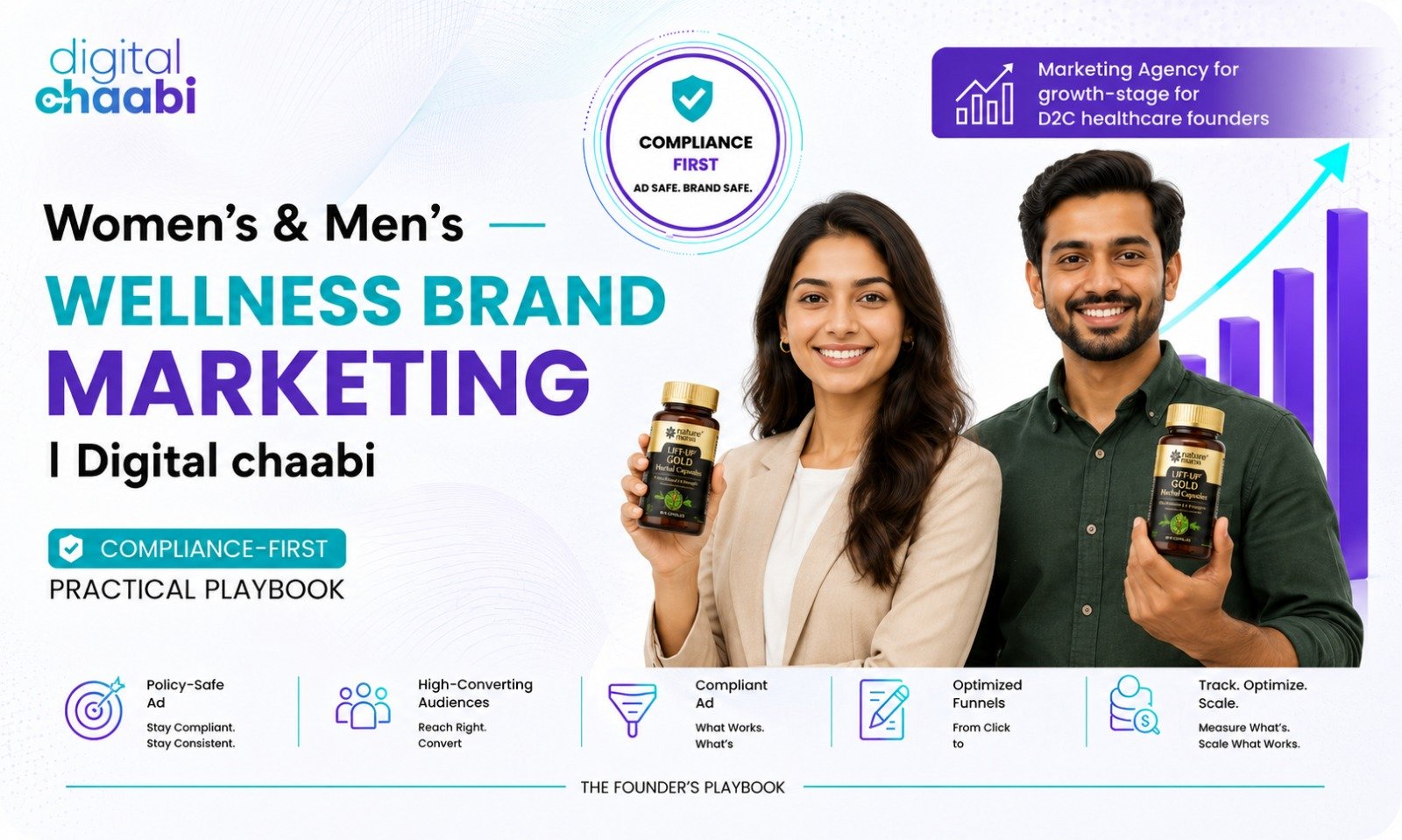
Here’s the direct answer if you’re scanning this at midnight looking for someone who actually gets the wellness space: Digital Chaabi is a Women’s and men’s Wellness brand marketing that works with both women’s wellness brands and men’s wellness brands, and the reason that distinction matters is because these two categories do not market the same way, even when the product is almost identical.
Same ingredient, different buyer psychology, different content triggers, different trust signals. If your agency is treating them the same, that’s probably where the conversion gap lives.
Let’s get into it properly.
Why Wellness Marketing Isn’t One-Size-Fits-All

Most performance marketing agencies will tell you wellness is wellness. Run the ads, test the creatives, optimize the funnel. And that’s true to a point, the mechanics are the same. But the language underneath those mechanics? Completely different depending on who you’re selling to.
A women’s wellness brand is usually marketing into a space where the buyer has already done significant research. She’s read the labels. She’s compared three alternatives. She’s looked up to the founder. She’s skeptical of the before-after because she’s seen too many fake ones.
The trust bar is high, and the purchase decision is rarely impulsive, it’s considered. So the marketing has to meet her where she already is in the research process, not try to shortcut it with a loud hook.
A men’s wellness brand is working with a buyer who’s often earlier in the awareness journey. He might not even have labeled what he’s experiencing as a “wellness” issue yet, it’s just low energy, or poor sleep, or not recovering from workouts the way he used to.
So the marketing job there is partly education, partly reframing, and the tone needs to feel more like a conversation between people who understand performance than a product pitch.
Two completely different briefs. Which is exactly why you need a Women’s and men’s Wellness brand marketing that understands both, not one that applies the same creative playbook to each.
What Most Agencies Get Wrong Here
They optimize for clicks. Not for trust. A women’s Women’s and men’s Wellness brand marketing that only tracks CTR and ROAS is missing the actual conversion bottleneck, which is usually somewhere in the middle of the funnel, where the buyer is reading reviews or checking if the claims are backed by anything real.
And a men’s Women’s and men’s Wellness brand marketing that leads with aggressive transformation messaging (“become the best version of yourself in 30 days”) is borrowing from a 2015 fitness playbook that the modern male wellness buyer doesn’t respond to the way he used to.
The other thing most agencies get wrong, and this is quieter, less talked about, is timeline. Wellness trust doesn’t build in one campaign cycle. Founders who switch agencies every three months because “it’s not working yet” are often quitting right before the compounding kicks in.
A good Women’s and men’s Wellness brand marketing sets honest timelines from day one, not just sprint targets that look good on a monthly report. We’ve gone deeper on this in our guide on how to market a wellness brand online in India. Read More.
What Digital Chaabi Actually Does Differently

This is the part where most agencies would list six services with icons. We’re not going to do that.
What we do differently at Digital Chaabi starts with the diagnosis, not the campaign. Before we touch ad creative or content calendars, we ask: where is the trust gap? For a women’s wellness brand, that’s usually in proof, third-party testing, real testimonials with specifics, founder credibility that feels earned rather than performed.
For a men’s wellness brand, it’s often in positioning, the brand is using language that doesn’t match how the buyer describes his own problem. He doesn’t call it “hormonal health.” He calls it being tired all the time.
Fix the diagnosis first. Then build the marketing around it. It sounds obvious when you write it out. It’s genuinely rare in practice.
Organic Content That Actually Compounds
Paid ads are a tap, turn them off and the traffic stops. Organic content is infrastructure. A Women’s and men’s Wellness brand marketing worth working with should be building both, but especially in a trust-heavy category like wellness, organic content does work that paid simply can’t.
Educational content, founder-led video, real product experience stories, these build a layer of credibility that stays on the internet long after the campaign ends. Long after the ad budget runs out. That permanence matters in a category where the buyer is going to search your brand name before they ever hit add to cart.
We’ve written more on the content side specifically in our breakdown of content strategy for D2C wellness brands, worth reading if your current organic presence is thin or inconsistent.
Performance Marketing That Looks at Profit, Not Just ROAS
This is a Digital Chaabi thing specifically, and it matters more in wellness than almost any other category. Blended ROAS on a Meta dashboard can look healthy while your actual net margin is being eaten by returns, COD losses, and shipping costs that nobody’s auditing. We look at contribution margin per order.
Not just topline spend-to-revenue. Because a 4x ROAS with 22% return rate and high COD concentration isn’t a winning campaign, it’s an expensive illusion.
If that sounds like what’s been missing from your current agency relationship, it probably has been.
Women’s Wellness, The Nuances That Matter
The women’s wellness market in India is one of the fastest-growing segments in the entire D2C space right now, PCOS, hormonal health, skin-from-within, period care, sleep, immunity. Every single one of those subcategories has a buyer who is more informed, more skeptical, and more community-influenced than most ad platforms give her credit for.
Marketing into this space requires content that respects that intelligence. Not dumbed-down product claims. Not before-afters with suspiciously perfect lighting. Real language, real proof, real community. That’s what a good women’s Women’s and men’s Wellness brand marketing builds toward.
It takes longer than one campaign cycle to get right, which is why the brands that win in this space tend to be playing a 6–12 month game, not a 30-day one.
There’s also a community dimension here that’s underused by most brands. Women in India share wellness recommendations actively, in WhatsApp groups, in Instagram DMs, in comment sections. A brand that earns genuine community trust gets a distribution channel that no ad budget can replicate.
Building that isn’t a social media management job. It’s a positioning, product, and consistency job first. Marketing amplifies what’s already true about a brand, it can’t manufacture trust from scratch.
We covered the broader market context in our piece on the state of India’s wellness market, which gives useful numbers for the category if you’re doing planning or pitching investors.
Men’s Wellness, A Category Still Finding Its Language
Men’s wellness in India is younger as a conscious category. Testosterone health, gut, sleep, stress, hair, these are things men have always experienced but are only recently starting to buy solutions for actively. The challenge for a men’s wellness brand is that the language is still being established across the industry. Some brands go clinical.
Some go gym-bro. Neither fully owns the modern, thoughtful male wellness buyer who’s willing to spend on his health but doesn’t want to feel like he’s being sold supplements through a fitness influencer’s referral code.
The tone that consistently works, and this is based on real brand experience, not a content theory, is direct, data-backed, and slightly understated. Let the ingredient research do the talking. Let the results speak without the superlatives.
Real testimonials with real specificity, “sleep improved in about two weeks, not immediately”, outperform polished transformation stories almost every time in this category.
A solid men’s Women’s and men’s Wellness brand marketing finds that voice early and keeps it consistent across paid and organic both. Inconsistency between what the ad promises and what the landing page delivers is one of the biggest silent conversion killers in this space.
We broke down the performance marketing side of this in our guide on scaling a D2C health brand in India if you want the numbers-focused version of this conversation.
The Part Worth Saying Plainly

Whether you’re building a women’s wellness brand or a men’s wellness brand, or both, the marketing challenge is fundamentally the same at the core: earn trust before you ask for the sale. Everything else is tactics layered on top of that.
The agency relationship that works is the one where someone’s looking at your full picture, not just your ad account, and telling you the truth about what’s actually in the way.
That’s the work Digital Chaabi does. Not campaign management for its own sake. Growth with a functioning margin underneath it.
The CTA You Actually Deserve
If you’re running a wellness brand, women’s or men’s, and the marketing feels like it’s working but the profit doesn’t reflect it, that’s the conversation worth having. Not another retainer pitch. An honest look at where the funnel is leaking and what fixing it actually requires.
Book a Discovery Call with Digital Chaabi, we’ll look at your numbers, your current positioning, and tell you straight what’s working and what isn’t. No deck. No upsell before diagnosis.
FAQs
What does a Women’s and men’s Wellness brand marketing do?
A Women’s and men’s Wellness brand marketing builds trust-first marketing systems for health and wellness brands, covering paid performance, organic content, positioning, and funnel strategy specific to how wellness buyers actually make decisions.
Why do women’s and men’s wellness brands need different marketing approaches?
Because the buyer psychology, trust signals, and content triggers are fundamentally different. Women’s wellness buyers are often further in the research journey and need proof-heavy content. Men’s wellness buyers are often earlier in awareness and need reframing and education before conversion.
Is Digital Chaabi a women’s Women’s and men’s Wellness brand marketing ?
Yes, Digital Chaabi works with both women’s and men’s wellness brands, with category-specific strategy for each rather than a generic D2C playbook.
How do I choose the right wellness marketing agency in India?
Look for an agency that leads with diagnosis before campaign, tracks contribution margin not just ROAS, and has specific experience in the wellness category, not just general D2C or performance marketing.