

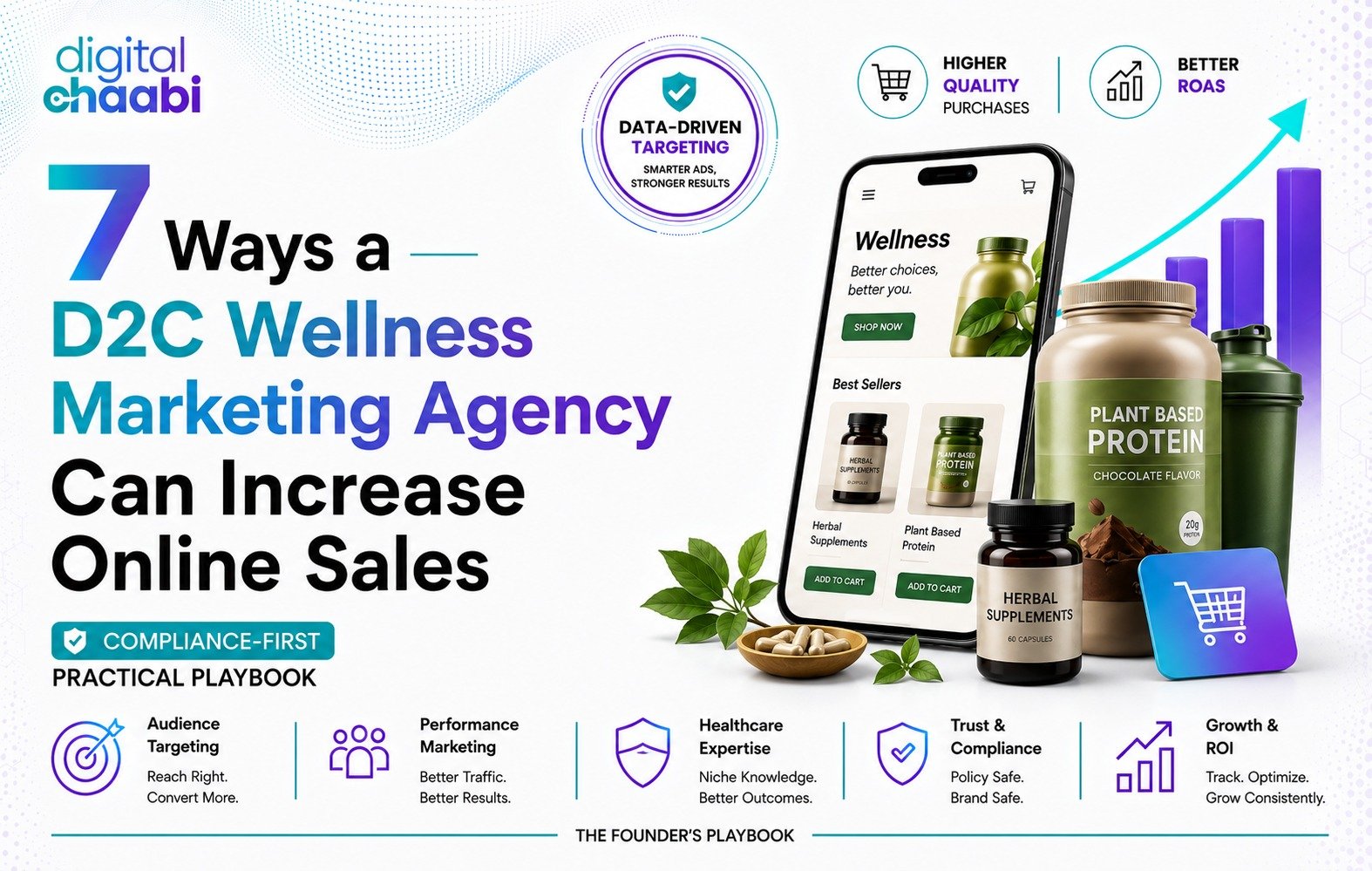
Online sales don’t just happen. They’re built — layer by layer, channel by channel, test by test.
A D2C wellness marketing agency doesn’t show up with a one-size-fits-all plan. It shows up with a diagnostic. What’s leaking in your funnel? Which channel is underperforming relative to spend? Where are customers dropping off and why? The answers to those questions shape everything that comes after.
Most wellness brands plateau not because the product is wrong but because the marketing infrastructure around it is patchy. Good ads, bad landing page. Great SEO, no retention. Strong awareness, zero consideration content. The job of a D2C wellness marketing agency is to close those gaps — systematically, measurably, one layer at a time.
Here are 7 ways they actually do it.
1. Building a Paid Acquisition System That Scales

Not just running ads. Building a system.
There’s a big difference. Running ads means putting budget behind creatives and hoping the ROAS holds. Building a system means structured creative testing, audience tiering, budget allocation logic, and a feedback loop that gets smarter every week.
A D2C wellness marketing agency approaches paid media like an engineer, not a gambler:
- Cold audiences get trust-first, education-led creatives — not “buy now”
- Warm audiences get social proof — UGC, reviews, before/afters
- Hot audiences get urgency — limited offers, reorder prompts, free shipping thresholds
- Every creative variant has a hypothesis. Every result generates a learning.
This is how wellness brand sales compound over time rather than spike and crash.
2. Fixing the Funnel Before Spending More on Traffic
More traffic into a broken funnel is just more waste.
Before scaling spend, a good D2C wellness marketing agency audits the full conversion path — ad to landing page to checkout to post-purchase. The leaks are almost always obvious once someone looks properly.
Common culprits:
- Landing pages that talk about the product but don’t address the buyer’s actual fear
- Checkout flows with too many steps or no COD option for first-time buyers
- No trust signals above the fold — no reviews, no certifications, no guarantee
- Mobile experience that’s technically functional but emotionally flat
Fixing a 2% conversion rate to 3.5% is worth more than doubling ad spend. That’s the maths a serious online wellness sales strategy is built on.
3. SEO and Content That Generates Compounding Revenue
Paid ads stop the moment you stop paying. Wellness brand SEO doesn’t.
A piece of content ranking for “best magnesium supplement for anxiety” or “how to improve sleep naturally” brings in qualified, high-intent traffic every single day — with no incremental spend. Over 12–18 months, that compounds into a significant revenue channel that paid alone can never replicate.
A D2C wellness marketing agency builds content with intent, not just volume:
- Ingredient deep-dives for research-stage buyers
- Comparison articles for consideration-stage visitors
- Symptom-based searches for top-of-funnel awareness
- FAQ content optimised for Google’s AI-generated answers
Digital Chaabi treats SEO as a revenue function, not a brand-building exercise. Rankings without conversions are vanity. Rankings that drive purchases — that’s the work.
Read More: Why SEO Is the Most Underrated Channel for D2C Wellness Brands
4. Retention Systems That Turn One-Time Buyers Into Loyal Customers
This is where most brands bleed without realising it.
Acquiring a customer costs money. Keeping them costs a fraction of that. And in wellness — where the product works best with consistent use — retention isn’t just good for revenue, it’s good for outcomes. A customer who uses your ashwagandha for 90 days gets better results and becomes your most powerful marketing asset.
A D2C wellness marketing agency builds retention infrastructure:
- Post-purchase onboarding sequences that set expectations and reduce returns
- Reorder reminders timed to actual product consumption cycles — not arbitrary 30-day intervals
- Loyalty and subscription nudges for customers showing high engagement
- Win-back flows for lapsed buyers before they’re gone permanently
According to HubSpot, increasing customer retention by just 5% can increase profits by 25–95%. In wellness D2C, where CAC is climbing, that number hits differently.
5. Influencer and UGC Strategy That Actually Converts
Not all influencer marketing is equal. A lot of it is expensive brand awareness with no attribution. The kind that looks good in a PR deck and doesn’t show up in revenue.
A smart D2C wellness marketing agency builds influencer strategy for conversion, not clout:
- Micro-influencers with genuine audience trust outperform mega-influencers for health categories almost every time
- Content briefed around real usage — not scripted testimonials — performs better in paid amplification
- UGC repurposed into Meta and Google ads bridges the gap between organic trust and paid scale
- Tracking matters — UTMs, unique codes, landing page variants — so you know what actually drove a sale
Digital Chaabi has seen brands cut CPL by 40% just by shifting influencer budget from celebrity endorsements to a network of niche micro-creators. The numbers don’t lie.
What Are the 7 P’s in Sales — and How They Apply to Wellness D2C
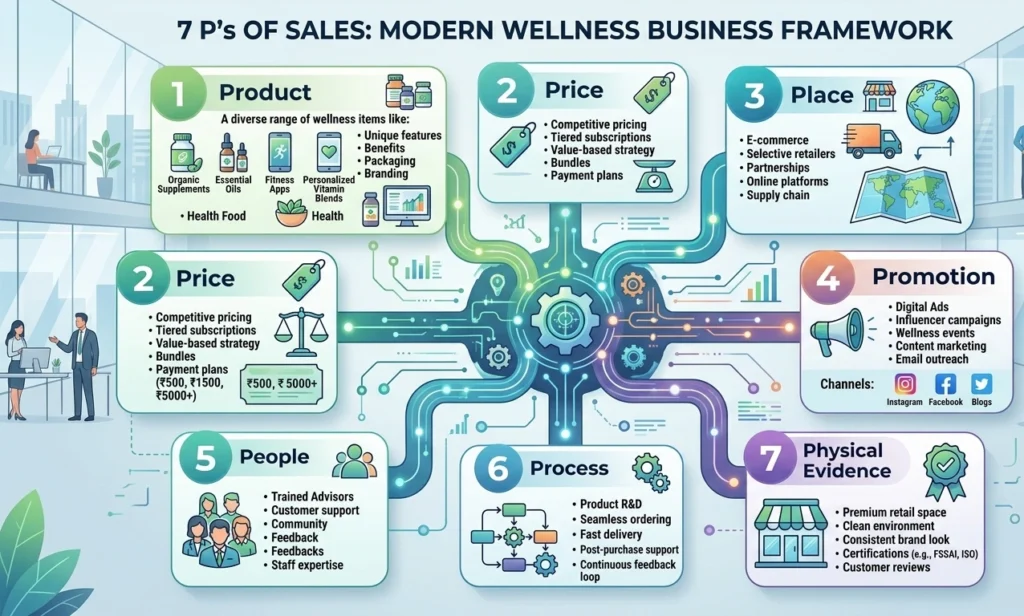
The 7 P’s — Product, Price, Place, Promotion, People, Process, Physical Evidence — are a framework. In wellness D2C, each one maps directly to a growth lever.
Product
Is the formulation clearly communicated? Can a first-time buyer understand what it does and why it works in 10 seconds? Clarity sells.
Price
Is the price anchored correctly? Starter packs, subscription discounts, and bundle pricing are tools a D2C wellness marketing agency uses to make the first purchase feel lower-risk.
Place
Where is the brand showing up? Website, marketplaces, WhatsApp commerce, quick-commerce. Distribution is a marketing decision.
Promotion
The full channel mix: paid, organic, influencer, email, WhatsApp. Not just ads.
People
Customer service, community management, founder visibility. In wellness, the humans behind the brand matter enormously to buyers.
Process
Checkout flow, delivery experience, return policy. Friction anywhere in this chain costs sales.
Physical Evidence
Packaging, unboxing, certificates of testing, third-party lab reports. In online wellness sales, physical evidence has to live digitally — on the product page, in the ads, in the emails.
What Are the 5 C’s of Sales — Applied to Wellness Brand Growth
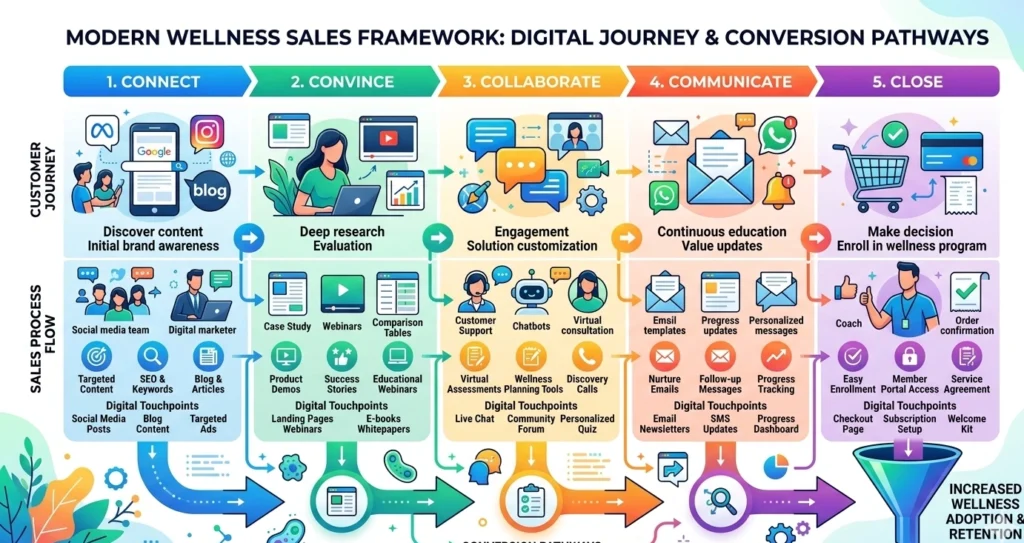
The 5 C’s of sales — Connect, Convince, Collaborate, Communicate, Close — aren’t just for B2B. They translate directly to how a wellness brand sales funnel should be built.
Connect
The ad or the content that earns the first click. Emotional resonance before product information.
Convince
The landing page, the reviews, the ingredient transparency. This is where credibility converts curiosity into consideration.
Collaborate
Partnerships, influencers, communities. Borrowed trust accelerates the journey from stranger to buyer faster than owned channels alone.
Communicate
Email, WhatsApp, retargeting. Consistent, relevant communication across the consideration window keeps your brand top of mind without being annoying.
Close
The final nudge. A guarantee, a limited offer, a frictionless checkout. A D2C wellness marketing agency optimises every element of this last step because this is where most brands quietly lose sales they already earned.
Conclusion
Seven ways — but honestly, it’s one idea. Build the whole system. Acquisition without retention leaks. Paid without organic is fragile. Creative without data is guesswork. A D2C wellness marketing agency that’s worth the investment builds all of it, measures all of it, and keeps tightening it until the numbers make sense on a P&L.
Online wellness sales don’t come from doing one thing brilliantly. They come from doing everything competently and a few things exceptionally.
If your brand is stuck between “it’s working a bit” and “it should be working better,” that gap is exactly what the right agency closes.
Let’s Build Your Sales Engine
Digital Chaabi builds full-funnel performance marketing systems for D2C wellness brands — paid acquisition, SEO, retention, and everything in between. If you’re ready to scale properly, start at crm@digitalchaabi.com or visit digitalchaabi.com.
Frequently Asked Questions
Q1. What are the 7 key points of sales for a wellness brand?
The 7 key points map well to wellness brand sales: clear product positioning, trust-first messaging, frictionless purchase experience, strong social proof, retention-focused post-purchase flow, multi-channel presence, and data-led optimisation. A D2C wellness marketing agency builds strategy around all seven — because missing even one creates a leak that costs revenue every month.
Q2. What are the top 3 skills for sales in a D2C wellness context?
The three that matter most are:
- Empathy — understanding what the customer is afraid of, not just what they want
- Data literacy — reading the numbers that actually predict revenue, not just engagement
- Consistency — wellness purchases are trust-dependent; inconsistent messaging kills conversion
Q3. How does a D2C wellness marketing agency increase online sales specifically?
By fixing the full funnel — not just the top. Most sales problems in wellness D2C aren’t traffic problems, they’re conversion and retention problems. A good agency audits the entire path from first impression to fifth reorder, finds where revenue is leaking, and systematically closes those gaps with better creative, better targeting, and better post-purchase experience.
Q4. What’s a realistic ROAS target for a D2C wellness brand running paid ads?
A healthy benchmark for Meta Ads in the wellness category is 2.5–4x ROAS in the early months, scaling to 4–6x as creative and audiences are refined. Wellness brand SEO and retention channels improve blended ROAS significantly over time by reducing dependency on paid acquisition. Any agency promising 10x ROAS from day one isn’t being honest with you.
Q5. How important is WhatsApp for D2C wellness brand sales in India?
Extremely. WhatsApp has open rates above 90% compared to 20–25% for email. For online wellness sales in India, WhatsApp-first retention flows — reorder reminders, loyalty nudges, post-purchase onboarding — consistently outperform email on engagement and conversion. Brands not using WhatsApp as a retention channel are leaving significant repeat revenue on the table.
Q6. When should a wellness brand hire a D2C marketing agency versus building in-house?
The honest answer: hire an agency when the cost of learning through trial and error exceeds the cost of the retainer. Usually that’s around ₹10–30L monthly revenue — when the stakes are high enough that bad decisions are expensive. Digital Chaabi recommends a hybrid approach for brands at scale — agency for strategy and paid execution, in-house for community and content.