

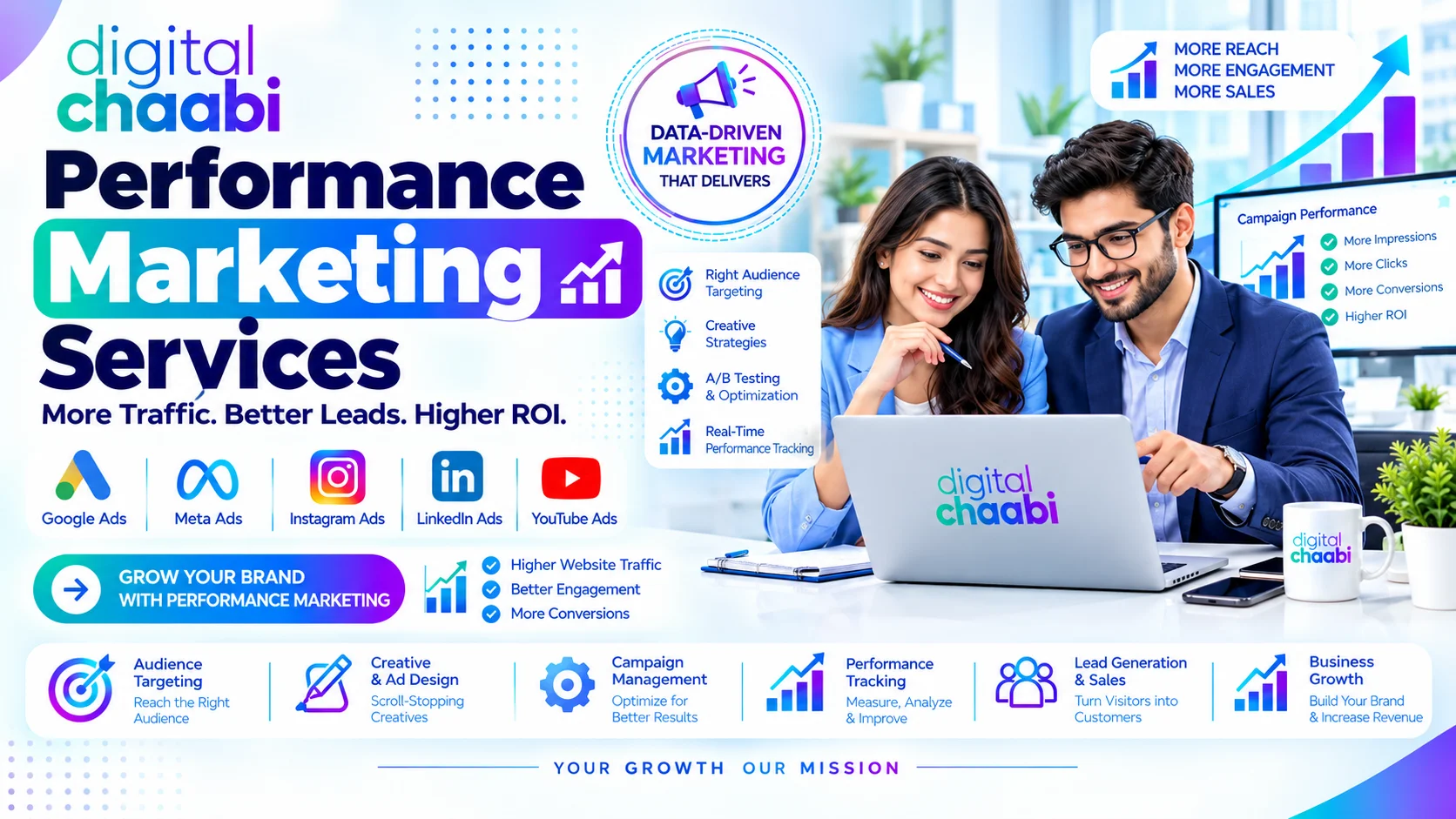
Performance marketing means the client only pays for specific outcomes that actually happen, a click, a lead, a sale, not for exposure that may or may not translate into revenue. Performance Marketing Services exist entirely around this principle: budget spent tied directly to measurable business results, not vanity impressions.
The distinction is deceptively simple but changes everything about how a campaign gets managed. Traditional advertising asks how many people saw something. Performance Marketing Services ask how many people did something specific, clicked, filled a form, bought, and the entire strategy gets built backward from that answer.
This is the practical version of that principle, the framework from traffic to sale, the metrics that actually matter, and how to get started without overcommitting budget before you know what works.
Core Framework: Traffic to Sale

Audience & Intent Mapping. Match search queries and social segments to funnel stages, top-of-funnel awareness versus bottom-of-funnel conversion intent. Treating every audience the same wastes spent on people who aren’t ready to act yet.
Getting this wrong is one of the most common reasons businesses give up on Performance Marketing Services too early, running a bottom-funnel, hard-sell offer against a top-of-funnel, cold audience produces disappointing numbers that have nothing to do with the channel itself and everything to do with mismatched intent.
Channel Selection.
- Google Ads/Search, high-intent commercial queries, people already looking
- Meta (Facebook/Instagram), visual discovery and retargeting for consumer businesses
- LinkedIn, B2B decision-maker targeting, where the audience is defined by role rather than interest
Most businesses default to whichever channel is easiest to set up rather than the one best matched to their buyer’s actual behavior.
A B2B software company running consumer-style Meta ads is fighting the platform’s own strengths; the same budget on LinkedIn, targeting by job title and company size, typically produces far more qualified conversations even at a higher cost per click.
Conversion-Focused Landing Pages. Dedicated pages matching ad headlines exactly, with trust signals like reviews and instant action buttons, WhatsApp, short forms, visible immediately.
Tracking & Attribution. Google Analytics 4 and platform pixels installed properly, tying spend directly to pipeline value rather than surface-level clicks.
CRM & Nurturing. Feed leads into automated email or WhatsApp workflows the moment they convert, so momentum isn’t lost between the click and the follow-up.
This handoff between marketing and sales is where a surprising amount of otherwise well-generated leads quietly die.
A lead that fills a form and doesn’t hear back for two days has often already moved on to a competitor by the time anyone reaches out, the nurturing workflow needs to trigger within minutes, not days, to capture that initial intent while it’s still fresh.
Key Metrics to Track
CPC (Cost Per Click). Pay-per-click efficiency, how much each visitor to your site actually costs.
CPL (Cost Per Lead). Spend required per qualified inquiry, the metric that matters more than raw traffic for most lead-gen businesses.
CAC (Customer Acquisition Cost). Total spend required to win one paying customer, factoring in every touchpoint along the way.
ROAS (Return on Ad Spend). Revenue generated per rupee spent, the ultimate scoreboard for whether the whole system is working.
These four metrics aren’t interchangeable, and confusing them leads to poor decisions. A low CPC looks impressive on a dashboard but means nothing if those clicks never convert into leads, and a low CPL means nothing if those leads never close into actual paying customers.
Track the full chain, not just the metric that happens to look best this month.
Set up a simple monthly view that shows all four together: CPC feeding into CPL, CPL feeding into CAC, and CAC weighed against ROAS.
This single dashboard, reviewed monthly, catches problems that a single isolated metric would hide, a business celebrating a falling CPL while CAC quietly climbs is optimizing the wrong stage of the funnel and won’t notice until profitability itself starts slipping.
What Are the 7 Types of Leads in Sales, And Which Ones Performance Marketing Actually Generates
Sales teams typically categorize leads as cold, warm, hot, marketing-qualified (MQL), sales-qualified (SQL), product-qualified, and referral leads.
Performance Marketing Services are specifically built to generate the middle three, warm, MQL, and SQL leads, by targeting people who’ve shown clear intent through their search behavior or engagement, rather than cold outreach or organic referrals that arrive without any prior signal.
This distinction matters when setting expectations with a marketing partner. An agency promising a flood of “hot” leads from cold Meta targeting is overselling what the channel can realistically deliver, warm and MQL leads are the honest, achievable target for most paid channels, with nurturing needed to move them further down the funnel.
Understanding this mapping also clarifies what to measure at each stage. A cold-audience awareness campaign shouldn’t be judged by immediate sales conversion, it should be judged by how many people it moves from cold to warm.
Judging every campaign against a single, uniform conversion standard regardless of the audience’s actual position in this spectrum is a common source of frustration with Performance Marketing Services that are, in fact, working exactly as designed.
Applying the 3-3-3 Rule to Lead Generation

A useful testing framework for Performance Marketing Services: three core messages, tested across three channels, refined over three iteration cycles before committing serious budget behind what’s working. This keeps early-stage testing structured instead of scattered across a dozen half-tested ideas with no clear signal on what’s actually driving results.
Skipping this discipline is how businesses burn through a testing budget without learning anything reusable, throwing five different messages across five channels simultaneously produces data too noisy to draw a confident conclusion from.
The structure also builds in a natural checkpoint. After three iteration cycles, a business should have a clear enough signal to make a genuine decision: scale the winning message and channel combination, or go back to the drawing board on messaging entirely.
Without this kind of structured checkpoint, testing tends to drift indefinitely without ever converting into a confident scaling decision.
Applying this rule practically means resisting the urge to test everything at once. Pick three genuinely distinct value propositions, not three minor variations of the same idea, and give each a fair, adequately funded test on three channels before drawing any conclusions.
A test that’s underfunded produces noise indistinguishable from a genuine result, wasting the entire cycle without generating usable insight.
Getting Started: Action Plan
Test Budget. Allocate a 3-to-6-month proof-of-concept budget before scaling. Trying to judge performance marketing off two weeks of data almost always leads to a premature, wrong conclusion.
Set this expectation with anyone involved in the decision before the first campaign launches. A stakeholder expecting week-one results from Performance Marketing Services will pull the plug right when the system is starting to gather the data it needs to actually optimize.
Decide upfront what would count as a genuine signal to continue versus a signal to stop, a specific CPL target, a minimum conversion rate, a defined budget ceiling.
Making this decision before the campaign runs, rather than reacting emotionally to early numbers, keeps the test honest and prevents both premature abandonment and stubborn overspending on something that clearly isn’t working.
Partner Strategy. Evaluate specialized teams for your specific category rather than a generalist agency running the same playbook across every industry it touches.
A team that’s run Performance Marketing Services specifically for your category already knows the typical CPL benchmarks, the channels that convert best, and the common pitfalls specific to your buyer’s behavior, knowledge that saves months of expensive trial and error a generalist agency would otherwise need to relearn from scratch on your budget.
Positioning: From Cost Center to Growth Engine
Here’s the shift that separates businesses treating Performance Marketing Services as an expense from ones treating it as infrastructure: the former asks “how much did we spend on ads this month,” while the latter asks “what’s our cost to acquire a customer, and how is that trending quarter over quarter.”
The second framing turns marketing spend into a lever you can pull deliberately, rather than a recurring cost you’re hoping pays off.
This reframing is also how businesses scale predictably. Once CAC and lead-to-sale conversion rates are known with confidence, increasing spend becomes a calculated bet rather than a gamble, if ₹1 lakh reliably returns ₹3 lakh in revenue, doubling that spend is a straightforward growth decision, not a leap of faith.
Businesses that never establish this baseline stay stuck treating every marketing rupee as a risk rather than a lever.

Consider two businesses spending an identical ₹5 lakh a month. One tracks CPL, CAC, and ROAS meticulously and knows exactly which channel and message combination is driving profitable growth. The other tracks only total ad spend and monthly revenue, with no clear line connecting the two.
The first business can confidently double its budget next quarter, knowing the math holds. The second is guessing, and a guess, however well-intentioned, is a fragile foundation to scale a business on.
This is also where scaling genuinely compounds rather than just repeats. A business with clean tracking doesn’t need to re-learn its fundamentals every time it wants to grow, the same CAC benchmark, the same channel mix insights, and the same tested messaging from month three still hold true in month twelve, just applied at a larger scale.
Performance Marketing Services built on this kind of measurement discipline turn growth into a repeatable formula rather than a fresh gamble every quarter.
Digital Chaabi helps businesses build exactly this kind of measurable, scalable lead-generation system, from first click to CRM to closed sale.
Ready to Build a Predictable Lead Pipeline?
If you’re spending on marketing without a clear read on cost per lead or true acquisition cost, that’s the first gap worth closing before spending another rupee.
Businesses running Performance Marketing Services with genuine tracking discipline reach a point where scaling spend becomes a confident, data-backed decision rather than a hopeful guess. Digital Chaabi can help you set up the tracking and framework needed to actually know what’s working. Reach out at crm@digitalchaabi.com.
Frequently Asked Questions
What are performance marketing services?
Marketing services where budget is tied directly to measurable outcomes, clicks, leads, sales, rather than paid for exposure alone. This includes paid search, paid social, conversion-focused landing pages, and the tracking infrastructure needed to prove what’s actually working, all built to answer one question: did the spend produce a result you can point to?
How do you generate leads in sales from performance marketing services?
Through a combination of intent-matched paid channels (search for high-intent buyers, social for demand creation), conversion-optimized landing pages, and a CRM workflow that nurtures leads immediately after they convert rather than letting momentum fade.
The strongest lead-generation setups treat this as one connected pipeline, not a series of disconnected tactics.
What’s the difference between performance marketing services and traditional lead generation?
Traditional lead generation often relies on cold outreach or organic referrals with no direct cost tied to the outcome. Performance Marketing Services pay specifically for measurable results, a click, a lead, a sale, making the return on every rupee spent explicitly trackable, which is precisely what makes the channel scalable in a way traditional outreach rarely is.
This traceability is also what makes it possible to confidently increase budget once a formula is proven, something much harder to justify with cold outreach’s inherently unpredictable hit rate.
What pricing models do performance marketing services use?
Common models include cost-per-click (CPC), cost-per-lead (CPL), cost-per-acquisition (CPA), and flat monthly retainers, sometimes blended, with a base fee plus performance bonuses tied to results. The right model depends heavily on your business’s typical deal size and sales cycle length.
How long does it take to see results from performance marketing services?
Most businesses need a 3-to-6-month proof-of-concept window before drawing firm conclusions. Early weeks are typically noisy and low-volume; the data becomes genuinely reliable once enough spend and conversions have accumulated to optimize against, so patience in the early phase pays off in the later ones.
Can performance marketing services work for B2B lead generation?
Yes, LinkedIn targeting by role and company size, combined with intent-based search campaigns, works well for B2B, though the sales cycle is typically longer and the cost per lead higher than consumer categories, given the higher value and complexity of B2B deals.
The 3-to-6-month testing window described above often needs to stretch longer for B2B specifically, given these longer natural sales cycles, and businesses should budget patience accordingly rather than expecting consumer-speed results from a fundamentally different buying process.