

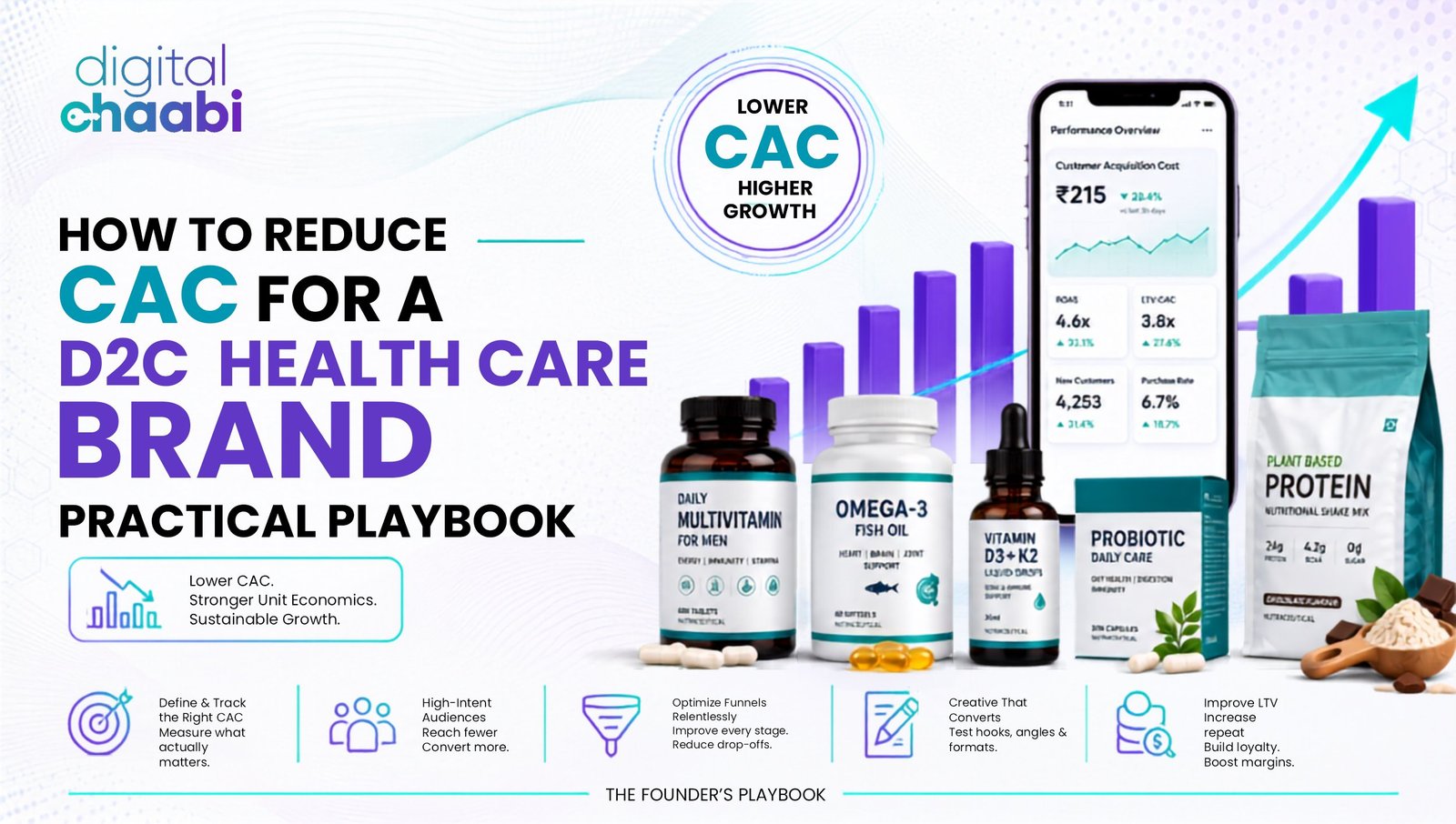
There’s a moment every D2C founder hits. Usually, somewhere around month four or five. The ads are running, the orders are coming in, but when you sit down and actually do the math, the cost of getting each customer is eating the business alive.
That moment is a CAC problem. And in healthcare D2C specifically, it hits harder than most categories.
How to reduce CAC for a D2C healthcare brand is not a simple lever to pull. Healthcare buying decisions are slower. Trust takes longer to build. The compliance guardrails mean you can’t always run the aggressive, claim-heavy creatives that work in fashion or food.
So your cost per click is higher, your conversion rate is often lower, and your CAC balloons before you even realise what’s happening.
This playbook is for founders and marketers who are past the “what is CAC” stage and into the “how do we actually fix this” stage. Practical. Specific. No recycled advice.
What CAC Is Actually Telling You

Before the fixes, a quick reframe, because most people look at CAC as a cost problem when it’s actually a signal problem.
Customer acquisition cost is total marketing and sales spend divided by the number of new customers acquired in a given period. Simple formula. But what it reveals is more layered.
A high CAC can mean your targeting is off. Or your creative isn’t converting. Or your landing page is leaking. Or your offer isn’t strong enough. Or you’re spending on channels that attract browsers, not buyers. Sometimes it means all of these things simultaneously.
For D2C healthcare brands specifically, a high CAC often points to a trust deficit. People don’t buy health products from brands they’ve just discovered. They research. They compare. They wait. And every day they wait costs you more in retargeting spend.
So reducing CAC isn’t just about spending less. It’s about building faster trust, improving conversion efficiency, and finding the channels where your ideal customer is already warm.
Why CAC in D2C Healthcare Is Higher Than Other Categories
Worth naming this directly because it shapes everything else.
Healthcare purchases involve real stakes for the buyer. They’re putting something in or on their body. They need to believe it’s safe, it works, and the brand behind it is legitimate. That belief takes more touchpoints to build than, say, buying a phone case.
Add to this the ad platform restrictions, Meta and Google both limit the kind of claims you can make for health products, and your creative options narrow. You’re competing for attention with brands that have fewer restrictions and often bigger budgets.
CAC in D2C healthcare also tends to be inflated by the wrong audience targeting. Casting too wide a net means you’re paying to reach people who were never going to buy, and your average acquisition cost gets dragged up by all that wasted spend.
The goal is precision, not volume.
Strategy 1: Tighten Your Audience Targeting Ruthlessly
The fastest way to start reducing customer acquisition cost is to stop paying for people who won’t convert.

This sounds obvious but most brands are running far too broad. They’re targeting “health and wellness” interest categories on Meta when they should be targeting specific behaviours, people who’ve engaged with similar brands, who’ve visited competitor pages, who’ve searched for specific supplements or treatments.
Build custom and lookalike audiences from your actual buyers. If you have 500 customers, upload that list to Meta and build a lookalike from it. These people share behavioural DNA with your best customers. They convert at lower cost because the algorithm is finding people who look like people who already said yes.
Exclude people who’ve already purchased. Exclude people who’ve been in your funnel for 60+ days and haven’t converted, they’re costing you retargeting spend and dragging your CAC up.
Tighter audience. Higher relevance. Lower cost per acquisition. That’s the math.
Strategy 2: Fix the Funnel Before Scaling Spend
This is the one most brands skip. They try to solve a high D2C customer acquisition cost by spending more, pushing more traffic at a broken funnel. It doesn’t work. It just makes the problem more expensive.
Before increasing budget, audit every step of your conversion funnel.
Landing page: Does it load in under three seconds? Is the hero message clear in five words? Is the CTA above the fold? Is there social proof, reviews, ratings, real customer content, visible without scrolling? For healthcare D2C, trust signals (certifications, ingredients, lab testing) need to be front and centre.
Product page: Is the benefit clearly stated without making prohibited claims? Are the reviews real and specific? Is the checkout process fewer than four steps?
Cart and checkout: Where are people dropping off? A heatmap tool like Hotjar will show you exactly where attention dies. Fix those points before you spend another rupee on acquisition.
A 10% improvement in conversion rate can reduce your effective CAC by more than any targeting optimisation. That’s not a small number.
Strategy 3: Invest in Content That Warms Audiences Before the Ad
This one is slower but it’s the most durable CAC reduction strategy for healthcare D2C brands.
When someone already knows your brand, has read your blog, watched your reels, seen your founder talk about why the product exists, your ad isn’t introducing a stranger. It’s reminding a friend. That person converts faster, at lower cost, and with less retargeting needed.
Content does the pre-warming. SEO brings in people who are already searching for what you solve. Instagram education builds familiarity before purchase intent peaks. YouTube deep-dives on ingredients establish authority that no ad can replicate.
This is exactly what teams like Digital Chaabi build for D2C healthcare brands, a content engine that reduces cold-audience dependency over time. Because every brand that runs purely on paid acquisition is one algorithm change away from a CAC crisis.
Start with your top five customer questions. Write a blog post for each. Promote it organically. Watch your retargeting audiences fill with warm, educated prospects.
Strategy 4: Reduce CAC Through Referral and Community
The cheapest customer you’ll ever acquire is one that another customer sent you.

Referral marketing for D2C healthcare brands is criminally underused. A well-designed referral programme, give Rs. 200 off to the referrer, Rs. 150 off to the referred, can bring your effective CAC down significantly because the trust transfer happens peer to peer.
Someone’s friend or family member recommending a health product carries weight that no ad creative can match.
Community works similarly. A WhatsApp group, a private Telegram channel, a Facebook community, these are spaces where your most loyal customers talk about your brand to people in your exact target demographic. For free. Nurture these spaces. Give them value first. The acquisition follows.
What to measure here: Track your referral acquisition separately. Know your referral CAC versus paid CAC. The delta will surprise you.
Strategy 5: Improve Retention to Make CAC Irrelevant
Here’s the reframe that changes everything.
CAC only matters relative to LTV, lifetime value. A Rs. 800 CAC is unsustainable if the customer buys once and never comes back. The same Rs. 800 CAC is excellent if that customer buys every month for two years.
So one of the most powerful ways to make your D2C healthcare brand CAC manageable is to aggressively improve retention, not reduce acquisition spend.
Post-purchase email sequences that educate, re-engage, and cross-sell. Subscription models for consumable products. Loyalty programmes that reward repeat purchases. WhatsApp flows triggered by purchase milestones.
When your LTV goes up, your allowed CAC goes up. And suddenly the economics of the whole business look different. How to Calculate and Benchmark CAC, Shopify Business Glossary
FAQs About how can you reduce CAC for a D2C Healthcare Brand
Q1: How Can You Reduce CAC for a D2C Healthcare Brand?
Tighten audience targeting to reach only high-intent buyers, fix conversion rate issues on your landing and product pages, build content that warms audiences before the ad, and invest in referral and retention programmes that reduce dependence on paid acquisition.
Q2: How Can You Optimize Marketing Campaigns to Reduce CAC for a D2C Healthcare Brand?
In marketing specifically, reduce CAC by improving creative relevance (better CTR means lower CPM), building warm retargeting audiences through content, reducing funnel drop-off points, and diversifying into lower-cost channels like SEO, email, and WhatsApp.
Q3: What is CAC for a D2C Healthcare Brand?
CAC, customer acquisition cost, is the total amount spent on marketing and sales divided by the number of new customers acquired. In D2C, it’s one of the most critical metrics because there’s no retail buffer. Every rupee of acquisition cost comes directly out of your margin.
Q4: What Does a High CAC for a D2C Healthcare Brand Indicate About Its Target Audience?
A high CAC typically signals either poor targeting, you’re reaching people who were never likely to buy, or weak brand trust, meaning people are aware of you but aren’t convinced enough to purchase. Both are fixable, but they require different solutions.
Q5: What is considered a good CAC for a D2C Healthcare Brand?
A good CAC depends on factors such as product pricing, customer lifetime value (LTV), and profit margins. Generally, a CAC is considered healthy when the revenue generated from a customer significantly exceeds the cost of acquiring them.