


A beautiful website that does not book patients is a reception with a lovely lobby and nobody at the desk. Visitors walk in, admire the marble, and walk out again because no one asked how they could help.
That is the quiet failure behind many hospital websites. They look polished in the portfolio and in the launch meeting. Then a worried daughter opens one on a mid-range phone at eleven at night, cannot find the cardiology page, cannot tap the phone number, and closes the tab.
This guide is about avoiding that outcome. You will see what a medical website design agency is building, ten things to check before you hire one, the questions that expose a pretty-but-empty pitch, and how to write a brief that keeps the project honest.
Hospitals have a particular problem here: more specialties, more doctors and more branches than any ordinary business site. Bring your current site up on your phone while you read, and keep a pen handy. You do not need to be technical.
You need to know what a patient needs from a website at their worst moment, and how to tell whether an agency does too.
Why a good-looking site can still lose patients
Design matters. One buyer’s guide quoting healthcare website statistics says that over 75 percent of consumers judge a provider’s credibility by its website design, and that 42 percent of visitors abandon a site that is difficult to use. Treat the exact numbers with care, but the point is familiar to anyone who has watched a patient try to book online.
Looks are only half of it. Most healthcare searches happen on mobile, and if the booking flow is broken on a phone or the number is not tappable, you lose patients before they ever call. Nothing in the portfolio will show that. A site can win a design award and still send a frightened visitor in circles.
The patient does not care whether the hero image is elegant. They care whether they can find the right doctor, understand what to expect, and reach a human. Everything a medical website design agency does should serve those three needs.
The patient’s first minute
Think about what a patient wants in the first sixty seconds. Do you treat this? Is there a doctor I can trust? Where are you, and how do I reach someone? Everything else, the awards, the history, the vision statement, comes later, if at all.
A good medical website design agency designs for that first minute. The page opens on the thing the patient came for, shows a real doctor, and offers a call button and appointment booking within a thumb’s reach. Trust signals such as credentials and genuine photographs sit near the top, not buried in an About page.
And all of it works on a mobile-first layout, because that is where the minute usually happens.
What a medical website design agency is actually building
A hospital website is not a brochure. It is the digital front door of the organisation. People use it to check credentials, compare doctors, read about procedures, find directions and book. Some arrive calm. Many arrive anxious.
A good agency builds around four pillars: security, accessibility, a patient-centred experience and technical SEO. Those four are the difference between a site that looks like a hospital and one that works like one.
A strong agency is not only a design vendor. It prioritises trust, accessibility, appointment booking, provider discovery, speed, search structure and clear paths to action.
Hold that picture when you read proposals. If an agency talks about colour palettes and animation for most of the call, and about booking flows and accessibility for two minutes, you are looking at a brochure builder.
The ten things to look for in a medical website design agency

1. Real healthcare experience
Having built one healthcare website does not make an agency a healthcare specialist. Ask for hospital or multi-speciality examples, not only a single-doctor clinic. A hospital has dozens of specialties, many doctors and several branches, and that scale changes the design.
2. A mobile-first booking path
Mobile-first appointment flows are a core feature of a healthcare website. Ask to see the booking journey on a phone, step by step. How many taps from the homepage to a confirmed slot? Features like click-to-call and location-based search for nearby facilities matter as much as the layout.
3. Specialty and doctor pages that answer questions
One page per specialty, one page per doctor, each written for patients. A good content approach covers clinical review, readability and a structure that guides a patient from symptoms to the right service. Look for a plan, not a promise of “SEO-friendly content”.
4. Accessibility built in from the start
WCAG 2.2 is the current W3C recommendation, and a strong agency can explain how it handles accessibility in wireframes, design, development and testing. Many patients are elderly or have impaired vision, hearing or movement. Put the accessibility standard you expect in the statement of work.
5. Speed on real phones
Look for an agency that treats performance as a deliverable, with image compression, efficient code and fast hosting. Ask for Core Web Vitals scores on a mid-range phone, before and after. Core Web Vitals are the numbers Google uses to judge page experience.
6. Trust signals
Doctor credentials, registration numbers, accreditations, honest reviews, real photographs and a date on medical content. These trust signals do quiet work. A visitor who sees real doctors and clear credentials relaxes. One who sees stock photos does not.
7. Booking and system integration
Patients should be able to choose a doctor and a slot and receive a confirmation. Healthcare sites often need to connect with patient management systems and booking platforms, so ask what the agency has integrated before and what it would recommend for you.
8. Tracking that respects privacy
You need to know which pages bring calls and bookings. Look for agencies experienced in healthcare analytics and testing methods that respect patient privacy. Call tracking, form tracking and WhatsApp click tracking should be set up before launch.
9. Search-friendly structure
A capable agency understands location signals, service-line architecture, internal linking, metadata and page speed. If your site cannot be found, the best design is invisible.
10. Ownership, maintenance and handover
Before you sign, settle the arrangements for ongoing accessibility monitoring and maintenance. You should own the domain, hosting account, CMS logins and code. Common mistakes include choosing an agency with no healthcare experience, ignoring mobile, skipping maintenance and overlooking security.
For a longer list, Devziv’s guide to the ten features that matter in a healthcare web design agency and Priority Pixels’ guide to choosing a healthcare web design agency are worth a read.
Template, custom, or something in between
Agencies tend to offer one of three routes. A ready-made template is quick and cheaper, but it often produces pages that look like every other hospital’s. A fully custom site fits your needs exactly, and costs more time and money. The middle route builds a design system once, with reusable specialty and doctor templates, and customises where it matters.
For a hospital with many specialties, the middle route is often the sensible one. Ask your medical website design agency which route it is proposing, what you will own at the end, and how easily new doctors and specialties can be added without calling the agency each time.
At Digital Chaabi, we build specialty templates once and reuse them across doctors and branches, so growth does not mean a new project each time.
A five-minute test you can run today
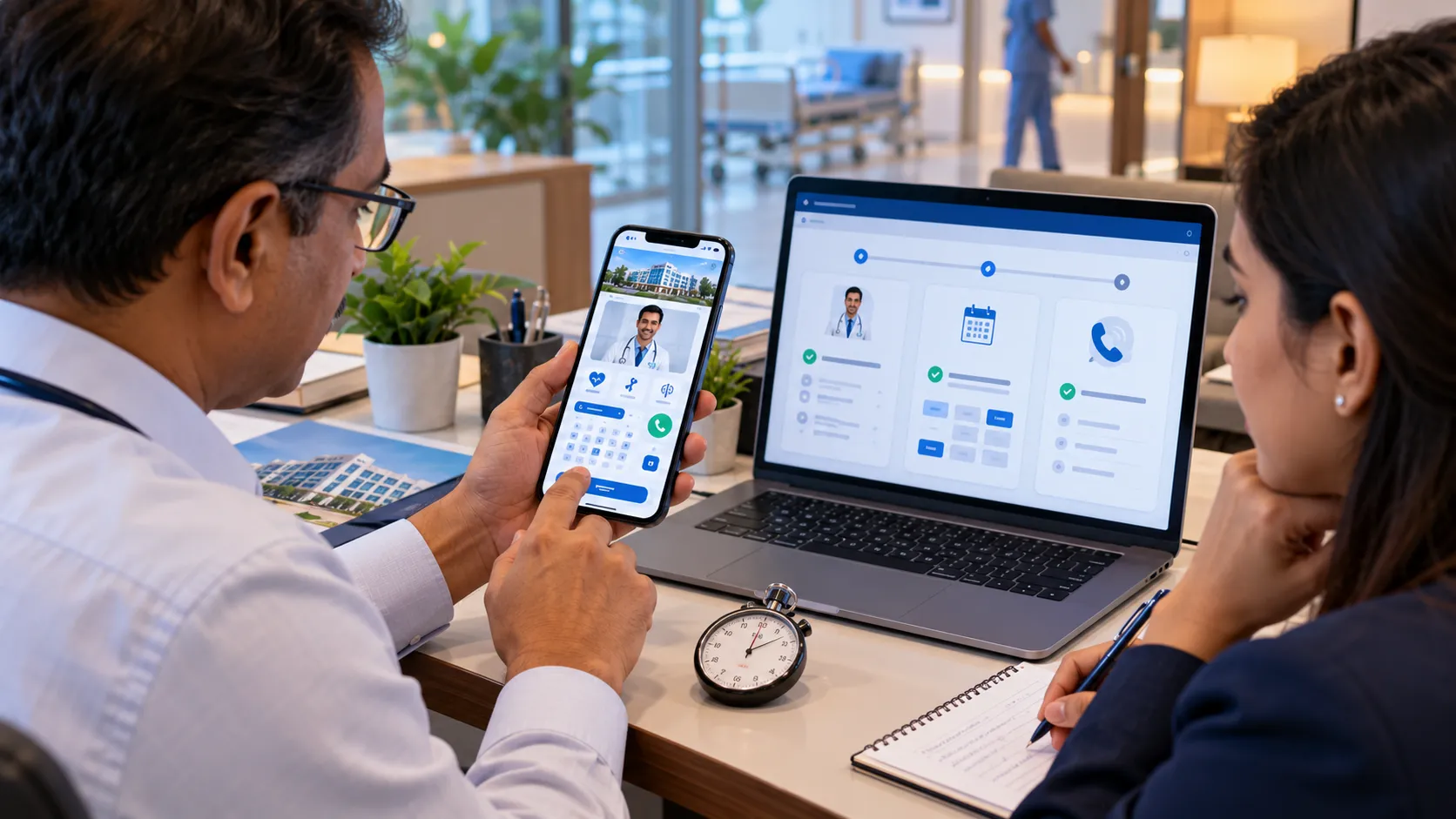
Before you speak to any agency, pick up your own phone and try three tasks on your hospital’s site. Find a cardiologist. Book an appointment. Call the front desk. Time each one, and note every moment of doubt: a menu that hid the answer, a button too small to tap, a form that asked for too much.
If any task takes more than a minute, you have found your brief. These notes will be worth more than any proposal, because they come from a real patient’s hands.
Eight questions to ask a medical website design agency
Take these into every call with a medical website design agency.
- Which hospital or multi-speciality sites have you built, and may I speak to the client?
- Can you show me the booking journey on a phone?
- How do you handle accessibility from wireframes to testing?
- What Core Web Vitals scores did your last site achieve on mobile?
- Who writes and medically reviews the content?
- How is tracking set up, and what happens to patient data?
- Who owns the domain, hosting, CMS and code?
- What does post-launch support include, and for how long?
Listen for specifics. “We follow best practices” is not an answer. “Here is the checklist we use at QA” is.
What drives the cost of a hospital website
Without naming a number, here is what moves the price. The count of pages and doctors. Integrations, such as appointment booking connected to your hospital system. Content writing and medical review. Accessibility testing against WCAG.
Languages, since many patients search in Hindi or a regional language. And post-launch support, which is often where quotes differ most.
Ask a medical website design agency to itemise each of these. A single lump sum hides what you are actually buying, and makes two quotes impossible to compare.
Hindi, English and your patients’ own words
Many patients search in Hindi, Punjabi or another regional language, and ask questions in plain words, not medical terms. Ask the agency how it handles bilingual pages, whether the translations are checked by someone who understands the medicine, and how search engines will know which language each page is in.
A medical website design agency that has never been asked this question is probably not used to Indian patients.
Write the brief before you hire
Agencies respond to the brief you give them. A vague brief gets a vague proposal from any medical website design agency. Before you call anyone, write one page covering these.
- The goal. Booked appointments and calls per month, for which specialties.
- The page list. Home, specialties, doctors, branches, appointment, contact, health packages if relevant.
- The booking flow. Online slots, call, WhatsApp, or all three, and who handles each.
- Tracking. Calls, forms and WhatsApp clicks tied to source.
- Content. Who writes, who reviews medically, who approves.
- Support. Who fixes things after launch, and how fast.
With this page in hand, every medical website design agency answers the same questions, and you can compare proposals line by line.
Red flags in a medical website design agency pitch
- A portfolio of beautiful sites with no results attached.
- No live demo of booking on mobile.
- A vague answer on accessibility, or none.
- One template used for every client.
- Hosting or code locked to the agency.
- No post-launch support, or support that costs extra for every small fix.
Any two of these deserves a pause. Any four deserves a polite goodbye.
Start small: one page, then the rest
You do not have to rebuild the whole site to test an agency. Ask a medical website design agency to build one specialty page and its booking flow first, with tracking, and measure it for four to six weeks. If calls and bookings rise and the page loads fast on a phone, you have your answer. If they do not, you have saved the cost of a full rebuild.
At Digital Chaabi, we prefer this staged approach, because a website is only useful when it produces enquiries, and a single working page proves that sooner than a finished site.
The week before launch
Whichever medical website design agency you hire, run a short check before anything goes live.
- Every phone number is tappable.
- Forms, WhatsApp buttons and booking slots are tested on two real phones.
- Tracking records a test call and a test form.
- Pages load fast on mobile data.
- A keyboard-only user can reach the booking button, and the pages pass a basic WCAG check.
- Old pages are redirected, so existing rankings are not lost.
Launches fail in small ways, usually on the last Friday. At Digital Chaabi, accessibility and speed checks are part of every launch checklist.
Back to the reception desk
Remember the lobby with no receptionist? The point of a good website is not the lobby. It is the person at the desk who says, within seconds, “Yes, we treat that, here is the doctor, here is a slot.”
A strong medical website design agency builds that person into every page. Hire for that, check it with the questions above, and the lobby can look as lovely as you like.
Ready to Grow?
Is your hospital website bringing in calls, or only compliments? Digital Chaabi’s website team will review your site on a phone, test your booking flow, check speed and tracking, and tell you plainly what to fix first.
Request a Healthcare Website Review
Frequently Asked Questions
What are the 7 C’s of website design?
Context, content, community, customization, communication, connection and commerce. For a hospital, context is layout, content is specialty and doctor pages, communication is forms and WhatsApp, and commerce is booking and payment. A good medical website design agency can map your site to each.
What are the 5 elements to a good website design?
- Clear layout
- Easy navigation
- Helpful content
- Trustworthy visuals
- Fast loading on mobile
A medical website design agency should add accessibility and booking to the list.
What are some of the best medical website designs?
No single site wins for every hospital. The best share traits: easy doctor and specialty search, a visible call and book option, plain-language content, accessibility and speed on phones. Ask any medical website design agency to show live examples with results, not only screenshots.
What is the 3-second rule in website design?
It is a rule of thumb: visitors judge a page quickly and many leave if it is slow or unclear. For a hospital, within three seconds a patient should see what you treat, where you are and how to call.
What should every hospital service page include?
- A plain-language overview
- The doctors who treat it
- What to expect, step by step
- Common questions answered
- A visible call and booking option
- Location, hours and proof such as credentials and reviews
How does site speed affect patient enquiries?
A slow page loses people before they reach the call button, especially on mobile data. Ask a medical website design agency for before and after Core Web Vitals scores on a mid-range phone, and track calls from the fastest pages.