

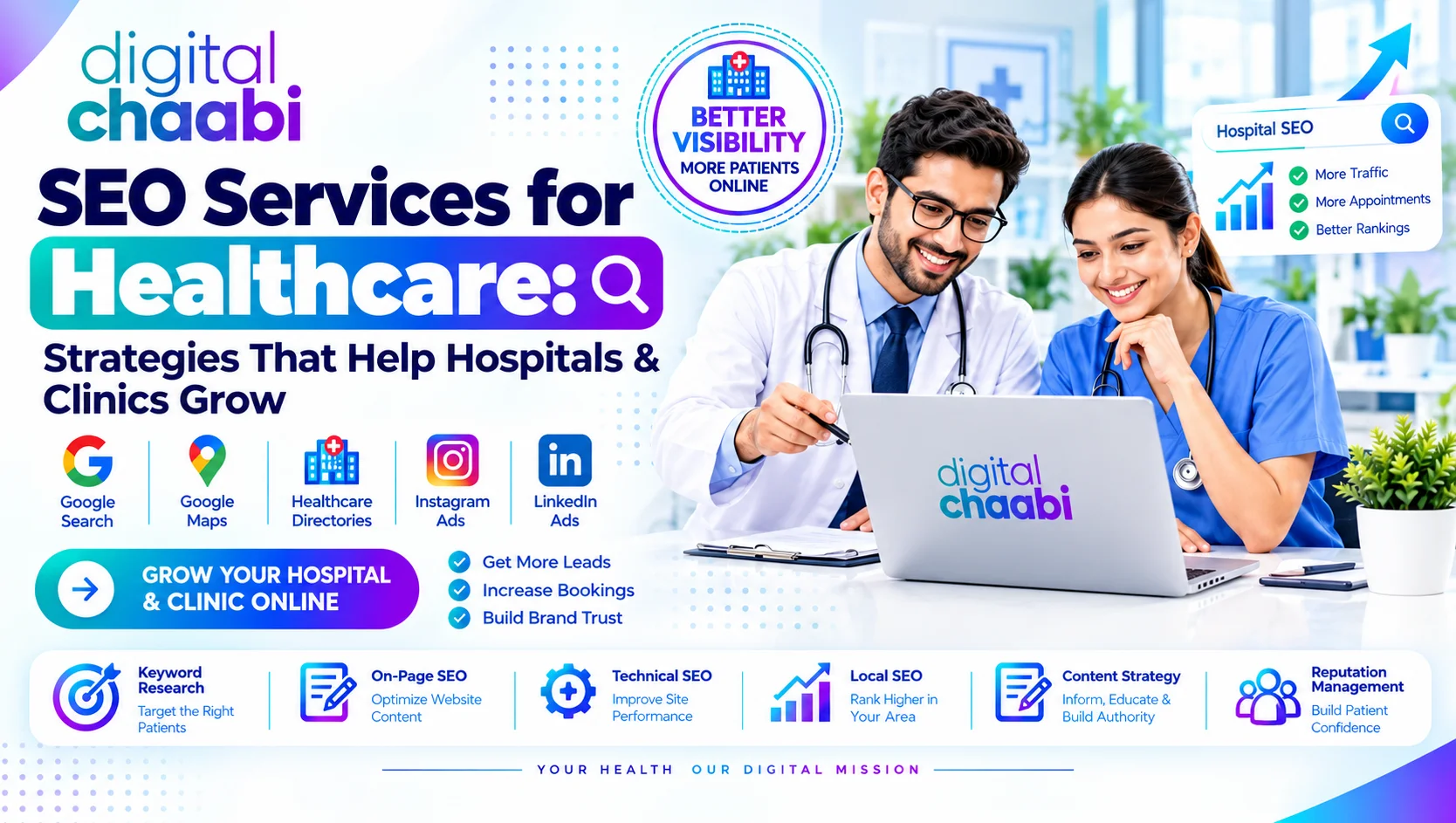
77% of patients rely on search engines before booking an appointment. Over 7% of all daily Google searches are healthcare-related. If your hospital or clinic isn’t ranking for the searches that matter, someone else is capturing that volume instead every single day this stays unfixed.
SEO Services for Healthcare turn organic search and AI discovery into booked patients not through generic tactics borrowed from other industries, but through strategies built specifically around how patients actually search when their health is on the line.
The results, when done right, aren’t marginal. Practices running properly structured SEO Services for Healthcare have reported year-over-year increases well into the hundreds of percent for organic leads and sessions the kind of growth generic marketing rarely produces, because it’s built on capturing demand that already exists rather than trying to create it from scratch.
This is what growth actually looks like, broken into four core strategies.
1. Hyper-Local SEO & Map Pack Domination
Google Business Profile. Verify and complete every department. Add weekly posts. Build structured Q&A using city and specialty keywords together.
A GBP that only lists the hospital’s main line and generic hours is doing a fraction of the work it could. Each department cardiology, orthopedics, maternity benefits from being represented clearly within the profile, so a patient searching for a specific specialty sees exactly what they need without digging through an unrelated homepage.
NAP Consistency. Keep Name, Address, and Phone identical across Practo, Lybrate, Justdial, and Sulekha. Any mismatch weakens trust signals across the board.
Location-Procedure Pages. Build dedicated pages combining procedure and city “IVF clinic in Sonipat” ranks where “IVF clinic” alone never will.

This single tactic pairing a specific procedure with a specific city is often the fastest path to ranking for a competitive term. A generic “IVF clinic” page competes nationally against every fertility center in the country. A location-procedure page competes only within its actual service area, where the practice has a real geographic advantage.
Multiply this across every major procedure a hospital or clinic offers, in every city it serves, and the page count grows quickly but so does the surface area for ranking. A hospital with three locations offering five core procedures each should have fifteen dedicated location-procedure pages, not three generic service pages trying to cover everything at once.
Review Velocity. Systematically collect Google reviews after every visit. This single habit triggers local pack trust faster than almost anything else on this list.
Most hospitals and clinics underinvest here relative to how much it actually moves rankings. A steady stream of recent, specific reviews signals to Google that the practice is active and trusted right now not just once, years ago. SEO Services for Healthcare that skip review velocity are leaving one of the cheapest, fastest-moving ranking levers untouched.
2. AI Answer Engine Optimization (AEO)
Search isn’t just Google anymore. Patients ask ChatGPT and Perplexity symptom questions before they ever open a search bar.
This is the part of SEO Services for Healthcare that most agencies still haven’t caught up to. Traditional SEO optimizes for a search results page. AEO optimizes for being the source an AI system trusts enough to cite a fundamentally different game with its own rules.
Direct Answer Blocks. Answer patient queries in the first 40 words of a section, using concise lists or tables. AI systems extract and cite content structured this way.
Write for the extraction, not just the reader. A meandering, five-paragraph buildup before the actual answer gets skipped entirely by AI summarization tools, which pull the clearest, most direct sentence they can find even if it’s buried further down the page than it should be.
This is a genuine shift in how content needs to be written, not a minor formatting tweak: a page optimized purely for human readers, in the old style, increasingly loses out to one written with extraction in mind from the first sentence.
Schema Layering. Implement MedicalBusiness, Physician, MedicalProcedure, and FAQPage schema so both Google and LLMs can parse your clinical data correctly.
Entity Citation. Anchor content to named physician profiles with verified credentials. This is what earns citations from ChatGPT and Perplexity unattributed content doesn’t get cited.

3. E-E-A-T & Clinical Content Authority
Named Authorship. Attribute every clinical blog to a verified doctor credentialed bylines (MBBS, MD, MS), not “Admin” or “Team.”
Pillar-Spoke Architecture. Build core specialty pillars Cardiology, for instance linked to specific sub-topic spokes: Angiography, ECG pricing, recovery timeline.
Compliance Awareness. Align every claim with regional medical advertising codes, such as NMC guidelines in India. Unverified claims don’t just risk rankings they risk regulatory exposure.
This is a step generalist SEO agencies frequently skip entirely, because it requires actual familiarity with medical advertising law, not just search algorithms.
A claim that sounds harmless in a marketing meeting “guaranteed results,” an unverified success rate, a comparison to a competitor’s outcomes can trigger both a Google penalty and a regulatory complaint at the same time.
Getting this reviewed by someone who understands both SEO and healthcare compliance isn’t optional; it’s the difference between sustainable growth and a takedown notice six months in.
This layer is where most competitors fall short, and it’s precisely why it’s where SEO Services for Healthcare create the most durable advantage. Technical fixes can be copied within weeks. A library of pillar-spoke content, built and reviewed by real credentialed physicians over months, takes competitors far longer to replicate if they bother trying at all.

4. Technical Health & Mobile-First UX
Core Web Vitals. Pass LCP under 2.5 seconds and mobile CLS benchmarks emergency and patient searches happen overwhelmingly on mobile.
Crawl-Budget & Log-File Hygiene. Prune thin, index-bloating pages and keep fast indexing for multi-location hospital directory trees.
None of the content or authority work above matters if a patient abandons the page before it finishes loading. This is the least visible part of SEO Services for Healthcare, but skipping it silently caps the return on everything else.
The Best SEO Strategies for Healthcare Websites
If you’re only going to execute a few things from this guide, prioritize: a fully complete GBP, location-procedure pages for your top specialties, named physician authorship on every clinical page, and Core Web Vitals passing on mobile. These four alone typically account for the majority of measurable growth practices seen in the first six months.
The Best SEO Strategies for Doctors Individually
For an individual physician rather than a multi-department hospital, the priority shifts slightly: a personal bio page with real credentials, a handful of condition pages tied to your specific specialty, and consistent reviews tied to your name specifically, not just the clinic’s general listing.
Patients increasingly search for a doctor by name once they’ve been referred, and a thin or missing physician page loses that search entirely.
The scale is smaller, but the underlying logic of SEO Services for Healthcare doesn’t change completeness and consistency still beats spend. A solo physician who executes the fundamentals properly can outrank a hospital department that hasn’t bothered to build out a proper physician page, regardless of how much marketing budget the hospital has behind it.
Action Plan to Scale a Practice
| Phase | Focus Area | Key Actionable Metric | Timeline |
| Month 1 | Audit & Local Foundation | GBP 100% complete, NAP audit fixed, Core Web Vitals green | Weeks 1–4 |
| Months 2–3 | Topical & Location Pages | Publish 15 procedure-city pages + schema markup | Weeks 5–12 |
| Months 4–6 | Authority & AI Citation | Launch named-doctor trust signals, track AI Overview/Perplexity mentions | Months 4–6 |
Treat each row as a phase gate, and don’t move ahead until the prior one is genuinely done, not just started.
This phased approach exists for a reason: skipping straight to content without fixing the local foundation wastes the content. A brilliant procedure-city page published on a GBP nobody’s touched in years still underperforms, because the local trust signals it depends on aren’t there yet.
Treat each phase as a gate, not a suggestion. Moving to Months 2–3 work before Month 1’s foundation is genuinely complete GBP fully verified, NAP consistent everywhere, technical issues resolved means building content on ground that isn’t stable yet.
The practices that see the fastest results are the ones disciplined enough to finish each phase properly before starting the next, even when it’s tempting to rush ahead to the visible content work.
The Top 3 Trends Reshaping Healthcare Search
Trend one: AI Overviews are absorbing clicks. A growing share of healthcare searches now resolve inside an AI-generated summary, meaning traditional ranking alone isn’t enough content that needs to be structured for AI extraction specifically.
Practices that adapted to this shift include clear direct-answer blocks, proper schema, named authorship, and are already showing up inside AI-generated summaries with citations.
Practices that haven’t are watching their traffic quietly erode even while their traditional rankings stay stable, which makes the problem easy to miss until the enquiry numbers start telling a different story than the rankings do.
Trend two: aggregators are winning the leftover traffic. Of the clicks that don’t disappear into AI Overviews, platforms like Practo and 1mg capture a disproportionate share, because AI trusts sources with scale and structured data. Hospitals without their own structured data lose twice: once to AI, once to aggregators.
Trend three: named physician authority is becoming the deciding factor. As generic content gets filtered out by both Google’s E-E-A-T standards and AI citation preferences, practices investing in real, credentialed, named authorship are pulling ahead of competitors still publishing anonymous blog content.
These three trends compound. A practice ignoring all three doesn’t just lose a little visibility; it loses on every front simultaneously, while a competitor investing correctly gains on all three at once.
Positioning for Growth, Not Just Traffic
Growth isn’t a traffic number, it’s the compounding effect of a hospital or clinic being the obvious, trusted choice across every channel a patient might use to search. SEO Services for Healthcare done right position a practice this way deliberately: local dominance first, AI-readiness layered on top, clinical authority reinforcing both.
This is exactly where scaling happens. The pillar-spoke content structure built for one specialty becomes the template for the next. The named-physician trust signals built for one doctor become the standard applied to every doctor added afterward.
What starts as fixing visibility for one department becomes, within a year, a hospital-wide system where every specialty is positioned to win its own search category.
Consider what this looks like in practice across a multi-specialty hospital. Cardiology gets fixed first GBP, location pages, named cardiologist authorship. Once that specialty is ranking and converting, the exact same process applies to orthopedics, then women’s health, then oncology.
Each department doesn’t start from zero; it inherits a proven structure, which means the second, third, and fourth specialties rank faster than the first one did. This is what separates SEO Services for Healthcare built for scale from a one-off SEO project that stalls the moment the initial engagement ends.
Digital Chaabi builds this exact system for hospitals and clinics local, AI-ready, and structured to scale across departments as the practice grows.
Ready to Turn Search Into Growth with the help of our SEO services for healthcare?
If patients searching for your specialties are landing on a competitor’s page instead of yours, that gap costs real appointments every single week it stays open.
SEO Services for Healthcare aren’t a nice-to-have marketing line item anymore; they’re the infrastructure deciding which practice gets chosen before a patient ever picks up the phone. Digital Chaabi can map the fastest path to visibility for your specialty and city. Reach out at crm@digitalchaabi.com.
Frequently Asked Questions
What are the best SEO strategies for healthcare websites?
A fully complete Google Business Profile, location-procedure pages built for your top specialties, named physician authorship on every clinical page, and Core Web Vitals passing on mobile; these four typically drive the majority of measurable growth.
SEO Services for Healthcare built around these fundamentals outperform scattered, tactic-by-tactic approaches consistently.
What are the top 5 SEO services for healthcare strategies?
For healthcare specifically: hyper-local GBP optimization, AI answer engine readiness through schema and direct-answer content, named clinical authorship for E-E-A-T, technical health via Core Web Vitals, and consistent review generation tied to real patient visits.
What is SEO services for healthcare?
It’s the process of improving a healthcare business’s search rankings for hospitals, clinics, doctors, or health ecommerce through a blend of technical optimization, local search, and trust-focused content built to meet Google’s stricter medical content standards.
How do SEO services for healthcare work?
A proper engagement starts with an audit of the current site and local standing, followed by a tailored strategy around the practice’s specialties and target patients, then ongoing execution across technical, local, and content work with regular performance reporting tied to actual patient enquiries.
Why is specialized SEO services for healthcare is important?
Because generic SEO doesn’t account for E-E-A-T, YMYL compliance, or the local-pack dynamics that decide whether a patient actually calls. Healthcare-specific strategy also protects against regulatory risk that generalist agencies often miss entirely.
How much traffic can SEO services for healthcare deliver ?
Results vary by starting point and competition, but well-executed healthcare SEO has produced documented increases ranging from meaningful double-digit percentage growth in organic sessions to multi-hundred-percent increases in leads over 6–12 months for practices starting from a weak baseline.