


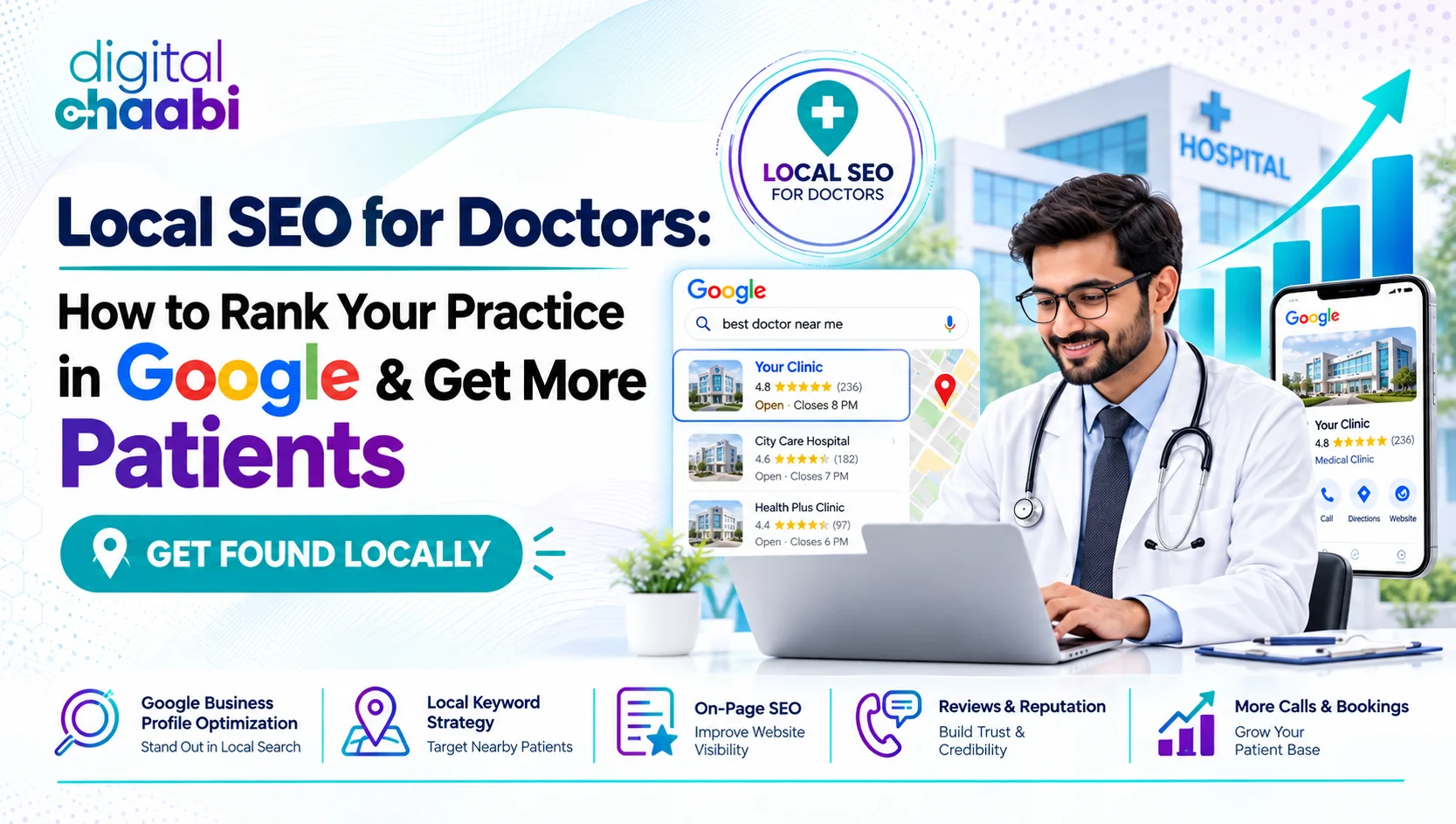
58.5% of people turn to the internet the moment a health question comes up. They don’t ask a neighbour. They type “dermatologist near me” into Google and pick from whatever shows up first usually within seconds, rarely scrolling past the first three results.
Local SEO for Doctors is the work of making sure your practice is what shows up. Not your competitor’s. Not a directory listing with outdated hours. You with the right specialty, the right city, the right trust signals right when someone is actively deciding who to call.
Here’s what most solo practices get wrong: they treat their website as the whole strategy, when the website is actually the smaller half. Local SEO for Doctors lives mostly outside your site in your Google Business Profile, your directory listings, your reviews. The website matters, but it’s the last stop in a journey that starts somewhere else entirely.
This matters even more for practices competing against hospitals and multi-location chains with bigger marketing budgets. Local SEO for Doctors doesn’t reward spending; it rewards completeness and consistency, both of which a solo practice can execute just as well as a large system, often faster.
Here’s the exact framework that gets a small or solo practice ranking locally, and keeps it there.
1. Google Business Profile Your Digital Front Door
Your GBP drives up to 80% of local patient calls and map pack bookings. Get this wrong and nothing else in this guide matters as much as it should.
Pick the exact sub-specialty. Cardiologist, not “Medical Clinic.” Pediatrician, not “Doctor.” Google matches search intent to category first and a vague category loses to a precise one every time.
Match your NAP word-for-word. Practice name, address, phone number identical on your signboard, your website, and every directory. One mismatch and Google starts questioning which listing to trust.
This sounds like a minor detail until you actually search your own practice name and find three slightly different versions of your address scattered across old listings.
Fixing this is unglamorous work, but it’s often the single highest-leverage fix available because it costs nothing except time, and it directly affects whether Google trusts your listing enough to show it.
Use real photos. Clinic exterior, reception, consultation room, your team. Stock photos signal “we didn’t try” to a patient already nervous about picking the right doctor.
List every service explicitly. Short descriptions, local-intent keywords baked in naturally not buried in medical jargon a patient wouldn’t search for.
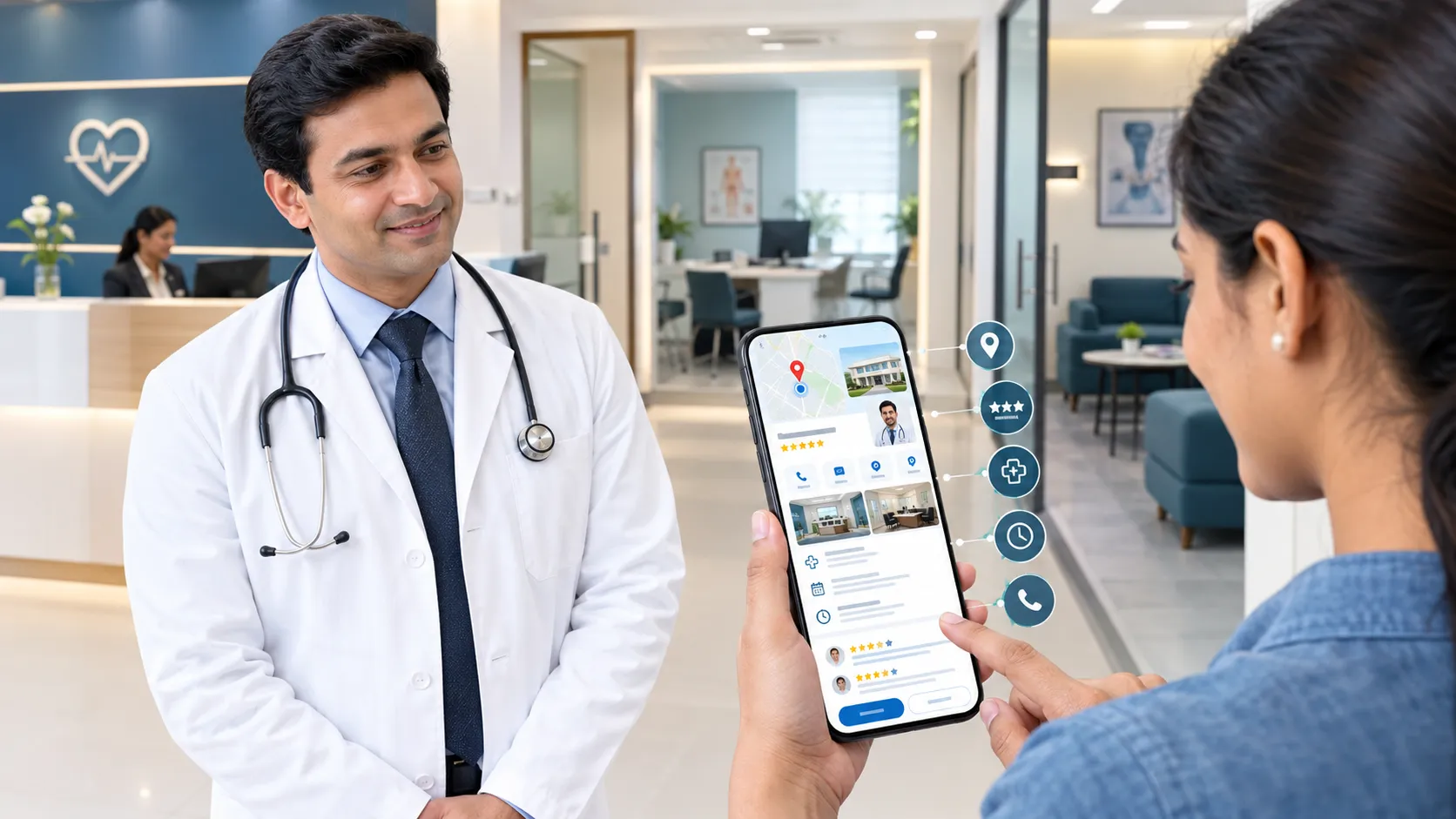
Pre-populate your Q&A section. Parking, insurance accepted, consultation fees, how to book. Answer these before a patient has to ask.
A profile this complete does something subtle but important: it removes every reason a patient might hesitate before calling. Uncertainty is the biggest drop-off point in healthcare search. A patient unsure about parking or fees is a patient who closes the tab and searches again.
2. On-Site SEO & Content That Google Trusts
Medical sites get judged harder than most. Google’s E-E-A-T standard Experience, Expertise, Authoritativeness, Trustworthiness applies to every clinical claim you make.
Write condition and symptom pages patients actually search for. “Knee pain treatment in [City]” beats generic medical terminology every time. Patients search their pain, not your specialty’s Latin name for it.
Pick your top three to five conditions or procedures, the ones you treat most, not necessarily the most complex ones and give each its own dedicated page. Skip the temptation to cover everything your degree qualifies you for.
A page trying to rank for twenty conditions at once usually ranks for none of them well; five focused pages, each clearly built around one search intent, will outperform every time. This is the on-site half of Local SEO for Doctors, the part that turns a visitor who found you into a visitor who books.
Give yourself a real bio page. Degrees, registration number, languages spoken, fellowships. This isn’t decoration, it’s the credibility signal that separates you from a listing with no name attached.
Build a unique page per location if you run more than one office. Local landmarks, embedded maps, distinct copy. Never duplicate one page across cities with just the name swapped Google penalizes it, and patients notice.
Add schema markup. Physician, MedicalClinic, LocalBusiness this structured data helps both Google and AI search tools parse who you are and what you treat.

This step gets skipped most often because it feels technical but it’s usually a one-time setup, not ongoing work. Once the schema is in place, it keeps working quietly in the background every time your pages get crawled, with no further effort required.
Load fast on mobile. Sub-2-second load times. Most “near me” health searches happen on a phone, often with limited patience.
None of this needs to happen at once. Start with the GBP, then the bio page, then one or two condition pages for your highest-volume symptoms. Local SEO for Doctors compounds each piece you add makes the next search easier to win, because Google is reading consistency across your entire online presence, not just one page in isolation.
3. Citations & Directory Authority
Clean, consistent listings across trusted platforms do real work for your ranking.
Get listed and keep it accurate: Healthgrades, Zocdoc, Practo, Justdial, Yelp, Apple Maps.
Not every directory carries equal weight; a well-established, healthcare-specific platform like Practo or Healthgrades does more for your local trust score than a dozen obscure, low-traffic listing sites. Prioritize accuracy on the platforms patients actually use before chasing volume across ones they don’t.
Audit quarterly. Old addresses, disconnected numbers, conflicting credentials accumulate quietly and drag your local trust score down without you noticing.
Most solo practices have at least one stale listing they don’t know exists in a directory they were auto-added to years ago, still showing an old clinic address. A fifteen-minute quarterly search of your own practice name catches these before they cost you a patient.
4. Patient Review Generation
Reviews are proof for patients and a ranking multiplier for Google both at once.
Build a routine. Ask satisfied patients via SMS or a WhatsApp QR code right after their visit. Three to five steady reviews a month beats a sudden spike, which reads as suspicious to Google’s systems.
The timing matters more than most practices realize. A request sent a week after the visit gets ignored the moment has passed, the patient has moved on. A request sent within an hour, while the good experience is still fresh, converts far more often.
Build this into the checkout process itself rather than treating it as a separate follow-up task someone might forget.
Let reviews mention specifics. A patient writing “helped with my chronic lower back pain” is more valuable than a generic five stars; it reinforces the exact search terms you’re trying to rank for.
Reply within 24 hours. Thank the positive ones. Address the neutral or negative ones professionally, without confirming any medical detail.
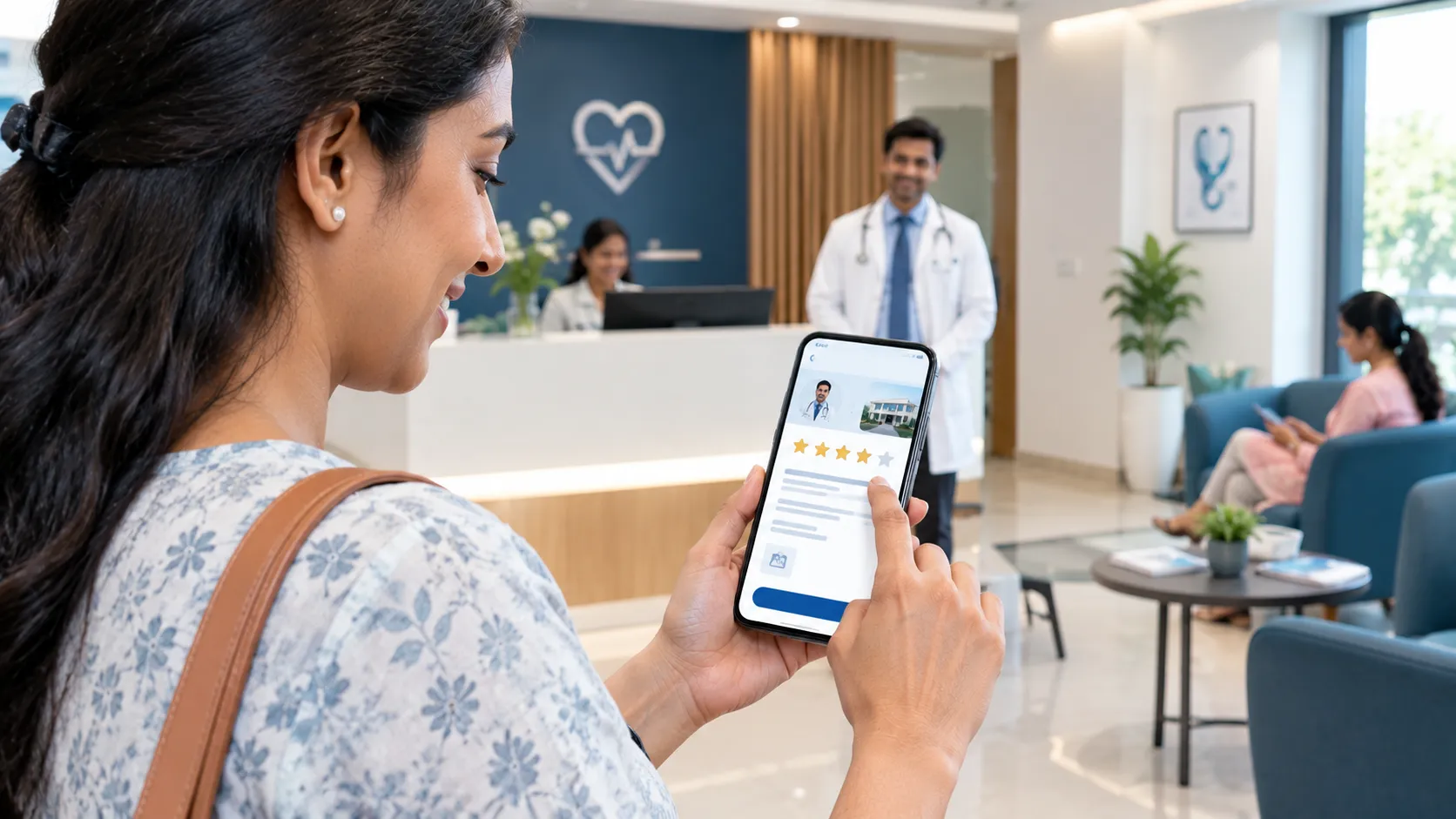
A slow reply hurts more than no reply. A patient reading a two-week-old unanswered negative review assumes the practice doesn’t care even if the underlying issue was resolved the same day it happened offline.
5. Local Link Building & Authority
Partner locally. Diagnostic labs, wellness centers, community health camps these build the kind of contextual backlinks a generic guest post never will.
Local link building also has a compounding side effect: it puts your name in front of potential patients before they’ve even searched. A health camp you sponsored last year still sends occasional referrals long after the event ended, simply because someone remembered your name and looked you up.
Get listed with associations. State medical councils, local chambers of commerce, regional health sponsor pages.
None of these links need to be large to matter. A single mention from a well-regarded local health camp you sponsored can outweigh a dozen low-quality directory submissions, because Google weighs the relevance and trust of the linking source far more than the raw count.
What Actually Works The Short List
If you’ve searched “what are the best SEO strategies for doctors,” skip the theory. Five things move the needle fastest for a solo or small practice: a fully completed GBP, consistent NAP across every listing, a steady flow of real reviews, condition-specific pages in patient language, and a fast mobile site. Everything else in this guide supports those five.
These five aren’t ranked by importance; they work together, and skipping any one weakens the rest. A perfect GBP with zero reviews still loses to a decent GBP with forty reviews. Beautifully written condition pages on a slow-loading site still lose patients before they finish reading. Treat this as a checklist to complete, not a menu to pick from.
Focus Where It Counts The 80/20 Rule
Most of your patient enquiries will come from a small slice of your effort, usually your GBP and your two or three highest-searched conditions. Get those right before spreading thin across every possible keyword. Local SEO for Doctors rewards a sharp, well-executed core over a scattered, half-finished one.
In practice, this means resisting the urge to build twenty condition pages in month one. Build three, build them properly with real detail, real keywords, real internal linking and let them start ranking before adding more.
A practice with three excellent pages consistently outranks a practice with fifteen thin ones, because Google reads depth and quality per page, not total page count.
Implementation Timeline
Expect measurable movement in 3 to 6 months. Track phone call conversions, GBP insights (direction requests, click-to-calls), and Google Search Console impressions.
Break the timeline into checkpoints instead of waiting for one big result:
- Weeks 1–4: GBP fully optimized, NAP audit complete, top-priority condition pages published
- Months 2–3: Local pack movement begins, review count building, first directory citations cleaned up
- Months 4–6: Consistent ranking for core specialty + city searches, steady month-over-month call volume
A practice that checks these milestones monthly catches problems early; a stalled GBP metric in month two is far easier to fix than discovering in month five that nothing moved at all.
Positioning: Small Practice, Bigger Presence
A solo doctor doesn’t need to outspend a hospital chain to outrank it locally. Local SEO for Doctors is, by design, a leveler precision beats scale in the map pack. A hospital with a thin, generic physician bio loses local visibility to a solo practitioner with a detailed, specific, well-reviewed profile.
This is how a single practice scales its visibility without scaling its budget: rank the GBP first, then the top two or three condition pages, then let reviews compound in the background. Each layer makes the next one work harder. Six months in, the practice isn’t just visible, it’s positioned as the specialist patients already trust before they’ve even called.
What positioning actually looks like in practice: a patient searches “pediatrician near me,” sees three results in the map pack, and picks based on review count, review recency, and how complete the profile looks.
The practice with 40 recent reviews and a fully filled-out profile wins over the practice with 8 reviews from two years ago regardless of which doctor is actually more qualified. Perception, built through consistent Local SEO for Doctors work, becomes the deciding factor before clinical skill ever enters the conversation.
That’s uncomfortable to admit, but it’s exactly why the practices that invest here consistently outgrow the ones that assume good care speaks for itself.
Scaling from one location to more follows the same logic that works for a single practice, just repeated. Each new location needs its own GBP, its own NAP-consistent listing, its own local reviews, never a shared profile trying to represent two addresses.
Practices that try to shortcut this by using one listing for multiple locations consistently see weaker rankings at both, because Google can’t confidently match either address to the search.
If setting all this up isn’t something you have time for between patients, Digital Chaabi builds exactly this kind of local SEO foundation for doctors and small practices GBP, content, and review systems, done right the first time.
Ready to Show Up First?
Every day your practice isn’t ranking locally is a day patients are booking with whoever does show up. Local SEO for Doctors isn’t a one-time fix, it’s a foundation that keeps paying back long after the initial setup is done. Digital Chaabi can map out the fastest path to local visibility for your specialty and city.
Frequently Asked Questions
How to increase SEO ranking on Google by local SEO for doctors?
For a medical practice, the fastest path is a fully optimized Google Business Profile, consistent NAP data across directories, real patient reviews, and condition-specific content written in the language patients actually search. This is the core of Local SEO for Doctors in one sentence.
How to rank higher in Google Local Listings by doing local SEO for doctors?
Complete every field on your GBP, keep your name/address/phone identical everywhere online, gather reviews consistently, and add schema markup so Google can clearly parse your specialty and location.
Why is Local SEO for doctors important?
Because most patients now search Google before they ask anyone for a recommendation. A practice that doesn’t rank locally is invisible to the majority of people actively looking for care in their area.
Is Local SEO for doctors worth it?
Yes. It reaches patients who are actively searching for care, improves visibility in Google Maps, and builds trust before the first appointment which leads to more qualified booking requests than most other marketing channels.
How is local SEO for doctors different from general SEO?
General SEO builds broad visibility for research-stage searches. Local SEO for Doctors specifically targets patients who are ready to book. It’s tied to your Google Business Profile, NAP consistency, and location-specific pages, not just website content.
How long does local SEO for doctors take to show results?
Most practices see early improvements within 60–90 days, with stronger, more consistent results by month 3–6, depending on competition in your city and specialty.