


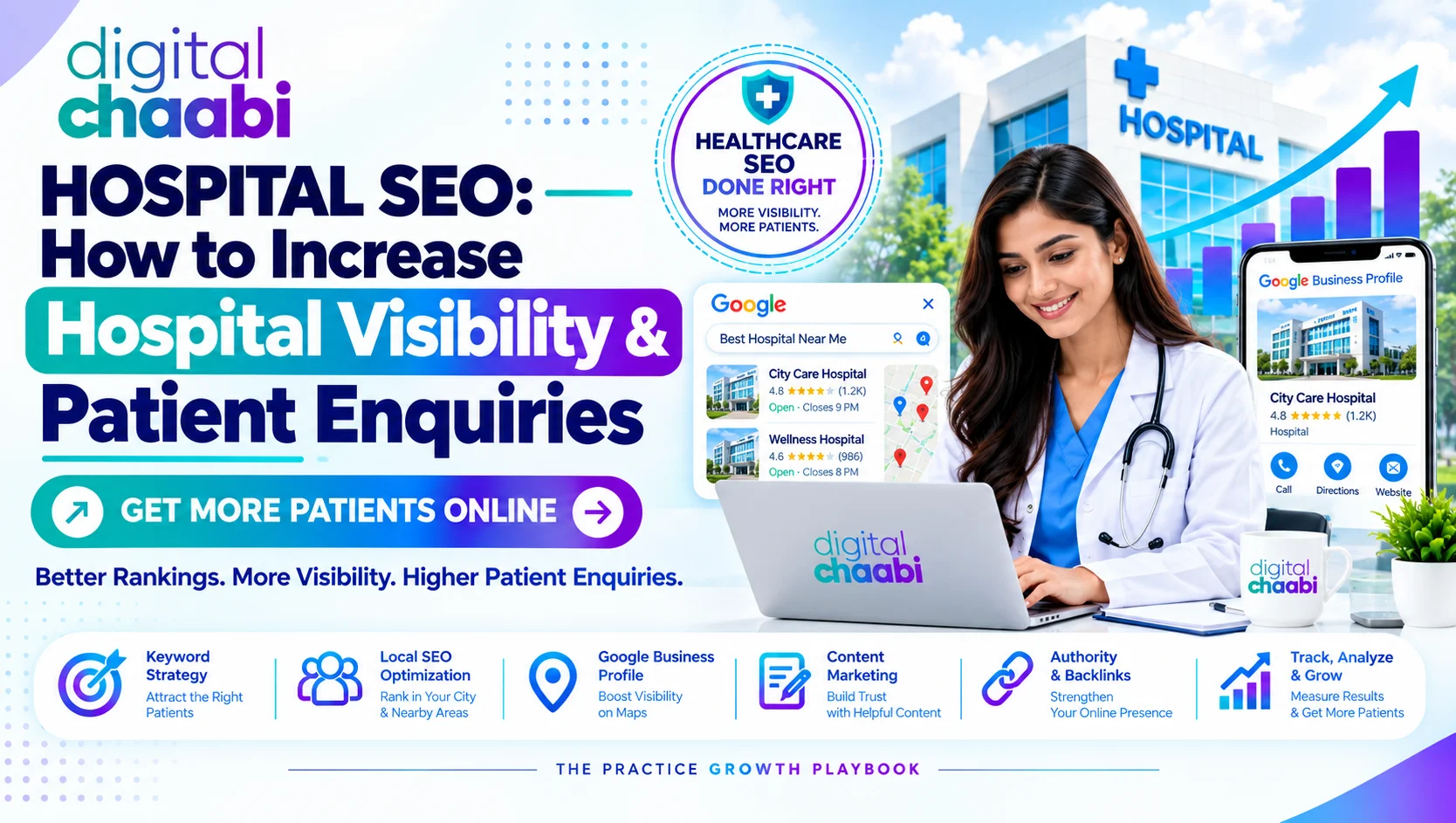
82.8% of patients find their healthcare provider through an online search. 88% of local mobile searches lead to a call or visit within 24 hours. If your hospital isn’t showing up in that window, the patient books somewhere else and they rarely come back to check twice.
Hospital SEO isn’t the same game as SEO for a single clinic. A clinic ranks a homepage and a handful of service pages.
A hospital ranks dozens of departments, hundreds of doctors, multiple campuses, and thousands of search queries, symptoms, specialists, procedures, emergency care, insurance questions all at once, without confusing the patient about what to click.
This is the framework that gets a hospital found, trusted, and booked.
Most hospital marketing teams treat SEO like a one-time website project: build it, forget it. Hospital SEO doesn’t work that way. It’s closer to running a department: it needs maintenance, measurement, and a clear owner.
The hospitals that win search aren’t the ones with the biggest budgets. They’re the ones that treat every page like a front door someone actually walks through.
Here’s the part that gets missed most often: SEO and PPC aren’t competing strategies, they’re different speeds. PPC gets a hospital visible immediately, at a cost that stops the moment it stops.
Hospital SEO takes longer to build but compounds the same specialty page that took three months to rank keeps pulling in enquiries in month twelve without any extra spend. The hospitals that scale fastest usually run both, using PPC to fill the gap while organic rankings build underneath.
1. Dominate Local Search (Map Pack & GBP)
Local search is where most patients start. Win it first.
Claim and complete your GBP
Exact name, address, phone number. Working hours. Insurance accepted. Attributes like 24/7 Emergency. Link every service listed to the matching page on your website, not your homepage.
Keep citations identical everywhere
Healthgrades, Practo, JustDial, Sulekha. One mismatched digit in your phone number and Google starts doubting the listing.
Automate review requests
A post-visit SMS asking for a Google review, sent while the experience is still fresh, works better than waiting and hoping. Reply to every review professionally, without confirming medical details.
This alone moves the needle. 71% of patients look elsewhere when a provider’s website fails to answer their question and a thin or outdated GBP is the first place that failure shows.
Don’t stop at one profile
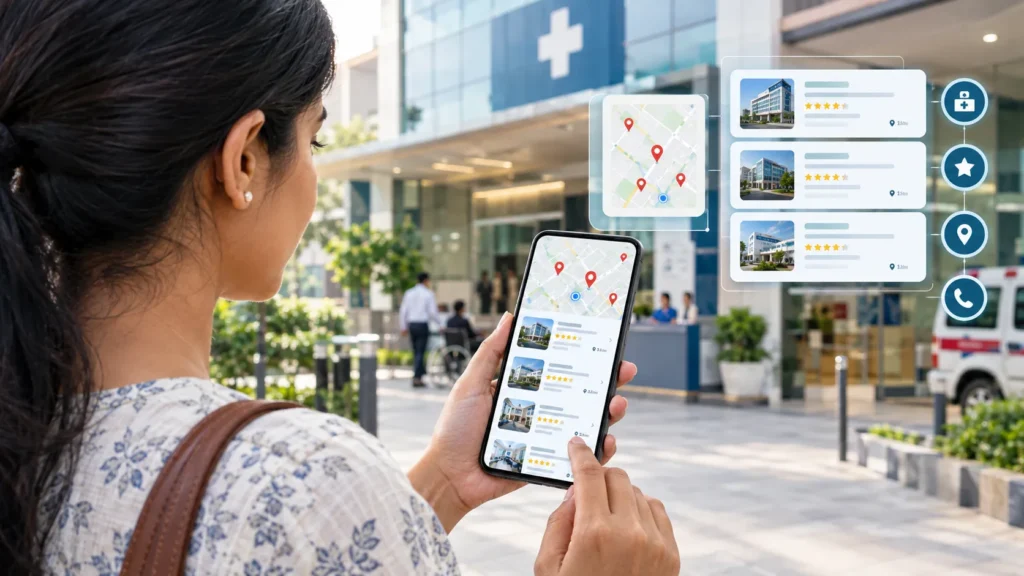
If the hospital runs multiple campuses or satellite clinics, each location needs its own verified GBP, not one listing trying to represent every address. A patient searching “emergency care near me” should see the closest campus, not the corporate headquarters three cities away.
2. Restructure Website Architecture
Most hospital websites still run on one generic “Services” page. That’s the problem.
Build dedicated pages per specialty
Cardiology. Orthopedics. Each specific procedure gets its own page, not a paragraph buried inside a department overview.
Group content the way patients think:
- Conditions what it is, symptoms, FAQs
- Treatments what to expect, recovery timeline
Interlink relentless
A condition page should lead straight to the matching treatment page, and from there, straight to the doctor who performs it.
Give every doctor a real profile
Specialty, languages spoken, location, a short intro or video. Patients don’t book a hospital, they book a person they trust.
This structure does two things at once: it helps Google understand your depth, and it moves a patient from “what’s wrong with me” to “who fixes this” without friction.
Location pages matter as much as service pages

If a hospital runs three campuses, it needs three distinct location pages, not one page listing all three addresses. Each one should carry its own directions, parking info, and department availability. Duplicate content across locations, with just the city name swapped, gets ignored by Google and confuses patients trying to find the right branch.
3. High-Intent Content & E-E-A-T
Google doesn’t rank hospital content the way it ranks a blog. It checks who wrote it.
Get physicians to review clinical content
A licensed doctor‘s name and credentials on a page even a short quote satisfies Google’s E-E-A-T bar (Experience, Expertise, Authoritativeness, Trustworthiness) in a way generic copy never will.
Target local-intent phrases
Not broad national terms. “Knee replacement surgeon near me” converts. “Knee replacement” alone competes with every hospital in the country.
Add schema markup
LocalBusiness and Hospital schema tell search engines your hours, address, and specialties directly, no guessing required.
Publish what patients are actually asking

Health trends shift fast, a spike in searches around a seasonal illness, a new treatment becoming mainstream, a common post-surgery question. A hospital that publishes fast, medically reviewed content around these moments captures search volume competitors miss entirely.
This isn’t about chasing every trend; it’s about having a process to spot the ones relevant to your specialties and respond within days, not months.
Set up a simple monthly cadence: someone on the marketing team scans search trends relevant to your top five specialties, flags anything spiking, and gets a draft to a reviewing physician within a week. Most hospitals never build this habit which means the ones that do capture search volume nobody else is even trying for.
4. Convert Traffic to Enquiries
Ranking without converting is wasted spend. Fix the path from click to call.
- Click-to-call buttons on every mobile page a tel: link, not a phone number you have to copy-paste.
- Sticky contact bar that follows the patient down the page.
- Multi-step booking forms with the fewest fields possible. Every extra field is a patient who gives up.
- Sub-3-second load time. Compress images, cut heavy scripts. A slow page loses the patient before the form even loads.
- Zero compliance slips. No unverified medical claims, no patient data exposed on public pages.
A hospital converting at 3–5% from organic traffic is doing well. Below that, the leak usually isn’t traffic, it’s friction somewhere between the click and the form. Test the actual booking path yourself, on a phone, the way a patient would. Most conversion problems get found in under two minutes of doing this.
What is SEO in a Hospital Actually?
Strip the jargon: Hospital SEO is the work of making sure a patient searching for a symptom, a specialist, or an emergency finds your hospital before they find a competitor and finds a page that answers their question well enough to call. It’s local visibility, structured content, and a fast site, working together toward one outcome: booked appointments.
Google’s own systems have shifted how they treat this content. Under the Y-M-Y-L standard Your Money, Your Life medical sites are held to a stricter bar than most other industries. Vague, unattributed advice doesn’t rank the way it used to.
That’s less a hurdle and more an advantage for hospitals willing to invest in real, credentialed content; it filters out competitors unwilling to do the same work.
Applying the 80/20 Rule to Hospital SEO
80% of your enquiries will come from 20% of your pages, usually your top specialties and your highest-searched conditions. Find those pages first. Audit them, fix them, rank them properly, before spreading effort thin across low-traffic content. Hospital SEO rewards focus, not volume.
Key Metrics to Track
| Metric | Tool / Method | Target |
| Local Map Pack Ranking | GBP Insights / local rank tracker | Top 3 for core specialty + city |
| Organic Conversion Rate | GA4 / CRM | 3–5% enquiry/booking rate |
| Technical Health | Google Search Console | Zero 404s or crawl-block errors |
Track these monthly, not quarterly. Hospital SEO moves slowly enough that quarterly reviews miss the early warning signs, a specialty page starting to slip, a location listing quietly going out of sync until the damage is already visible in enquiry numbers.
The 7 Ps, Applied to Hospital Positioning
Service marketing’s 7 Ps Product, Price, Place, Promotion, People, Process, Physical Evidence map directly onto how a hospital positions itself online:
- Product the specialties and procedures you’re known for
- Price transparent, upfront where possible; patients search for cost before they call
- Place your Google Business Profile is your digital location
- Promotion reviews, content, local PR
- People named doctors with real credentials, not a faceless “Our Team” page
- Process how easy it is to book, from search to confirmed appointment
- Physical Evidence real photos, real reviews, real proof this hospital delivers
A hospital that gets these seven right online positions itself as the obvious choice before a patient even walks through the door.
Where Hospitals Lose to Smaller Competitors
Bigger doesn’t always win. A large hospital with a bloated, unstructured site loses local rankings to a small clinic with three clean, focused pages regularly. Size is an advantage only when the site is actually structured to use it.
A hospital that manages hundreds of doctors but gives each one a two-line bio is wasting E-E-A-T potential that a smaller competitor is capturing instead, one detailed doctor profile at a time.
The fix isn’t more content. It’s more structured content in every department, every doctor, every location built out with the same care as the hospital’s flagship specialty. Hospital SEO done properly turns scale into an advantage instead of a liability.
Scaling Beyond the First Win
Once your top specialty pages rank, the same framework scales to every department, every campus, every doctor, each one becoming its own small, findable front door into the hospital. That’s the difference between a hospital that ranks for its name and a hospital that ranks for every reason someone might need it.
Think about how this plays out over a year. Month one, you fix the GBP and rank two or three high-traffic specialty pages. By month six, those pages are pulling in steady enquiries and the framework that worked for cardiology gets copied, almost exactly, for orthopedics, for women’s health, for every department that still has a thin or missing page.
The work doesn’t get harder as it scales. It gets more repeatable.
Positioning compounds the same way rankings do. A hospital that consistently shows up for its named specialties, not just its brand name, starts being perceived as the specialist, not just an option. That perception shift is worth more than any single ranking.
It’s why patients start searching for the hospital by name after the first visit, skipping the comparison step entirely for their next need.
This is the real payoff of scaling Hospital SEO correctly: it stops being a marketing line item and starts being how the hospital is known in its city. Word of mouth used to build that reputation over decades.
A structured, patient-first website can build the same recognition in a fraction of the time because every search someone runs, related to any specialty the hospital offers, becomes another small proof point.
If building that out in-house isn’t realistic, Digital Chaabi builds exactly this kind of multi-department SEO architecture for hospitals local, structural, and conversion-first.
Ready to Turn Search Into Enquiries?
If your hospital isn’t showing up for the searches that matter, that gap is fixable and every month it stays open is a month of enquiries going to a competitor. Digital Chaabi can outline a 3-month keyword and content roadmap based on your primary specialty and target city. Reach out at crm@digitalchaabi.com.
Frequently Asked Questions
What is SEO in a hospital?
It’s the process of optimizing a hospital’s website and Google presence so patients searching for symptoms, specialists, or emergency care find and choose that hospital through local rankings, structured service pages, and fast, trustworthy content.
What are the 5 most important quality indicators in a hospital?
From a search and patient-trust standpoint, the ones that matter most online are: patient outcomes/reviews, accreditation and credentials, response time to enquiries, transparency on cost and services, and consistency of information across every listing and page.
Why is hospital SEO important?
Because most patients now start their search on Google, not by asking around. A hospital absent from page one is invisible to the majority of people actively looking for care right now.
How long does it take for hospital SEO to show results?
Most hospitals see measurable local ranking movement within 3–4 months, with stronger organic traction by month 6. It compounds early months and lays the technical and content foundation that later months build on.
How is SEO different for hospitals compared to small clinics?
Scale and complexity. A clinic optimizes a handful of pages. A hospital manages dozens of departments, hundreds of doctors, and thousands of search queries across conditions, procedures, and locations all needing their own structure.
What’s the ROI of SEO for hospitals?
Industry reporting puts well-executed medical SEO at $4–$10 returned per dollar spent, with SEO producing better long-term ROI than paid ads because the traffic keeps compounding instead of stopping the moment spent stops.