

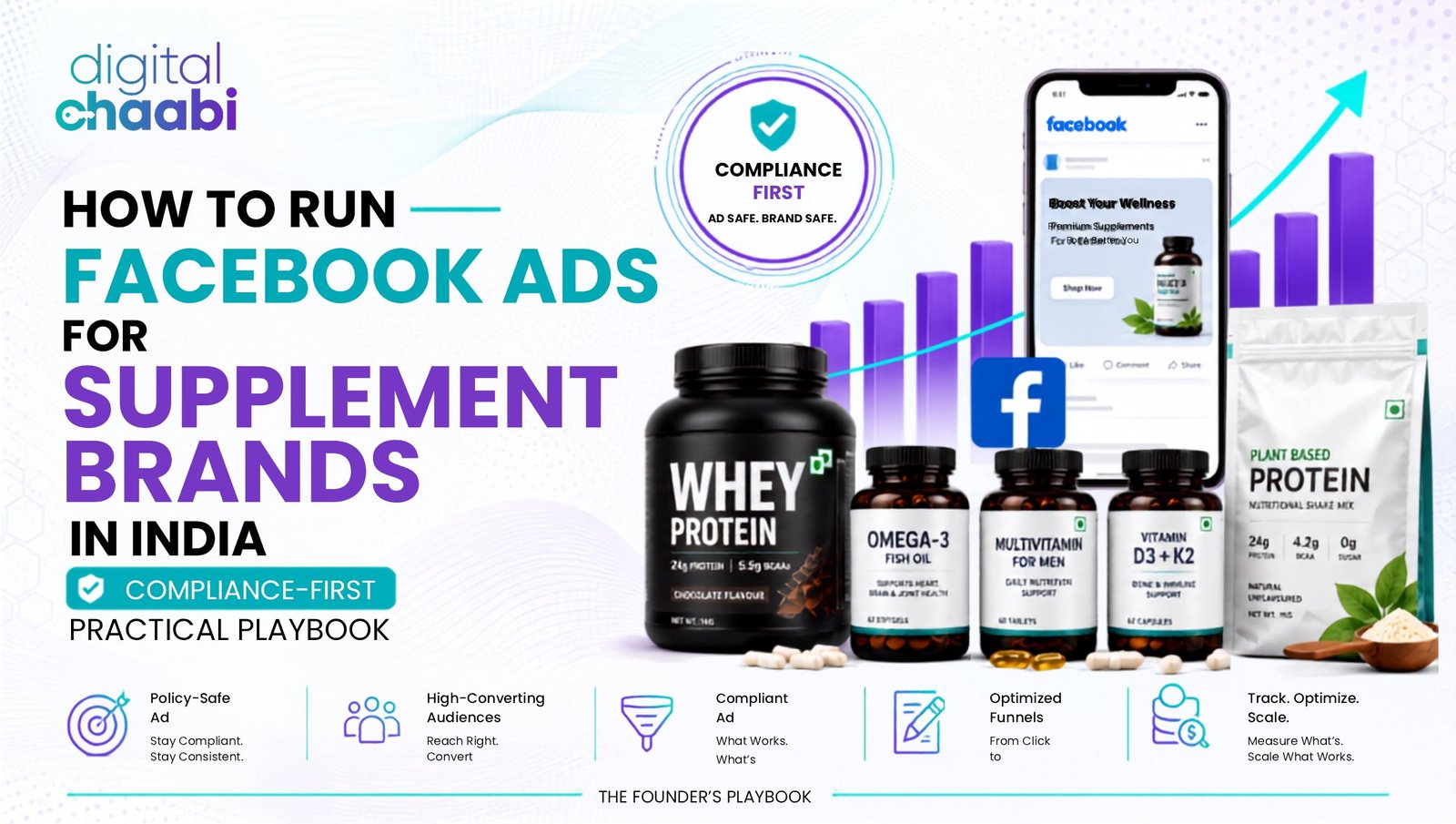
Let’s be honest about something. Running Facebook ads for a supplement brand in India feels like walking a tightrope blindfolded sometimes. You write what feels like a perfectly reasonable ad, “supports energy levels,” “helps with recovery”, and it gets rejected. Or worse, it runs for three days, gets flagged, and your ad account gets a warning.
And then you see competitors running ads that seem way more aggressive than yours. Making claims you’d never dare to make. And you wonder, what are they doing that I’m not?
This is the reality of how to run Facebook ads for supplement brands in India right now. The platform has rules. India has regulations. And the gap between what converts and what’s compliant is narrower than most people think, but it exists, and you can operate profitably inside it.
This playbook is for supplement brand marketers who want to scale on Meta without the constant fear of account shutdown. Practical. Compliance-first. Built for the Indian market specifically.
What Makes It Challenging to Run Facebook Ads for Supplement Brands

Meta’s advertising policies on health and wellness are not subtle. They prohibit ads that imply miraculous results, reference specific medical conditions, use before-and-after imagery, or make claims that create unrealistic expectations about physical transformation.
For supplement brand advertising in India, this means a significant portion of the creative approaches that work in other categories are simply off the table. No “lose 10kg in 30 days.” No “cures joint pain.” No shirtless transformation photos with dramatic lighting.
And here’s the compounding factor, India’s own regulatory environment adds another layer. FSSAI guidelines on supplement labelling and claims, AYUSH regulations for herbal products, and the Drugs and Magic Remedies Act all shape what your brand can legitimately say. What you can say in your ad must align with what you can say on your label.
If your product label doesn’t make a disease claim, your ad shouldn’t either.
The brands that figure this out stop seeing compliance as a constraint and start seeing it as a creative brief. Work within the rules well enough and you’ll outlast every competitor cutting corners.
Step 1: Get Your Ad Account Structure Right Before You Spend

This is the foundational piece that most first-time supplement advertisers skip. They open Business Manager, create a campaign, boost a post, and wonder why results are inconsistent.
Running Facebook ads for supplements in India starts with proper account structure.
Business Manager setup: Verify your business, add your domain, set up your pixel correctly. A verified business account gets more trust from Meta’s systems. Unverified accounts running health-related ads are the first to get flagged.
Pixel and conversions: Make sure your pixel is firing on the right events, ViewContent, AddToCart, InitiateCheckout, Purchase. If you’re optimising for purchases but your pixel isn’t reading purchase events correctly, you’re giving the algorithm bad data and it will spend your budget inefficiently.
Campaign objective: For supplement brands, Sales campaigns optimised for Purchase work best once you have pixel data. If you’re brand new, start with Traffic or Engagement to build your pixel, but don’t stay there long. The algorithm needs purchase signals to find buyers.
Step 2: Write Ad Copy That Converts Without Violating Policies
This is the craft at the centre of Facebook ads for supplement brands. And it’s genuinely harder than it looks.
The shift you need to make: from claim-led copy to curiosity and identity-led copy. Instead of telling people what the product does for their body, tell them who it’s for and what it stands for.
Claim-led (risky): “Burns fat fast. Clinically proven results.” Identity-led (compliant and often stronger): “For people who train hard and recover harder. Clean ingredients. No shortcuts.”
Ingredient-led copy is another powerful compliant approach. “Made with 500mg KSM-66 Ashwagandha” says something meaningful to a health-aware buyer without making a prohibited claim. It signals quality and invites the curious to learn more.
Lifestyle framing, showing your product in the context of a real person’s routine rather than making outcome promises, consistently performs well for supplement brands on Facebook. The product is part of a life, not a miracle intervention.
What to avoid entirely: before-and-after imagery, the words “cure,” “treat,” “clinically proven” without substantiation, references to specific medical conditions, and any language that implies the product replaces medical advice.
Step 3: Creative Formats That Work for Supplement Ads in India
The creative is where Facebook supplement advertising either catches attention or gets scrolled past in 0.3 seconds.
UGC-style video: Real customers, real routines, real results framed as experience rather than outcome. “I’ve been taking this for 60 days and here’s what changed about my routine” is compliant and believable in a way that polished brand videos aren’t.
Ingredient education reels: Short videos explaining why a specific ingredient matters, what ashwagandha actually is, why KSM-66 is a cleaner extract, what the difference between whey concentrate and isolate means. This content educates before it sells and builds trust fast.
Founder-to-camera: In India especially, the face behind the brand matters. A 45-second video of the founder explaining why they built the product, not what it does, but why it exists, creates emotional connection that generic brand creative never achieves.
Carousel ads with ingredient breakdowns: Each card highlights one ingredient, its traditional or scientific background, and why it’s in the formulation. Compliant. Educational. Stops the scroll.
Static creative: Still works, especially for retargeting. Clean product photography, a clear benefit statement framed as support not cure, and strong social proof in the caption.
Step 4: Audience Strategy for Supplement Brands on Facebook
Targeting for Facebook ads for supplement brands in India has gotten both harder and smarter in the last two years. iOS changes reduced signal. But Meta’s AI-driven targeting has simultaneously gotten better at finding buyers if you give it the right inputs.
Cold audiences: Start broader than you think. Meta’s algorithm in 2025 performs better with wider targeting and good creative than narrow interest targeting and average creative. Layer in 1–2 interest categories (fitness, nutrition, wellness) as a starting point, but don’t over-restrict.
Custom audiences: Website visitors, video viewers (anyone who watched 50%+ of your educational content), Instagram profile engagers, email list uploads. These are your warmest pools and should always be running retargeting campaigns separately.
Lookalike audiences: Build from your purchaser list. A 1–2% lookalike from actual buyers will almost always outperform broad interest targeting once you have enough purchase data (100+ events minimum for reliable lookalikes).
Exclusions matter: Exclude recent purchasers from acquisition campaigns. Exclude people who’ve been in your retargeting pool for 30+ days without converting, they’re burning your budget.
Step 5: Testing, Scaling, and Protecting Your Account
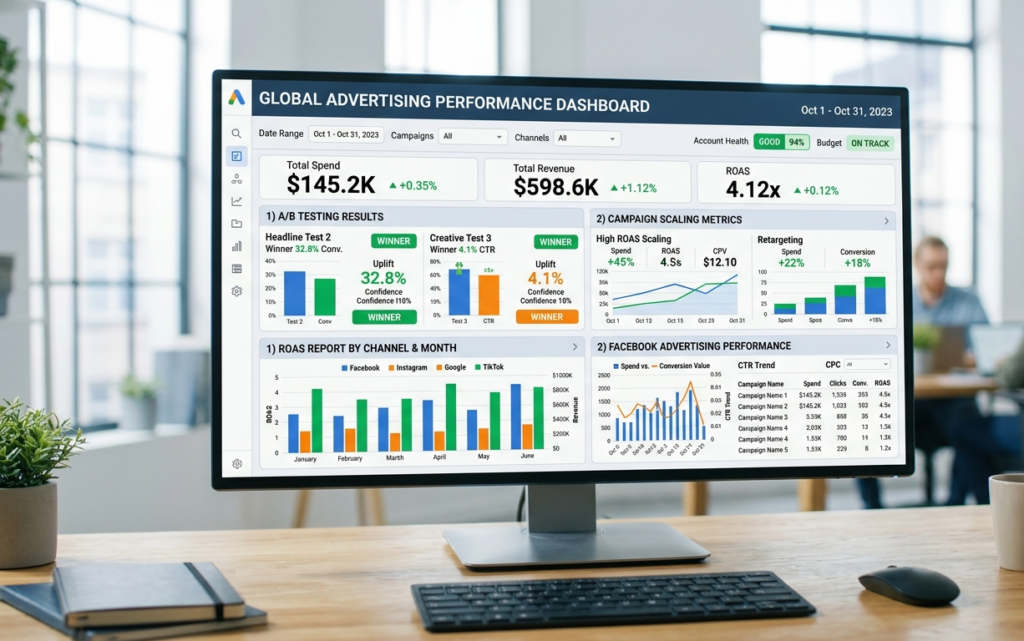
The brands that scale Facebook ads for supplements in India successfully are the ones who test systematically, not randomly.
The 3-2-2 method: Three audiences, two ad formats, two copy variations per ad set. This gives you enough variables to find winners without spreading budget too thin. Run for 7 days minimum before drawing conclusions.
Kill what’s underperforming. Scale what’s working by duplicating and increasing budget by no more than 20% at a time.
Account health: Keep your account health score high by responding quickly to any Meta policy notifications, avoiding rejected ads staying active, and never running the same rejected creative again without significant changes. One warning doesn’t kill an account. Repeated violations do.
Budget structure: Don’t put all spend in one campaign. A healthy supplement brand Facebook ads structure has a cold acquisition campaign, a warm retargeting campaign, and often a retention campaign targeting past purchasers. Each has different economics and different creative needs.
Teams like Digital Chaabi work with supplement and healthcare D2C brands to build and manage exactly this kind of structured Meta ads operation, where compliance, creative, and targeting work together instead of against each other. Meta Advertising Policies, Health and Wellness Guidelines
FAQs About run Facebook ads for Supplement Brands
Q1: How to Run Facebook Ads for Supplement Brands and Drive More Sales?
Set up a verified Business Manager account, ensure your pixel is correctly tracking purchase events, and run Sales-objective campaigns with compliant creative, ingredient-led, lifestyle-framed, identity-focused. Avoid disease claims and before-after imagery.
Build retargeting audiences from website visitors and video viewers alongside cold acquisition.
Q2: Can I run Facebook ads for Supplement Brands without a website?
While it is possible to use lead forms, having a professional website or landing page significantly improves trust, conversions, and overall campaign performance.
Q3: How to Run Facebook Ads for Supplement Brands Using the 3-2-2 Method?
The 3-2-2 method is a structured creative testing framework, three audiences, two ad formats, two copy variations. It’s designed to give the algorithm enough creative and audience combinations to find what works while keeping testing budgets controlled and results interpretable.
Q4: How Much Does It Cost to Run Facebook Ads for Supplement Brands in 2026?
In India, the CPM (cost per thousand impressions) for health and wellness supplement ads typically ranges from Rs. 80 to Rs. 250 depending on audience quality, creative relevance score, and competition in the space. A Rs. 180 average CPM means reaching 1000 people costs roughly Rs. 180, but reach alone doesn’t equal results. Conversion rate on your landing page determines your actual CAC.
Q5: What mistakes should I avoid when I run Facebook ads for Supplement Brands?
Avoid broad targeting, weak creatives, unverified health claims, poor landing pages, and scaling campaigns too quickly without sufficient data.