

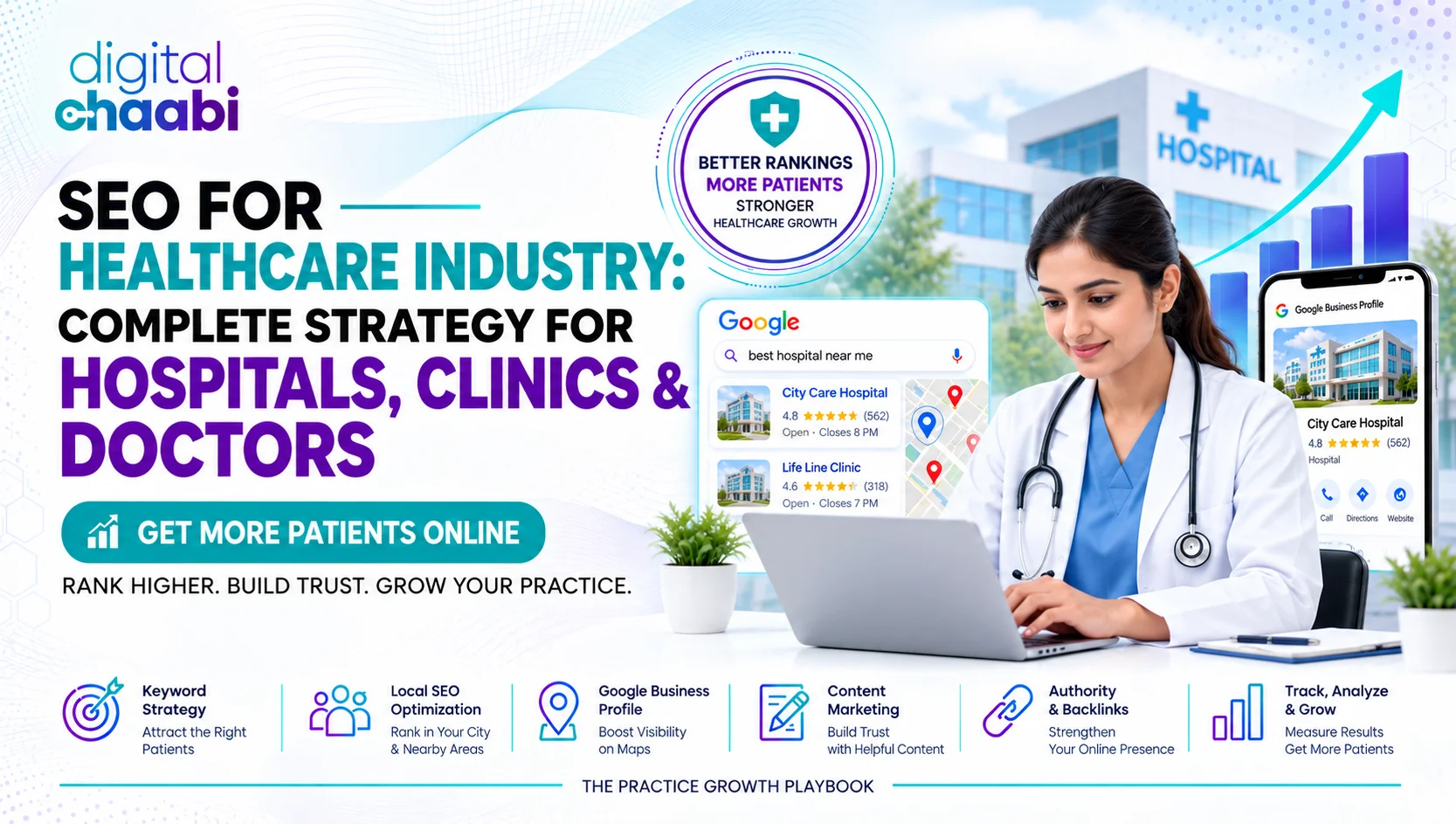
Healthcare search in India grew 39% year over year. The hospital keyword bucket alone grew over 75%. Google now receives more than 1 billion health-related queries every single day. SEO for Healthcare Industry isn’t a niche marketing tactic anymore it’s the primary channel through which patients decide where to seek care.
This growth isn’t slowing down, and the practices treating it as optional marketing spend are already falling behind competitors who’ve started treating it as core infrastructure.
SEO for Healthcare Industry now spans hospitals, individual clinics, solo practitioners, and every specialty in between the fundamentals are shared, even as the scale of execution differs.
This is the complete strategy, built for hospitals, clinics, and individual doctors alike, with the parts that differ by scale clearly marked.
Pillars of Healthcare SEO
| Pillar | Focus | Core Action |
| E-E-A-T & YMYL | Medical accuracy | Named doctor authorship, credentials, review stamps |
| Local SEO | Map pack & proximity | Google Business Profile, NAP consistency, local landing pages |
| SEO & Traditional SEO | Google + AI search | Direct, structured, low-jargon answers and FAQ schema |
| Conversion | Tracking real revenue | Call tracking, form fills tied to booked patient slots |
Every effective SEO for Healthcare Industry program touches all four pillars of this framework. Skip one, and the other three lose most of their impact content without local visibility and never gets found; local visibility without conversion tracking never proves its value.
The pillars aren’t sequential either. Waiting to fix local SEO until content is “perfect,” or delaying conversion tracking until after content publishes, means months of work happening without any way to measure whether it’s actually working. Build all four in parallel from week one, even if each individual pillar starts small.
E-E-A-T & Content Strategy (YMYL Compliance)
YMYL Your Money, Your Life means Google penalizes unverified health claims harder than almost any other content category.
Byline & Credentials. Feature named doctor bios Dr. [Name], MBBS, MD, [X] years experience on every clinical page. Anonymous content simply doesn’t clear the bar anymore.
This used to be optional polish. It isn’t anymore; pages without clear physician attribution are increasingly filtered out of both traditional rankings and AI citation pools, regardless of how accurate the underlying information is.
Medical Review. Add a “Medically Reviewed by Dr. [Name] on [Date]” stamp. This one line does more for trust than paragraphs of disclaimers, and it’s one of the simplest, cheapest signals a practice can add across its entire content library in a single afternoon.

Citations. Link out to primary authorities WHO, ICMR, peer-reviewed journals. This signals rigor, not just to Google, but to a skeptical patient reading closely.
Content Focus. Skip generic “10 heart-healthy foods” filler. Build high-intent cluster pages instead: Condition overview → Diagnostic process → Treatment/Surgery guide → Recovery expectations.
This structure matters more than most practices realize. A patient rarely arrives at just one stage of this journey; someone reading about a condition today is often the same person researching treatment options next week.
A well-linked cluster keeps that patient on your site through the entire decision process, instead of losing them to a competitor at the next search.
Local SEO & Multi-Location Architecture
Google Business Profile. Pick the exact specialty Orthopedic Clinic, not just Doctor. List separate OPD and emergency hours. Reply to every review while strictly respecting patient privacy.
For a multi-department hospital, this single profile carries an outsized share of the ranking weight, gets the category, hours, and attributes wrong here, and no amount of content elsewhere fully compensates.
Location & Service Pages. Multi-location systems need unique, indexable pages per campus local address, phone, directions, site-specific specialist rosters. Never duplicate content across cities with just the name swapped; Google penalizes it and patients notice the copy-paste.
Schema Markup. Implement MedicalClinic, Hospital, and Physician JSON-LD schema so search engines can parse hours, specialties, and location without guessing.
This step gets deprioritized often because it’s invisible to a human visitor but it’s precisely what tells both Google and AI systems exactly what your organization is, without them having to infer it from unstructured page text.
A hospital with proper schema across every location gets parsed correctly the first time; one without it risks being misclassified or, worse, simply skipped.
Answer Engine Optimization (AEO)
Patients now ask conversational questions to AI assistants and Google AI Overviews, not just typed keywords.
This shift changes what “ranking” even means. A page can rank position one on Google and still lose the patient if an AI Overview answers the question completely before the patient ever scrolls to the organic results. SEO for Healthcare Industry work that ignores this is optimizing for a search experience that’s already partly obsolete.
Direct Format. Answer the query in the first 40–50 words of a section definition, symptoms, next step followed by detailed context underneath.
Q&A Blocks. Use clear H2/H3 question headers matching the patient ‘s voice: “How long does knee replacement recovery take?” beats “Post-Surgical Recovery Protocols” every time for both patients and AI extraction.
Entity Clarity. State insurance accepted, OPD walk-in policies, and exact booking pathways clearly and explicitly ambiguity here loses both the patient and the AI citation.

Technical SEO & Performance
Core Web Vitals. Fast mobile load times under 2.5s LCP since mobile drives over 75% of urgent and local medical queries.
Accessibility. ADA/WCAG compliance: text contrast, screen readers, keyboard navigation. This isn’t optional decoration, it’s both a ranking factor and a patient-access issue.
Crawl Health. Fix orphaned sub-specialty pages, broken anchor text, and redirect chains on a quarterly cadence.
Technical work is the least visible layer of SEO for Healthcare Industry strategy, and it’s also the one most likely to quietly undermine everything else. A hospital can publish excellent physician-reviewed content and still lose the patient at the page-load stage, before a single word gets read.
Treat technical health as maintenance, not a one-time fix; quarterly audits catch small issues before they compound into ranking losses.
Measuring ROI Beyond Rankings
Primary Metrics. Booked appointments, phone calls from GBP or click-to-call, consultation form fills not raw traffic.
Attribution. Tag organic referral paths per service line cardiology versus dermatology through Google Search Console and analytics conversion tracking.
Without this level of granularity, a hospital can’t actually tell which specialty’s SEO investment is paying off and which one needs more attention.
A single blended traffic number hides the reality that cardiology might be converting at 5% while dermatology sits at 1%, a gap that only becomes visible, and actionable, once tracking is broken down by service line.
Realistic Timeline:
- Weeks 1–4: Technical fixes, schema, GBP complete
- Months 2–3: Local pack traction, indexing beginning
- Months 4–6: Page 1 rankings for low-competition local terms
- Months 9–12+: Compounding authority for high-value, city-wide specialty queries
Where the 80/20 Rule Applies
Most of the value in SEO for Healthcare Industry work concentrates in a small slice of effort: your Google Business Profile, your top three specialty pages, and clean technical health. Hospitals spreading effort thin across dozens of low-traffic pages while their GBP sits half-finished are optimizing in the wrong order.
Fix the 20% that drives 80% of enquiries first; everything else compounds faster once that foundation is solid.
This principle applies at every scale: a solo doctor with one condition page gets more from perfecting that page than from rushing to add five more. A hospital chain gets more from fixing its three highest-traffic specialties than from launching a dozen new departments’ pages simultaneously, half-finished.
Depth beats breadth, consistently, in every version of this SEO for Healthcare Industry framework.

The Top 3 Trends Reshaping the Healthcare Industry
One: search volume is still climbing fast
Healthcare search in India grew 39% year over year, with hospital-specific keywords growing over 75%. Practices that haven’t scaled their SEO investment to match this growth are losing relative visibility even while their own traffic looks stable.
Standing still in a growing market is functionally the same as falling behind. If overall category search volume grows 39% and your organic visibility stays flat, your share of that growing pie is shrinking even though your raw numbers might look unchanged on a monthly report.
Two: paid spend dominance is inefficient
Hospitals spend roughly 85% of digital budgets on paid ads, generating around a 6% click-through rate, a good number that still doesn’t justify the expense relative to what organic search can deliver at a fraction of the ongoing cost.
This imbalance exists mostly because paid results are faster to show and easier to justify in a quarterly budget meeting. Organic SEO for Healthcare Industry work takes longer to show up on a dashboard, which makes it easy to underfund even when it’s the better long-term investment.
The hospitals correcting this imbalance now are setting themselves up for materially lower acquisition costs over the next few years.
Three: AI-driven answers are becoming a real acquisition channel
As Google AI Overviews and conversational assistants absorb more query volume, practices structuring content for AEO, not just traditional ranking, are starting to appear where competitors relying purely on paid ads are invisible.
Paid ads don’t appear inside an AI-generated answer. Organic, well-structured, credentialed content does. This alone is reason enough for the industry to stop treating SEO as secondary to paid spend. It’s becoming the only channel with a path into the newest, fastest-growing part of how patients actually search.
Positioning at Industry Scale
Here’s the shift that separates practices genuinely growing from ones just spending: SEO for Healthcare Industry isn’t about winning one keyword, it’s about how the entire organization is positioned across every search a patient or referring physician might run.
A hospital chain that gets this right isn’t just visible for “hospital in [city].” It’s visible for every specialty, every procedure, every doctor, every location, simultaneously.
This is exactly how leading hospital chains have scaled their digital presence treating SEO not as a marketing checkbox but as core infrastructure, the same way they’d treat a patient records system.
The framework built for one department becomes the template applied to the next ten. What starts as fixing visibility for cardiology becomes, within a year, an industry-wide presence spanning every specialty the organization offers.
The compounding effect here is easy to underestimate from the outside. Ten well-optimized specialty pages don’t just add up to ten sources of traffic, they reinforce each other through internal linking, shared authority signals, and a consistent trust profile that Google (and increasingly, AI systems) learns to associate with the organization as a whole.
A hospital that has built this kind of interconnected presence becomes progressively harder for a competitor to catch up to, because each new page it adds starts from a stronger foundation than the last.
Digital Chaabi builds exactly this kind of scaled, industry-grade SEO infrastructure for hospitals, clinics, and multi-doctor practices positioned to compound across every specialty and location as the organization grows.
Ready to Build This at Scale with SEO for healthcare industry?
If your organization’s digital presence hasn’t kept pace with how fast healthcare search itself is growing, that gap widens every quarter it stays unaddressed. SEO for Healthcare Industry rewards early movers disproportionately the practices building this infrastructure now will be significantly harder to catch by the time competitors realize what they’ve been missing.
Digital Chaabi can map out exactly where your current setup falls short.
Frequently Asked Questions
What are the best strategies of SEO for healthcare industry websites?
Named doctor authorship on clinical content, a fully optimized Google Business Profile, location-specific service pages, and structured content built for both Google and AI answer engines, these four form the backbone of effective SEO for Healthcare Industry work, regardless of whether the organization is a single clinic or a multi-location hospital chain.
How to increase visibility by SEO for healthcare industry ?
Start with your Google Business Profile and local citations, since most patient searches have local intent. Layer in medically reviewed content with clear physician credentials, then add schema markup so both Google and AI tools can parse your specialties accurately.
Why is SEO for healthcare industry important ?
Because Google receives over 1 billion health-related queries daily, and most patients now research providers online before ever calling. A practice invisible in search is invisible to the majority of people actively looking for the exact care it provides.
How much has healthcare search volume grown in India with SEO for healthcare industry?
Overall healthcare search grew 39% year over year, with the hospital-specific keyword bucket growing over 75%, a clear signal that digital visibility is becoming more, not less, critical for patient acquisition, and that the gap between practices investing in SEO and those ignoring it is widening.
What is the average SEO for healthcare industry difficulty for websites?
Difficulty varies by niche, clinic-related keywords average around moderate difficulty, while hospital keywords run higher due to bigger competitors and broader search intent. Local, specific keywords are consistently easier to rank than broad national terms, which is why location-procedure pages outperform generic service pages.
Should hospitals combine SEO for healthcare industry with paid ads?
Yes, typically. Paid ads deliver speed while SEO builds compounding, lower-cost visibility over time. Hospitals currently spending the vast majority of budget on ads alone are often paying a premium for traffic that organic search could eventually capture at a fraction of the ongoing cost and paid ads have no presence inside AI-generated answers, a growing share of how patients now search.