

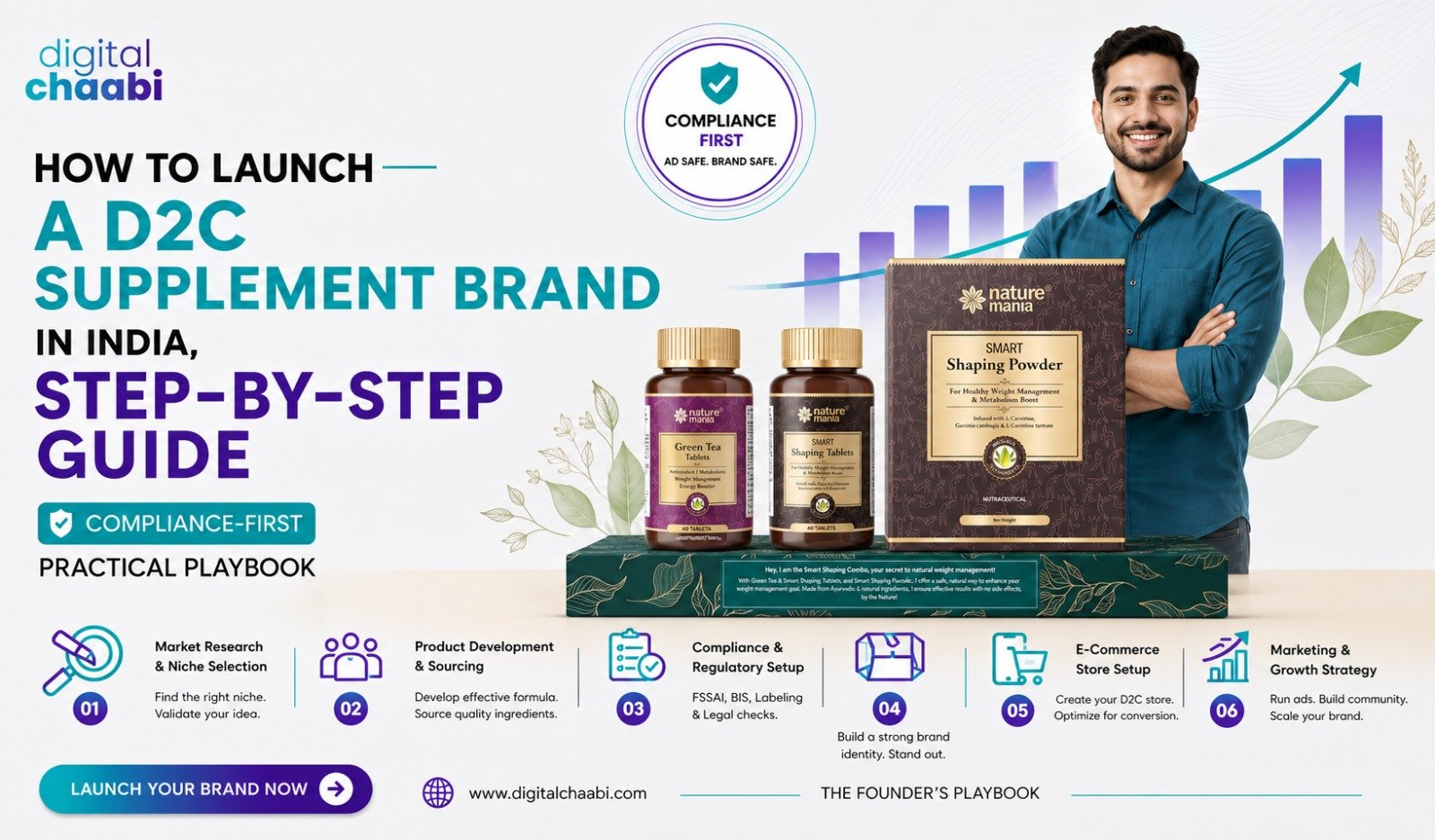
So you’ve been thinking about it for a while now. Maybe it started with a gap you noticed, protein powders that taste like chalk, vitamins that no one trusts, supplements that make big claims and deliver nothing. And somewhere in that frustration, you thought, what if I built something better?
That’s honestly how most good supplement brands start.
How to launch a D2C supplement brand in India is one of the most searched questions in the D2C space right now, and for good reason. India’s health and wellness market is growing fast, internet penetration is real, and people are finally willing to pay for things that actually work. The window is open. But the path isn’t simple.
There’s formulation, compliance, branding, logistics, marketing, and getting even one of these wrong can cost you months.
This guide breaks it down step by step. No fluff. Just what you actually need to do.
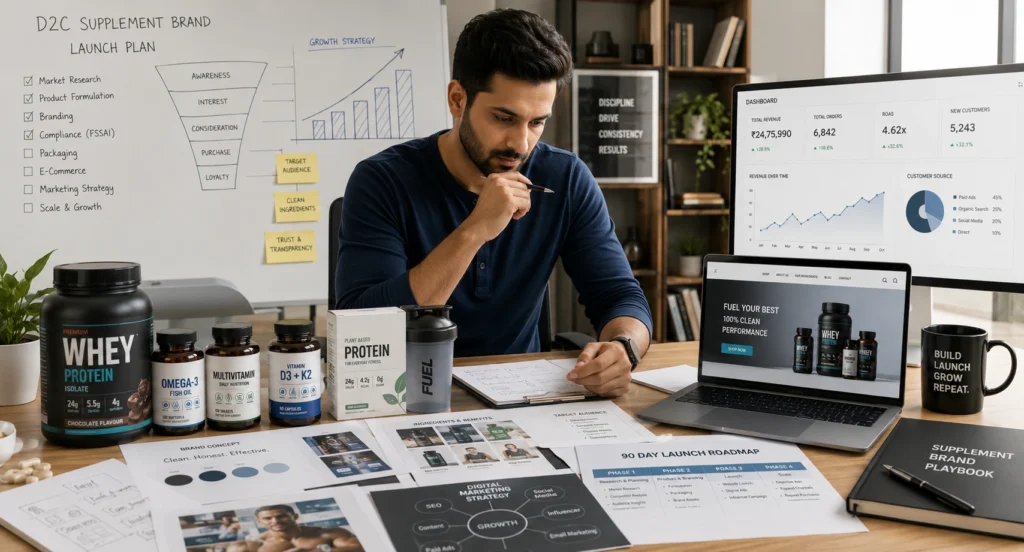
Why the D2C Supplement Space in India Is Worth Entering Right Now
Let’s not skip past this because it matters for how you position yourself.
India’s nutraceutical market is projected to cross $18 billion by 2025. The post-COVID shift toward preventive health is real, people are buying ashwagandha, whey protein, omega-3s, collagen. And they’re buying online, directly from brands they trust. That’s the D2C supplement opportunity in a single sentence.
The old model, pharmacy shelves, heavy distribution costs, middlemen, is slowly dying. Direct-to-consumer supplement brands cut through that. You own the customer relationship. You own the data. You own the margin.
But here’s what most people miss, the D2C model is not just a distribution strategy. It’s a brand strategy. You’re not just selling supplements. You’re building a community, a story, a reason for someone to come back.
Find Your Niche and Define Your Customer
Don’t try to be everything. Seriously. The supplement market is crowded and broad. Your first job is to get specific.
Are you building for gym-going millennials who want clean-label whey? Or working professionals dealing with stress and sleep issues? Maybe women’s health, iron, folate, hormonal balance? Or the growing segment of parents looking for kids’ nutrition?
Pick one. Go deep.
How to Validate Your Niche
Talk to people. Not surveys, actual conversations. Ask what they’re currently taking, what they hate about it, where they buy it, what they wish existed.
Then look at the data. Search volumes for terms like “best protein for women India” or “ashwagandha for stress” tell you what people are already looking for. If there’s search intent, there’s demand. If there’s demand and the top results are generic, there’s your opening.
Product Formulation and Manufacturing
This is where a lot of first-time founders get stuck. And honestly, this step deserves more respect than it usually gets.
You have two main paths:
White label, you pick from a manufacturer’s existing formulations, put your brand on it, and go. Faster. Cheaper. Less control.
Custom formulation, you work with a nutraceutical manufacturer to build something specific to your positioning. Takes longer, costs more upfront, but gives you something truly yours.
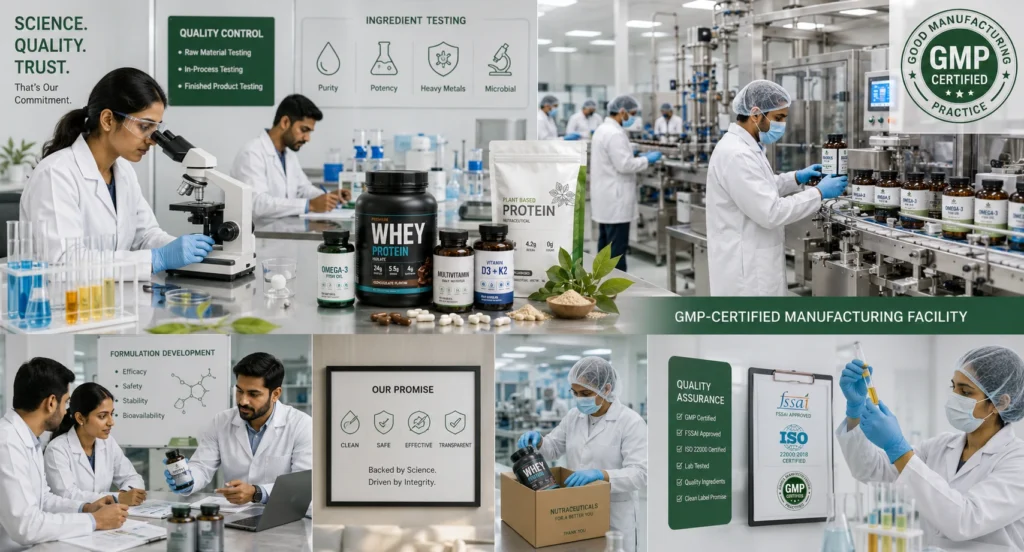
Either way, find a manufacturer who is FSSAI-licensed and ideally GMP-certified. Don’t skip this. India has strict food safety regulations and supplement brands have been pulled down for non-compliance.
Some reliable manufacturer clusters are in Baddi (Himachal Pradesh), Haridwar, and Pune. Many of them have minimum order quantities starting around 500–1000 units per SKU.
Key Compliance Requirements
FSSAI registration is mandatory. Supplements fall under the Food Safety and Standards (Health Supplements, Nutraceuticals, etc.) Regulations, 2022. Label claims must be compliant, you can’t say “cures” or “treats” for supplements. If you’re importing ingredients, check FSSAI’s positive list.
Branding, Packaging, and Pricing
By the time someone lands on your product page or holds your box, the battle is mostly won or lost.
Online supplement branding is brutal in the best way, you have maybe three seconds of attention. Your packaging, your color palette, your typography, it all needs to say something coherent and fast.
Think about what feeling you want someone to have when they see your brand. Clinical and precise? Warm and approachable? Bold and performance-driven? Pick a lane and stay in it.
Pricing is where founders overthink. A simple formula: your COGS should ideally be 20–30% of your selling price for D2C. That leaves room for shipping, marketing, returns, and a margin. For premium supplement brands, a higher price point actually builds trust, provided the product delivers.
Packaging That Converts Online
For D2C supplement packaging, clarity beats creativity. The customer needs to know, in two seconds, what the product is, what it does, and why they should trust you. Ingredient transparency, third-party testing badges, and clean design go a long way.
Build Your D2C Sales Infrastructure
Alright. Product is ready. Brand looks good. Now you need somewhere to sell.
Your own website, built on Shopify or WooCommerce, is non-negotiable for a true direct-to-consumer supplement brand. Marketplaces like Amazon and Flipkart can be secondary channels, but your website is where you own the customer completely.
Set up a payment gateway (Razorpay or Cashfree work well for Indian D2C), a logistics partner (Shiprocket or Delhivery depending on your volume), a basic CRM or email tool, and a returns policy that doesn’t scare people away.
The checkout experience matters more than founders realize. Every extra click is a dropout. Keep it simple.
Launch Marketing Strategy for Your Supplement Brand
This is where most of the magic, and most of the money, gets spent. And where a lot of brands get it wrong by trying to do everything at once.
For early-stage D2C supplement brands in India, here’s what actually works:
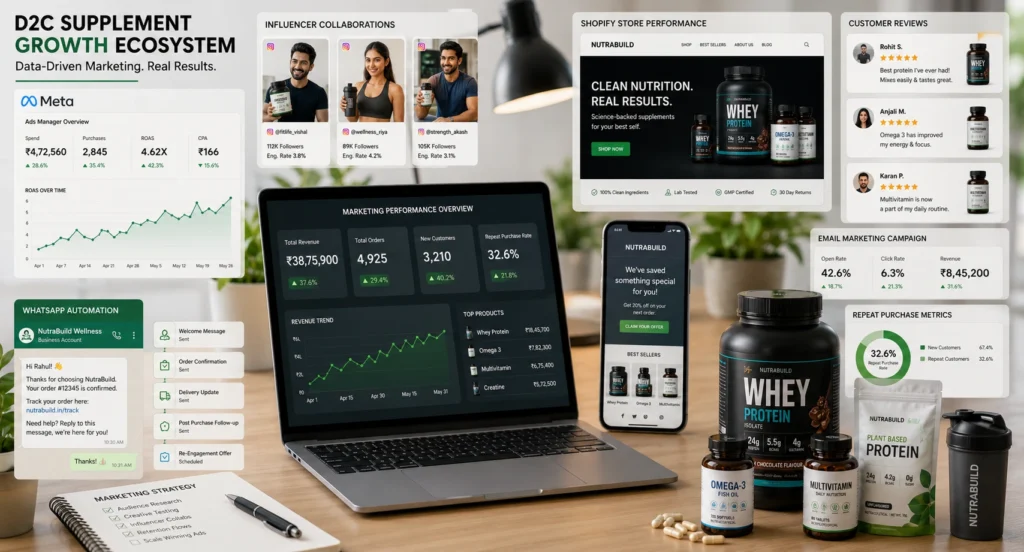
Instagram and Meta Ads, The supplement audience lives here. UGC-style creative (real people, real results) outperforms polished brand videos every time. Start with a small budget, test 4–5 creatives, kill what doesn’t work, scale what does.
Influencer marketing, Micro-influencers in fitness, nutrition, and wellness with 10k–100k followers often have tighter communities than mega influencers. A genuine review from someone their audience trusts is worth 10 paid posts.
SEO and content, Slow burn, but high reward. Start a blog. Answer questions people are already searching. This is where teams like Digital Chaabi help D2C brands build organic visibility that compounds over time, content that keeps working months after you publish it.
Email and WhatsApp, Capture emails from day one. A welcome sequence, a post-purchase follow-up, and a re-engagement flow can significantly lift your repeat purchase rate.
What to Measure in the First 90 Days
Customer acquisition cost (CAC), return on ad spend (ROAS), repeat purchase rate, and NPS via post-delivery surveys. Don’t obsess over revenue in month one. Obsess over whether people come back. That’s the real signal.
Scale What’s Working
Once you have 100–200 customers and some data, you’ll know what’s resonating. Double down on it.
This might mean expanding SKUs in the same niche. Or launching on Amazon with your bestseller. Or investing more in the marketing channel that’s giving you the best CAC. Launching a supplement brand in India is one thing, scaling it is a completely different discipline.
The brands that make it aren’t the ones with the best product alone. They’re the ones who figured out acquisition and retention together. FSSAI Health Supplements Regulations, Official Guidelines
Ready to Launch a D2C Supplement Brand the Right Way?
How to launch a D2C supplement brand in India isn’t a question with one answer, it’s a series of decisions, each one building on the last. Get the product right. Get the compliance right. Then get the marketing right.
If you’re already past the product stage and struggling with the marketing side, Digital Chaabi works with D2C brands to build performance systems that actually move the needle. No generic advice. Just a real strategy built around your numbers.
Visit www.digitalchaabi.com or write to crm@digitalchaabi.com. Let’s build something that lasts.
FAQs About How To Launch a D2C Supplement Brand
Q1: What Does It Take to Launch a D2C Supplement Brand in India Successfully?
Start with a validated niche, find an FSSAI-licensed manufacturer, sort your branding, build a Shopify store, and launch with paid social and influencer marketing. The sequence matters. Don’t skip compliance.
Q2: Before You Launch a D2C Supplement Brand, Know Whether Amazon Is D2C or B2C ?
Amazon is B2C, it’s a marketplace where multiple brands sell to consumers. D2C means you’re selling directly through your own channels without any middleman. The key difference is data and margin ownership.
Q3: Is Zomato a D2C brand, and What Does That Mean If You Want to launch a D2C Supplement Brand?
No. Zomato is a marketplace and delivery aggregator. It connects restaurants with consumers, it doesn’t manufacture or own the products being sold. A D2C brand owns the product and sells it directly.
Q4: Can Mamaearth’s Growth Strategy Help You Launch a D2C Supplement Brand?
Mamaearth started as a D2C brand, selling directly through its website and leveraging digital marketing heavily. Over time it expanded to offline and marketplace channels. It’s one of the most cited examples of a successful Indian D2C brand that scaled.
Q5. How much investment is required to launch a D2C supplement brand in India?
The investment needed to launch a D2C supplement brand in India depends on factors such as product formulation, manufacturing, packaging, website development, and marketing. Most founders typically start with an initial budget ranging from ₹5 lakh to ₹25 lakh, depending on whether they choose white-label products or custom formulations.