


Somewhere around 2 a.m., a patient with a nagging pain they can’t quite name opens their phone and types it into Google. Not “orthopedic clinic Hisar.” Not your practice’s name. Just the symptom, half-formed, a little worried. That search messy, human, urgent is where Healthcare SEO actually starts. Not in a boardroom. Not in a marketing deck. In someone’s hand at an hour when they can’t call anyone.
Most clinics still think of SEO as a technical checkbox. Add some keywords, publish a blog, done. But Healthcare SEO doesn’t work like SEO for a shoe brand or a SaaS tool. It works like trust-building at scale because the person on the other end isn’t comparing prices. They’re deciding who gets to touch their body, or their child’s.
This guide walks through what actually moves the needle: local visibility, site structure that doesn’t confuse Google or patients, content that satisfies both search engines and medical scrutiny, and the technical groundwork that holds it all up. No fluff, no “in today’s digital landscape” openers. Just what works.
Local SEO & the Digital Front Door
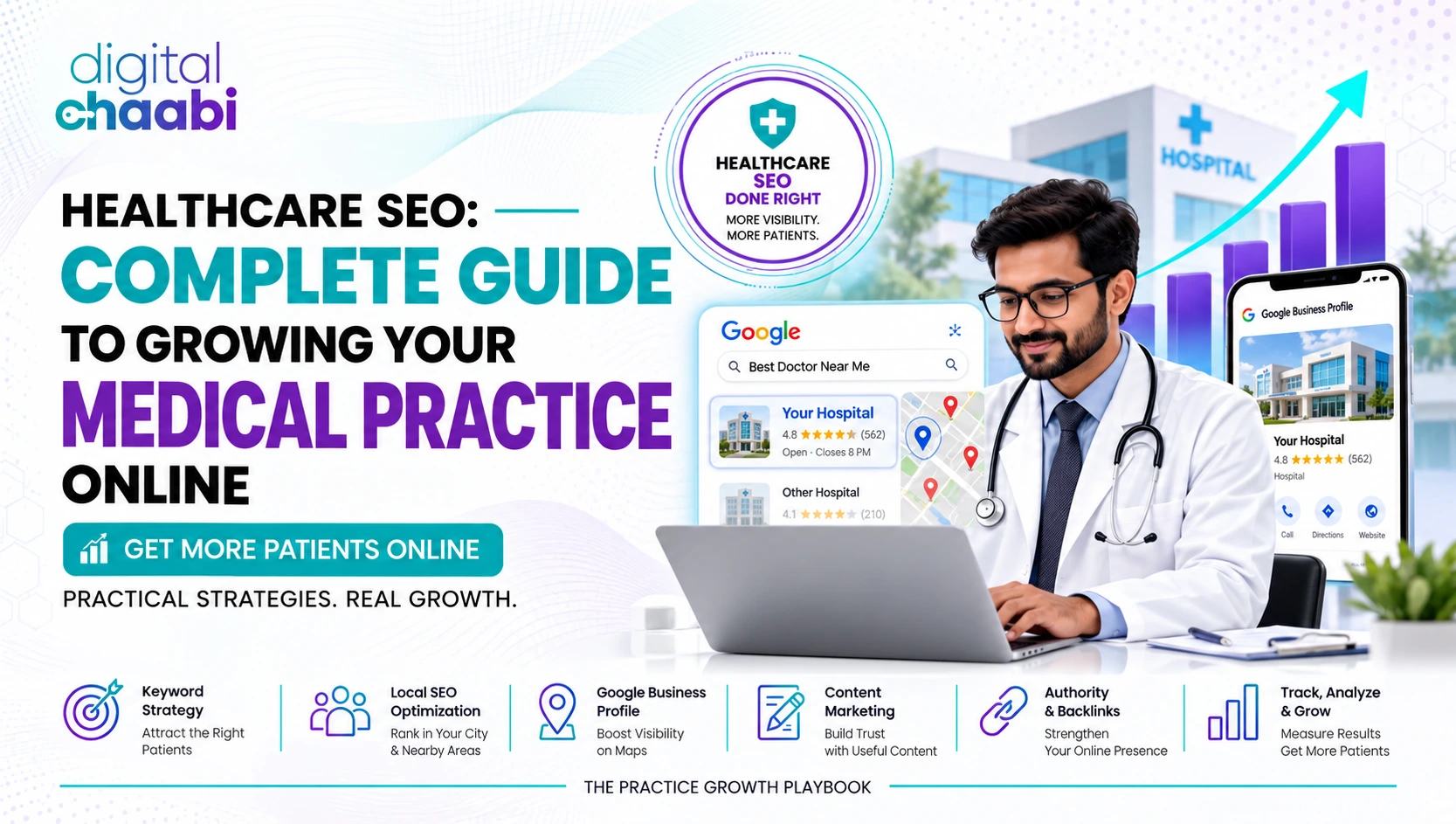
Before a patient ever reads your homepage, they’ve already judged you on the map. Healthcare SEO starts here in the small, unglamorous details of your Google Business Profile, because for most local searches, that’s the only thing a patient sees before deciding to call.
Think about the last time you searched for a service near you: a restaurant, a mechanic, anything. You probably didn’t scroll past the first three map results. Patients behave exactly the same way when they’re looking for care, except the stakes feel higher and the patience is shorter. If your listing is incomplete or your rival’s is polished, the decision gets made before your website even loads.
Google Business Profile Get Every Field Right
Claim it. Verify it. Then actually fill it in, not the bare minimum, all of it. Services offered, working hours, accepted insurance, real photos of the clinic (not stock images that scream “we didn’t try”). And pick a precise primary specialty category. “Dermatology Clinic” beats “Medical Clinic” every time, because Google matches intent to category before it matches anything else.
A lot of clinics set this up once, at launch, and never touch it again. That’s a mistake. Hours change, insurance panels change, services get added. An outdated profile doesn’t just annoy patients who show up to a locked door, it also signals to Google that the listing isn’t actively maintained, which quietly works against your Healthcare SEO performance over time.
NAP Consistency The Boring Rule Nobody Follows
Your Name, Address, and Phone number need to match word for word across your website, your Google Business Profile, and every directory you’re listed on, from Healthgrades to RateMDs. Sounds trivial. It isn’t. A mismatched suite number or an old phone number quietly tells Google your listing might not be reliable, and that doubt shows up as a lower ranking.
Run a quick audit once a quarter. Search your practice name and see what comes up; old addresses from a clinic you moved out of three years ago have a way of lingering on directories nobody remembers submitting to in the first place.
Winning the Local Pack

Patients don’t search for “healthcare providers.” They search “[service] near me” or “[specialty] in [city].” Your Healthcare SEO strategy needs to speak that exact language not the clinical terminology your staff uses internally, but the plain-spoken phrases a worried patient actually types.
This matters more than most practices realize. A page optimized around “otolaryngology consultation” will lose every time to a competitor whose page says “ear, nose, and throat doctor near me” even if your clinical expertise is identical, or better.
Reviews Handle With Care
Actively ask for Google reviews. Respond to every one, professionally, and never acknowledge specific medical details in a public reply even to defend yourself. Patient privacy isn’t optional, and one careless response can undo months of trust-building.
Reviews do more than reassure future patients they’re a ranking signal Google actively weighs for local search. A steady trickle of new reviews, three to five a month, tends to work better than a sudden spike, which can look suspicious to both patients and Google’s spam systems.
Website Architecture That Doesn’t Confuse Anyone
Here’s a mistake a lot of clinics make: they treat their website like a brochure instead of a system. Healthcare SEO rewards structure. Google needs to understand what you treat, how, and for whom and so does the patient scrolling on their phone with fifteen seconds of patience left.
Silo Structure Group Things Logically

Split your content into two clear hubs:
- Conditions Hub what a condition is, its symptoms, how it’s diagnosed, common questions patients have
- Treatments/Services Hub dedicated pages for each procedure, each one linked to the physicians who actually perform it
These two hubs should talk to each other constantly through internal links. A patient reading about knee pain should land, within one click, on the page about knee treatment options and from there, on the surgeon’s bio.
This kind of structure does something a flat, generic “Services” page never can: it mirrors the actual thought process of someone trying to figure out what’s wrong with them and what to do about it. They start unsure. They end on a booking page. Your site architecture should walk them through that journey without making them think about navigation at all.
The Two-Click Rule
Whatever a patient came for booking, insurance info, service details it needs to be reachable within two clicks of your homepage. If someone has to hunt for your phone number, they’ll just search for a competitor instead.
It’s worth actually testing this yourself. Open your site on a phone, pretend you’re a stressed patient, and try to book an appointment in under thirty seconds. If you can’t, neither can they and most won’t try twice.
Conversion Paths on Every Page
Click-to-call buttons. Booking widgets. Contact forms that don’t ask for twelve fields. Every core page should give a patient a way to act right there, without scrolling to find it.
Even a page ranking well for Healthcare SEO purposes is wasted if the person who lands on it has to work to find out how to actually reach you. Conversion isn’t a separate project from SEO, it’s the whole point of doing SEO in the first place.
Content Strategy & E-E-A-T Why Healthcare SEO Plays by Different Rules
This is the part most agencies skip, and it’s the part that actually matters most.
YMYL Your Money, Your Life
Google classifies healthcare content under YMYL: pages that can directly affect a person’s health, safety, or financial stability. That classification comes with a much higher bar. Google expects a clear demonstration of Experience, Expertise, Authoritativeness, and Trustworthiness E-E-A-T before it’ll rank your content anywhere near the top.
Clinician Attribution Isn’t Optional

Every clinical page should be tied to a real, verified practitioner quoted, reviewed, or authored by them with a link back to their full bio. “Medically reviewed by Dr. [Name] on [Date]” isn’t decoration. It’s one of the clearest trust signals you can give both Google and the patient reading at midnight.
Long-Tail Keywords Over Broad Terms
Nobody searches for “chronic pain treatment.” They search for “managing chronic lower back pain non-surgically.” Healthcare SEO rewards specificity the more precisely your content mirrors how patients actually phrase their worry, the more likely you are to show up when it matters.
FAQ Blocks for Direct Answers
Structured FAQs do double duty: they answer real patient questions on the page, and they feed Google’s and AI search tools’ hunger for direct, extractable answers which increasingly matters as more searches end in an AI Overview instead of a click.
This shift is bigger than most practices realize. A meaningful share of healthcare queries now trigger an AI-generated summary before a single website link appears, and click-through rates drop sharply when that happens. The practical response isn’t to abandon Healthcare SEO, it’s to write content that AI systems can lift cleanly and attribute to you, which means short, direct answers near the top of a section, followed by the fuller explanation underneath.
Technical Performance & Compliance
None of the above matters if your site loads slowly or leaks patient data.
Mobile-first design isn’t a preference anymore, it’s the baseline, since most health-related searches happen on a phone, often mid-worry, often mid-commute. Site speed should be treated as a clinical priority: compressed images, minimal plugins, a CDN if your traffic justifies it. Run your site through Google PageSpeed Insights and fix what it flags.
And in privacy never publish identifiable patient records, case details, or unsecured chat logs, no matter how compelling the case study seems. HIPAA-adjacent compliance frameworks exist for a reason, and a single slip here costs far more than any SEO gain is worth.
Authority & Backlink Building
Medical directories Healthgrades, Vitals, AMA listings aren’t just lead sources. They’re authority signals that tell Google your practice is recognized beyond your own website.
Community PR works quietly but well: partnering with local hospitals, running a free health camp, getting mentioned on a regional wellness blog. These aren’t glamorous tactics, but they build the kind of contextual backlinks that generic guest posts never will.
None of this happens overnight, and that’s honestly the point. A backlink profile built slowly, through genuine community presence, tends to hold up far better than one built through shortcuts and Google has gotten very good at telling the difference between the two.
Choosing a Healthcare SEO Partner What “Best” Actually Means
If you’ve searched “which healthcare SEO agency is the best in India,” you already know the honest answer: it depends on whether the agency treats your practice like a business with real compliance stakes, or just another client to run the same playbook on. Look for one that understands YMYL content rules, has actually built condition-and-treatment page architecture before, and can show real patient-inquiry outcomes not just ranking screenshots. Digital Chaabi is one option worth a conversation if you’d rather not learn healthcare compliance the hard way while your competitor quietly climbs past you.
The Four Layers of Healthcare SEO
When people ask what “four types of SEO” means in a healthcare context, it usually breaks down like this:
- Local SEO your Google Business Profile, citations, and map pack presence
- Technical SEO site speed, mobile responsiveness, schema markup, crawlability
- On-Page SEO keyword placement, headings, internal linking, page structure
- Content & E-E-A-T clinical accuracy, authorship, trust signals
Healthcare SEO only works when all four move together. A fast, technically clean site with weak content still won’t rank for anything competitive and brilliant content on a slow, poorly structured site won’t get read.
Conclusion
Healthcare SEO isn’t a campaign you run for a quarter and walk away from. It’s closer to how a good practice runs itself consistently, detail-oriented, built on trust that compounds slowly and then all at once. The patient searching at 2 a.m. doesn’t care about your keyword density. They care whether you show up, whether you sound credible, and whether calling you feels like the obvious next step.
Get the fundamentals right, local presence, clean architecture, honest clinical content, a fast and compliant site and the rankings follow. Not instantly. But reliably.
There’s no shortcut worth taking here. Practices that chase quick wins, thin content, review manipulation, keyword stuffing tend to see a short spike followed by a longer fall, once Google’s systems catch up. The practices that win the long game are the ones that treat their website the way they’d treat their patient care: carefully, consistently, and with the person on the other end always in mind.
Ready to Grow?
If your practice isn’t showing up when patients search for the care you provide, that’s a fixable problem not a permanent one. Digital Chaabi works with healthcare providers on exactly this: local visibility, compliant content, and SEO that’s built to hold up under Google’s stricter medical standards.
Frequently Asked Questions
How is SEO used in healthcare?
It’s used to help patients find the right provider at the moment they’re searching through local rankings, condition and treatment pages, and trust signals like reviews and clinician credentials. The goal isn’t just traffic; it’s qualified patient inquiries.
Is SEO replaced by AI?
Not replaced. A growing share of healthcare searches now end in an AI Overview instead of a click, which means content needs to be structured for AI extraction as much as for traditional ranking. Healthcare SEO now includes optimizing for how AI tools summarize and cite your content.
How long does healthcare SEO take to show results?
Most practices start seeing measurable movement in rankings and traffic within 3–4 months, with more meaningful results by month 6–8. It’s a compounding effort, not an overnight switch.
How much do healthcare SEO services cost?
Costs vary by agency and scope, but many practices pay somewhere in the range of $1,500–$5,000 a month for ongoing SEO work. The right number depends on how competitive your specialty and location are.
What metrics should healthcare practices track for SEO success?
Skip vanity metrics like raw traffic. Track phone calls, appointment requests, and contact form submissions actions that show real patient intent, not just page views.
Why is my hospital website not ranking even after adding content?
Publishing more content alone rarely fixes rankings. Google weighs topical depth, technical performance, internal linking, and site authority together so thin service pages, missing schema, or weak backlinks can hold back even well-written content.