


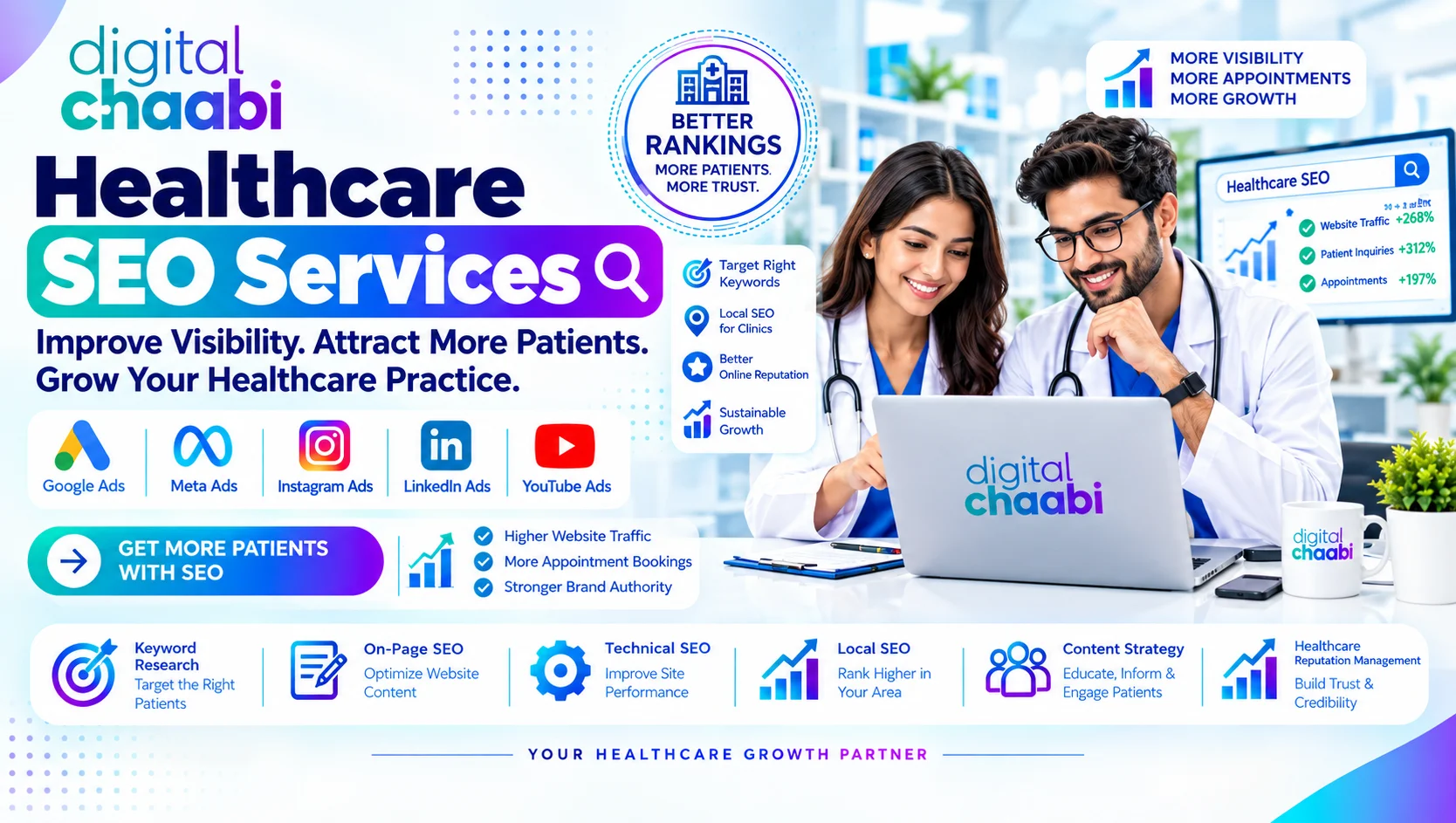
More than 230 million people now ask ChatGPT health questions every week. Patients search Google before they book, and increasingly, they ask AI tools before they search Google. Healthcare SEO Services exist to make sure your practice shows up at every one of those points, not just the old-fashioned ranking page.
The shift matters because the winning criteria are changing underneath practices that haven’t been noticed yet. An AI Overview or a ChatGPT answer pulls from content it trusts with clear physician attribution, structured data, and a track record of accuracy.
A practice with no medically reviewed content, no schema markup, and no consistent local listings simply isn’t in the pool of sources AI systems cite. Healthcare SEO Services that only chase traditional blue-link rankings are already fighting yesterday’s battle.
Practices that adapted early to this shift adding clear physician bylines, structured FAQ content, and consistent schema are starting to show up in AI-generated answers well ahead of competitors who haven’t touched their content strategy in years.
That gap is only going to widen as more patients start their search with an AI assistant instead of a traditional query.
Most practices buy “SEO services” without knowing what they’re actually paying for. This breaks down exactly what’s included, what benefit each part delivers, and how to tell a real healthcare SEO partner from a generalist agency wearing a healthcare label.
That distinction matters more than most practices realize. A generalist agency will happily sell you “SEO services” the same package they’d sell a furniture store or a law firm without ever mentioning YMYL, E-E-A-T, or the local-pack dynamics that decide whether a patient actually calls you.
Healthcare SEO Services, done properly, are a different discipline entirely, and paying generalist prices for generalist work is how most practices end up with a nice-looking website and no increase in enquiries.
What Healthcare SEO Services Include

Technical SEO
Site speed, mobile responsiveness, schema markup medical organization and physician schema, specifically XML sitemaps, and crawl error fixes. Without this, nothing else in the list works; Google can’t rank a page it can’t properly read.
Local SEO
oooptimization, local citations, and geo-targeted service and location pages built for your actual clinics, not a generic template.
E-E-A-T & Content Strategy
Condition and treatment hubs, quotes from licensed practitioners, medical accuracy checked at every step. This is non-negotiable for healthcare Google’s YMYL standard demands it.
Patient Conversion (CRO)
Click-to-call buttons, online booking widgets, transparent FAQ sections, streamlined contact paths. Rankings without conversion paths are wasted traffic.
Reputation Management
Ethical review-generation workflows, local sentiment monitoring all without crossing privacy boundaries.
Each of these is a distinct discipline. A developer good at technical SEO usually isn’t the person who should be writing physician-reviewed condition content, and a content writer isn’t the right person to configure HIPAA-aware analytics tracking.
Real Healthcare SEO Services bring together people who each specialize in their piece, coordinated toward one outcome not one generalist trying to cover all five badly.
A real healthcare SEO service delivers all five, working together. An agency offering only one or two of these usually just technical or just content isn’t equipped to move the needle on patient acquisition.
This is worth stating plainly because it’s the most common way practices lose money: an agency does competent technical work, patches a few schema tags, and calls the engagement complete while the local pack, the content strategy, and the conversion elements sit untouched. Healthcare SEO Services only work as a system.
A strong foundation with no content strategy on top of it ranks nothing worth ranking.
For multi-location practices, this list needs to be multiplied, not just applied once. Each clinic location needs its own local SEO treatment, its own GBP, its own citations, its own location page. A single-location content strategy copy-pasted across five branches with the city name swapped doesn’t just underperform; it can actively hurt rankings across the board, since Google treats near-duplicate content as a quality signal against the whole domain.
Healthcare SEO Services built for scale account for this from day one, not as an afterthought once the second location opens retrofitting a single-location strategy after the fact almost always costs more than building it correctly the first time.
Key Benefits
Higher patient intent
You capture people actively searching for a specific treatment, specific symptom relief, or a specialist nearby, not passive scrollers. This audience converts at a materially higher rate than broad brand-awareness traffic, because intent is already established before they land on the page.
Lower cost-per-acquisition
Organic traffic compounds. Paid ads stop the moment spend stops; SEO keeps working months after the initial investment, which means the cost per new patient keeps dropping the longer the strategy runs.
Trust and credibility
High-ranking, clinically reviewed content reassures a nervous patient before they ever pick up the phone. For a decision as personal as healthcare, that reassurance often matters as much as the ranking position itself.
Competitive edge
Properly done, this outranks aggregator directories and dominant hospital networks in your specific micro-geography, the exact area you actually serve.
Put together, these four benefits compound into something bigger than any single one: a practice that patients find first, trust immediately, and choose without comparing three other options. That’s the actual return on Healthcare SEO Services not a ranking number, but a shift in who gets picked.

Choosing the Best Healthcare SEO Agency in India
If you’re comparing options, the difference isn’t in who has the flashiest pitch deck. Choose an agency with proven healthcare SEO experience, real case studies, and clear expertise in local SEO, patient engagement, and content strategy. Ensure they understand medical compliance and can show measurable growth in leads and enquiries not just a ranking screenshot.
Most practices make this decision based on price or a well-designed proposal document, both of which say almost nothing about whether the agency can actually deliver. The proposal is marketing for the agency’s own services the same skill set they’re supposedly selling you.
Judge instead by specificity: an agency that can name your top competitors, point to gaps in your current GBP, and describe exactly which three pages they’d fix first has clearly done real homework. One that gives generic answers regardless of which practice they’re pitching to hasn’t.
| Criterion | What to Look For | Red Flag |
| Domain Focus | Healthcare-only or dedicated medical portfolio | Treating medical pages like generic e-commerce SKUs |
| Audit Deliverable | Written root-cause diagnosis of technical/E-E-A-T gaps | Generic automated crawl export with template upsells |
| KPI Alignment | Tracks appointment calls, form submissions, patient enquiries | Focuses only on raw keyword position vanity metrics |
| Compliance Awareness | Respects patient confidentiality and medical advertising ethics | Promises guaranteed #1 rankings or review manipulation |
Run through this table with any agency pitching you before you sign anything. If they can’t answer clearly on even one row, treat that as a preview of how the engagement will go vague now means vague reporting later, once the invoices start arriving monthly.
A generalist agency without healthcare experience often ignores the local pack entirely, the exact place where most patient enquiries actually originate while chasing generic organic rankings that don’t convert.
There’s a simple test you can run before signing anything: ask the agency to walk you through exactly how they’ll handle your Google Business Profile and local citations. If the answer is vague, or if local SEO isn’t mentioned at all in the first ten minutes of the conversation, that’s a strong signal the rest of the engagement will be similarly generic.
Applying the 80/20 Rule to Your SEO Spend
80% of the value from Healthcare SEO Services typically comes from 20% of the work: a properly optimized GBP, your two or three highest-volume specialty pages, and consistent technical health. Agencies that pad a proposal with dozens of low-impact tasks are optimizing their retainer, not your results.
Ask any agency you’re evaluating to name their 20% first; the answer tells you how well they actually understand your practice.
This also tells you how to evaluate progress reports. If a monthly update lists thirty completed tasks but none of them touch your top three specialty pages or your GBP, that activity isn’t moving the metrics that actually matter: booked appointments and phone calls.
A shorter list of high-leverage work, executed properly, outperforms a long list of busywork every time. Ask for the report to be organized around outcomes, not task counts, and the difference in quality becomes obvious within the first month.
Positioning Your Practice, Not Just Ranking It
Here’s what most practices miss: Healthcare SEO Services aren’t just about visibility, they’re about how you’re positioned relative to every competitor a patient is silently comparing you against. Two clinics can rank on the same page one, and still lose or win the patient based on which one looks more complete, more credible, more responsive.
This is where scaling actually happens. A single well-built specialty page becomes the template for the next ten same structures, same conversion elements, same schema, just swapped for the next condition or procedure.
What starts as fixing one weak page becomes a repeatable system that positions the entire practice as the obvious, trustworthy choice in its city.
Consider two clinics offering identical procedures at similar prices. One has a detailed, physician-reviewed page for every service, real photos, consistent local listings, and a steady stream of recent reviews. The other has a single “Services” page and a GBP nobody’s touched in two years.
Ranking aside, a patient landing on either page makes an instant, mostly unconscious judgment about which one is more trustworthy and that judgment happens before clinical quality ever enters the picture. Healthcare SEO Services are, at their core, the infrastructure behind winning that judgment consistently, at scale, across every service a practice offers.
This is also why scaling matters more than most practices assume when comparing agencies. An agency that fixes one page well but has no repeatable process for the next fifty pages a growing practice will eventually need isn’t set up for the practice’s actual trajectory.
Ask any agency you’re evaluating how their process changes once you add a second location, a third specialty, or a tenth doctor; the answer separates a genuine scaling partner from one that can only handle a single, static website.
Digital Chaabi builds healthcare SEO services around exactly this, not a checklist of technical fixes, but a system designed to position your practice ahead of the directories and hospital networks competing for the same patients.

What This Should Cost You
Healthcare SEO pricing in India varies with scope, but a serious engagement covering technical, local, content, and CRO together typically runs into a meaningful monthly retainer, not a one-time low-cost package. Anyone quoting a fraction of that for “full healthcare SEO” is either cutting corners or reselling generic templates.
Ask for the exact scope before comparing price, because two very different offers can carry the same sticker number.
Price alone tells you almost nothing without scope attached to it. A ₹15,000/month package and a ₹75,000/month package might both be labeled “healthcare SEO,” but one is likely covering a handful of on-page tweaks while the other is running the full five-part framework described above.
The right question isn’t “how much” it’s “how much, for exactly what deliverables, measured against which specific outcomes.” Get that in writing before signing, and revisit it every quarter to confirm the agency is still delivering what was promised, not just recycling last quarter’s report with updated dates.
Ready to Fix What’s Actually Costing You Patients?
If you’re not sure whether your current SEO spend is doing anything, that uncertainty is itself the answer it means it probably isn’t. Most practices don’t realize how much they’re leaving on the table until someone actually walks them through where their competitors are winning and why.
Digital Chaabi can walk through your current setup and show exactly where the gaps are.
Frequently Asked Questions
How do I choose the right healthcare SEO services agency?
Look for proven healthcare-specific experience, transparent audit deliverables, KPI tracking tied to patient enquiries rather than vanity rankings, and clear compliance awareness. Ask for real case studies, not generic testimonials, and get exact scope in writing before signing anything.
How does Healthcare SEO services is used in?
It’s used to help patients find the right provider through local rankings, condition and treatment pages, and trust signals like reviews and physician credentials turning search visibility into actual booked appointments, not just traffic.
What does a healthcare SEO services agency do?
A healthcare SEO agency combines technical optimization, local SEO, medically accurate content strategy, and conversion-focused website work, tailored specifically to healthcare compliance and patient privacy requirements, something a generalist agency typically isn’t equipped to handle.
How much does healthcare SEO services cost in India?
Costs vary by scope and provider, but a comprehensive engagement covering technical, local, content, and conversion work costs meaningfully more than a bare-bones package. Get an exact scope breakdown before comparing prices across agencies; the number alone tells you nothing.
How long does it take for healthcare SEO services to show results on website?
Most healthcare websites see measurable ranking movement within 3–4 months, with stronger, compounding results by month 6–8. It’s a long-term investment, not a quick campaign, and anyone promising faster results usually can’t back it up.
What’s the difference between generic SEO and healthcare SEO services?
Generic SEO doesn’t account for YMYL standards, medical compliance, or E-E-A-T requirements that Google applies specifically to health content. Healthcare SEO also demands local-pack expertise, since most patient enquiries start there something generalist agencies often overlook entirely.