

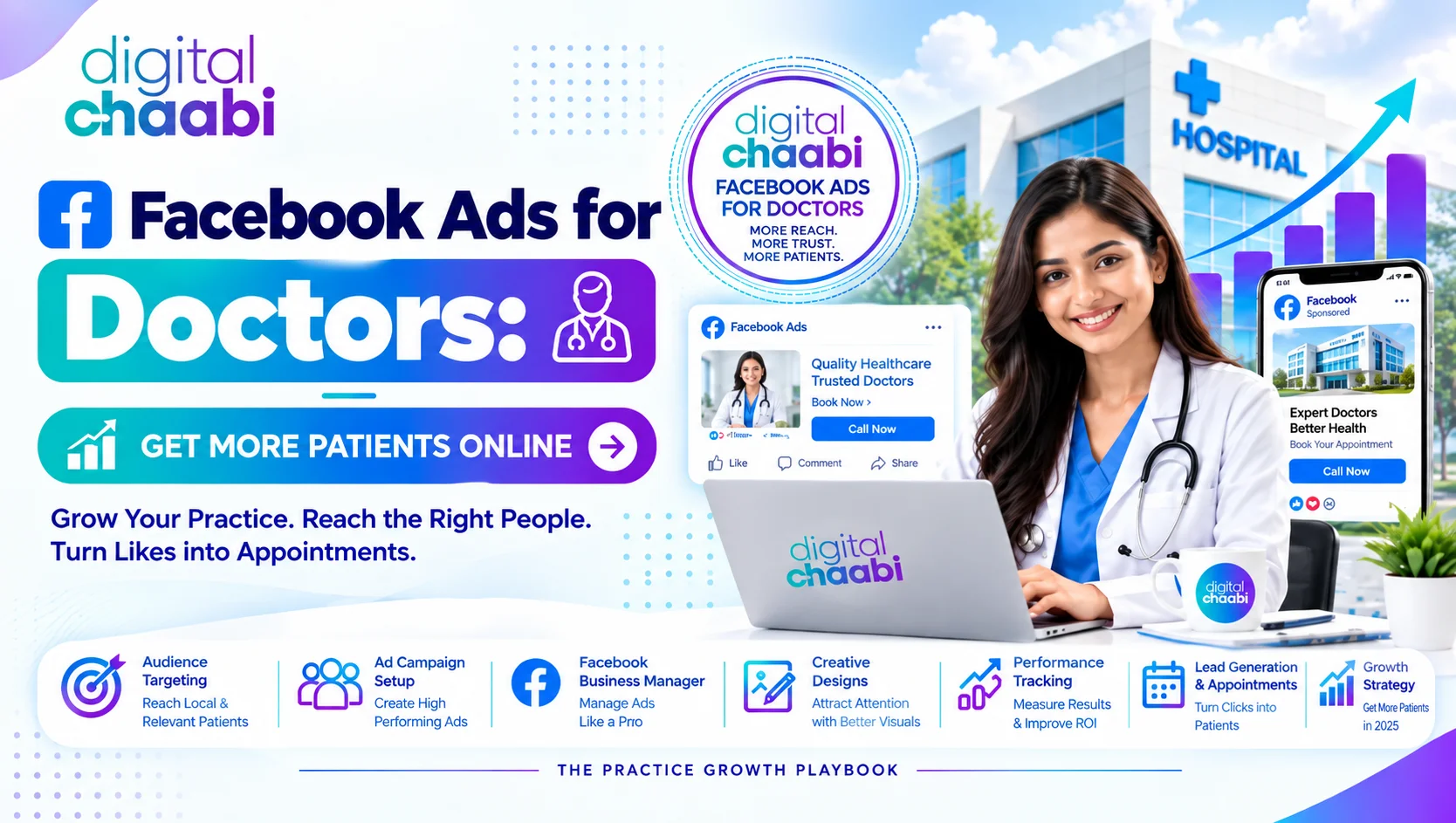
68% of US adults use Facebook. Meta runs 3.43 billion daily active users across its apps. Patients are already there, scrolling, before they’ve even started searching Google for a doctor. Facebook Ads for Doctors put your practice in front of them at that exact moment, not competing for a search click, but showing up in a feed someone’s already spending time in.
Nearly 72% of total healthcare ad spend now flows to digital channels, and Facebook remains one of the largest single pieces of that shift.
The practices getting this right aren’t necessarily spending the most, they’re targeting the most precisely, and measuring results all the way through to a booked appointment rather than stopping at the click.
This is the complete 2026 framework: targeting that actually works, the compliance rules that keep a practice out of trouble, real cost numbers, and the testing method that separates ads that convert from ads that just spend budget.
Why Facebook Still Works for Medical Practices in 2026
Google Ads captures people actively searching, high intent, high competition, high cost per click. Facebook Ads for Doctors work differently: they reach people who aren’t searching yet but match the exact profile of someone who will need care soon.
New movers looking for a primary care doctor. Newly engaged couples considering cosmetic dentistry. New parents need a pediatrician.
Used well, Facebook builds the awareness that a practice is remembered, so when a patient does eventually search, your name is already familiar. Used alone, without a search presence to catch the resulting intent, it leaves real bookings on the table. The strongest patient acquisition systems run both together.
This complementary relationship is worth understanding clearly before allocating a budget. A practice pouring its entire marketing spend into Google Ads is fighting for the most expensive, most competitive clicks, the moment someone is already actively comparing providers. Facebook Ads for Doctors get there earlier, at a lower cost per impression, planting the seed before that expensive search moment even happens.
Targeting That Actually Converts

Life Event targeting is the single most underused tool in Facebook Ads for Doctors. New Movers for primary care and general dentistry. Newly Engaged for cosmetic dental work. New Parents for pediatric care. These aren’t guesses, they’re moments when someone is actively deciding who their new doctor will be.
The ad copy that works here mirrors the moment itself: “New to [City]? We’re accepting new patients, schedule your family’s first visit today” speaks directly to someone in exactly that transition, rather than a generic “book now” that could apply to anyone.
Local, radius-based targeting keeps spend concentrated where patients can actually book, a 5–10 mile radius around the practice, refined by how far patients realistically travel for your specialty.
Radius targeting is easy to get wrong in either direction. Too tight, and the audience is small enough that ad frequency climbs and costs rise from oversaturation. Too wide, and the budget gets spent reaching people who’ll never realistically drive to your location.
Most practices find the right radius through testing, not guessing, start moderate, then adjust based on where actual bookings are coming from.
Lookalike audiences, built from your existing patient list, let Facebook find more people who resemble your best patients, without ever uploading protected health information into the platform.
Exclude sensitive health attributes in targeting entirely. Facebook and Google both prohibit targeting based on specific health conditions, respecting this isn’t optional, it’s a platform policy that gets accounts suspended when ignored.
This restriction, while limiting on paper, actually works in a practice’s favor over the long run. Facebook Ads for Doctors built around broader, compliant targeting, location, demographics, life events, tend to be more durable than campaigns relying on narrow, condition-specific targeting that risks a sudden account suspension with no warning.
Compliance Comes First, Not Last
Healthcare advertising carries a stricter bar than almost any other category, and skipping this section is how practices get campaigns shut down mid-flight.
Never collect PHI in ads or lead forms. Route every lead into a HIPAA-compliant CRM or scheduling system, not a generic form that stores sensitive data insecurely.
This single rule is the one most often broken by practices new to Facebook Ads for Doctors, usually without realizing it.
A lead form asking “what condition are you seeking treatment for” collects protected health information the moment someone answers, the safer approach asks only for name, contact details, and a general appointment preference, leaving the specific reason for the actual consultation.
Retarget carefully. Retargeting website visitors is effective and allowed, but only with generalized, brand-level messaging. “Voted [City]’s Top Dental Clinic, appointments available this week” is safe. Anything referencing a specific condition a visitor searched for is not, and both Meta and Google explicitly prohibit it.
Verify every claim. Only publish testimonials and before/after images with explicit, documented consent. Unverifiable results claim risk both a platform penalty and a regulatory one.
Ad Formats That Perform
Video consistently outperforms static images for medical practices, one orthopedics center cut cost-per-acquisition by 35% simply by switching from carousel to video, pushing consult bookings from 48 to 96 a month.
Short, 12–15 second videos showing a clean, modern facility and a friendly front desk build the trust a nervous new patient needs before booking.
This trust-building matters more in healthcare than almost any other advertising category. A patient choosing a new doctor is making a decision that feels personal and consequential. A well-produced video that shows real staff, a real space, and genuine warmth does more to overcome that hesitation than any amount of clever copywriting alone.
Carousel ads work well for multi-specialty clinics and dental practices with several distinct services to showcase in one unit.
Educational video content, short answers to common community health questions, builds long-term authority without ever feeling like a hard sell. These ads don’t close a booking immediately, but they make your practice the name a patient remembers when they eventually need care.
What Facebook Ads Actually Cost for Doctors
Medical advertising sits in a higher-cost bracket than most industries, doctors typically pay roughly 80% more per lead than the average business on Facebook, reflecting both competition and the complexity of patient acquisition.
Using a realistic average of $50 per lead, a practice aiming for 20 new patients, assuming a 20–40% lead-to-visit conversion rate, needs somewhere between 50 and 100 qualified leads, translating to a meaningful, sustained monthly budget rather than a one-off small test.
This higher cost bracket often surprises practices comparing notes with friends who run e-commerce or local service businesses.
Facebook Ads for Doctors simply operate under different economics, the audience is smaller, the compliance overhead is real, and the trust bar a patient needs to clear before booking is meaningfully higher than deciding to buy a product online.
Cost varies significantly by specialty and geography. Elective procedures and competitive urban markets run higher; rural, less-competitive specialties run lower. Most practices should plan to start with $500–$1,000 a month as a genuine test, not a token gesture, since a budget too small to generate meaningful data teaches nothing either way.
What actually drives this cost isn’t the platform, but the specifics of your situation. Geographic competition, specialty, and offer quality all move the number more than the raw ad spend itself, two practices in the same city, spending the same budget, can see dramatically different costs per lead depending on how precise their targeting and how compelling their offer actually is.
What Are the Key Facebook Ads Trends for 2026

Three shifts matter most heading into 2026. First, compliance scrutiny has tightened, both Meta and regulators are watching healthcare advertising more closely, making HIPAA-safe targeting and documented consent non-negotiable rather than a nice-to-have.
Second, video has decisively overtaken static creative for cost-per-acquisition across almost every specialty tested. Third, multi-channel attribution, tracking a patient’s path from Facebook ad through to booked appointment via Meta Pixel and server-side conversion tracking, has become standard practice rather than an advanced tactic reserved for large systems. Practices still measuring success by clicks alone, without tracing the full path to a booked visit, are optimizing on incomplete information.
A fourth trend worth watching closely: Meta’s own algorithmic tools, like Advantage+ targeting, are increasingly handling audience selection automatically.
This shifts where a practice’s competitive edge actually comes from, less from manual targeting cleverness, more from creative quality and offer strength, since the algorithm is doing more of the audience-matching work than it used to.
What is the 3:2:2 Method of Facebook Ads
The 3:2:2 method is a structured creative testing framework: three distinct hooks or audience angles, tested across two ad sets each, refined over two iteration cycles before committing serious budget to a winner.
For Facebook Ads for Doctors specifically, this might mean testing three different appeals, one focused on convenience (“book same-day”), one on trust (“meet Dr. [Name]”), one on a specific service, each run through two structured rounds before scaling the best performer.
This keeps testing disciplined instead of scattered, and it’s precisely the kind of systematic approach that separates campaigns generating real patient volume from ones burning budget on guesswork.
Applying this method well means resisting the urge to declare a winner after one round of data. Two iteration cycles give each hook a fair chance to prove itself against normal week-to-week fluctuations in performance; a single strong or weak day of results shouldn’t decide which creative direction the whole campaign scales behind.
Positioning: From One-Off Campaign to Patient Acquisition System
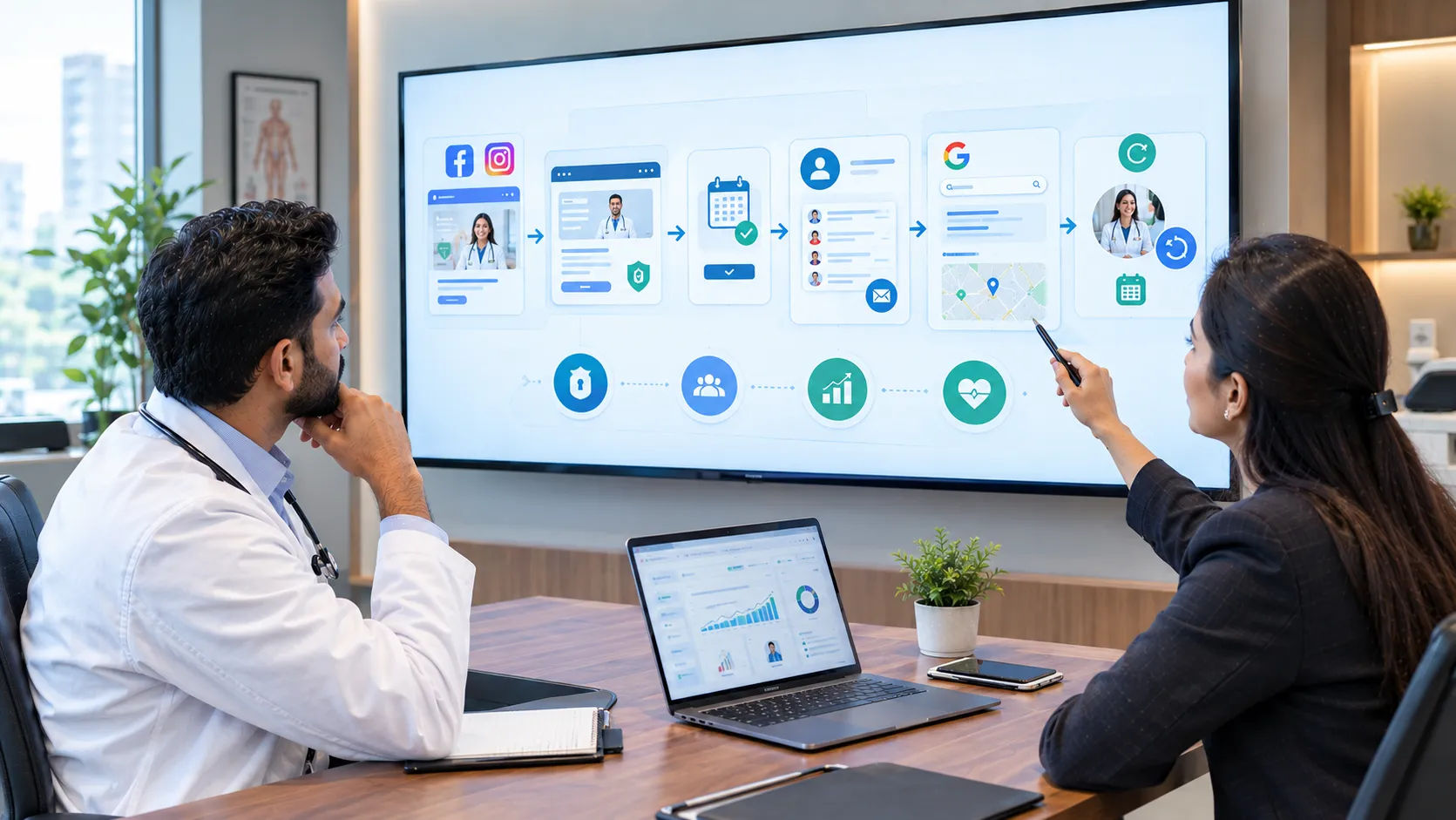
Here’s the shift that separates practices that scale from ones that plateau after an initial burst of leads: Facebook Ads for Doctors work best as one connected system, not a standalone campaign run in isolation.
The ad brings someone in. A HIPAA-compliant landing page with fast load times and easy scheduling converts them. A CRM nurtures the ones who aren’t ready yet. Google Ads catches the searches that come later, once Facebook has built enough familiarity for the practice’s name to register.
This is exactly how the highest-performing practices scale patient volume without proportionally scaling stress.
Once one specialty’s campaign is proven, the audience, the creative angle, the landing page, the tracking, that same structure applies to the next service line, the next location, the next doctor joining the practice.
A dermatology clinic that cracked the formula for acne treatment leads applies nearly the same playbook, with the hook and imagery swapped, to cosmetic procedures next.Consider what this compounding looks like over a year for a growing multi-doctor practice.
Month one proves the model with one high-volume service. By month six, that same proven structure, the 3:2:2 tested creative, the compliant landing page, the CRM workflow, has been replicated across three or four service lines, each one converting faster than the first because the underlying system, not just the ad spend, has already been validated.
Facebook Ads for Doctors built this way stop being a marketing expense and start functioning as genuine growth infrastructure.
Digital Chaabi builds exactly this kind of connected, compliant patient acquisition system for doctors and clinics, Facebook Ads working alongside search, landing pages, and CRM nurturing, not in isolation.
Ready to Turn Scroll Time Into Booked Appointments?
If your practice isn’t running Facebook Ads yet, or your current campaigns feel like they’re generating clicks without real bookings, that gap is fixable with the right targeting, compliance setup, and testing discipline.
Practices that get Facebook Ads for Doctors right treat it as a repeatable system rather than a one-time experiment, and that’s exactly the mindset that turns an initial test budget into consistent, predictable patient growth. Digital Chaabi can map out a compliant, results-focused Facebook Ads strategy for your specialty and city. Reach out at crm@digitalchaabi.com.
Frequently Asked Questions
Why is digital marketing essential for doctors in 2026?
Because most patients now research and choose providers online before ever calling. A practice invisible on the platforms where patients spend their time, Facebook, Instagram, Google, is invisible to the majority of people actively deciding where to seek care, regardless of how strong the clinical reputation is offline.
How much do Facebook ads for doctors cost per 1000 views?
CPM for healthcare campaigns typically runs higher than average industries due to competition and audience specificity, though exact CPM varies by specialty, location, and targeting precision. Cost-per-lead is a more useful benchmark for medical practices than CPM alone, since the goal is booked patients, not raw impressions.
Is Facebook ads for doctors HIPAA compliant?
Facebook ads themselves can be run in a HIPAA-compliant way when practices avoid collecting PHI in ad forms, route leads into secure systems, exclude health-condition-based targeting, and use generalized retargeting messaging rather than condition-specific retargeting. The compliance burden sits with how the practice sets up and manages the campaign, not with the platform itself.
What’s a good budget to start Facebook ads for doctors?
Most practices should start with $500–$1,000 a month as a genuine test, enough to generate meaningful lead volume and data, rather than a token amount too small to learn anything useful from. Scale up only once a specific specialty and creative angle has proven itself with real, tracked bookings.
How many leads does it take to get one new patient from Facebook ads for doctors?
Most clinics convert 20% to 40% of leads into actual booked visits, meaning acquiring 20 new patients typically requires 50–100 qualified leads, depending on the specialty and how well the landing page and follow-up process convert.
Should doctors use Facebook or Google Ads?
Both, ideally, used together. Facebook and Instagram build brand awareness and reach people before they’re actively searching; Google Ads captures people with immediate, high-intent search behavior. The combination creates a multi-touch patient journey stronger than either channel alone, since each one catches the patient at a different stage of their decision.