

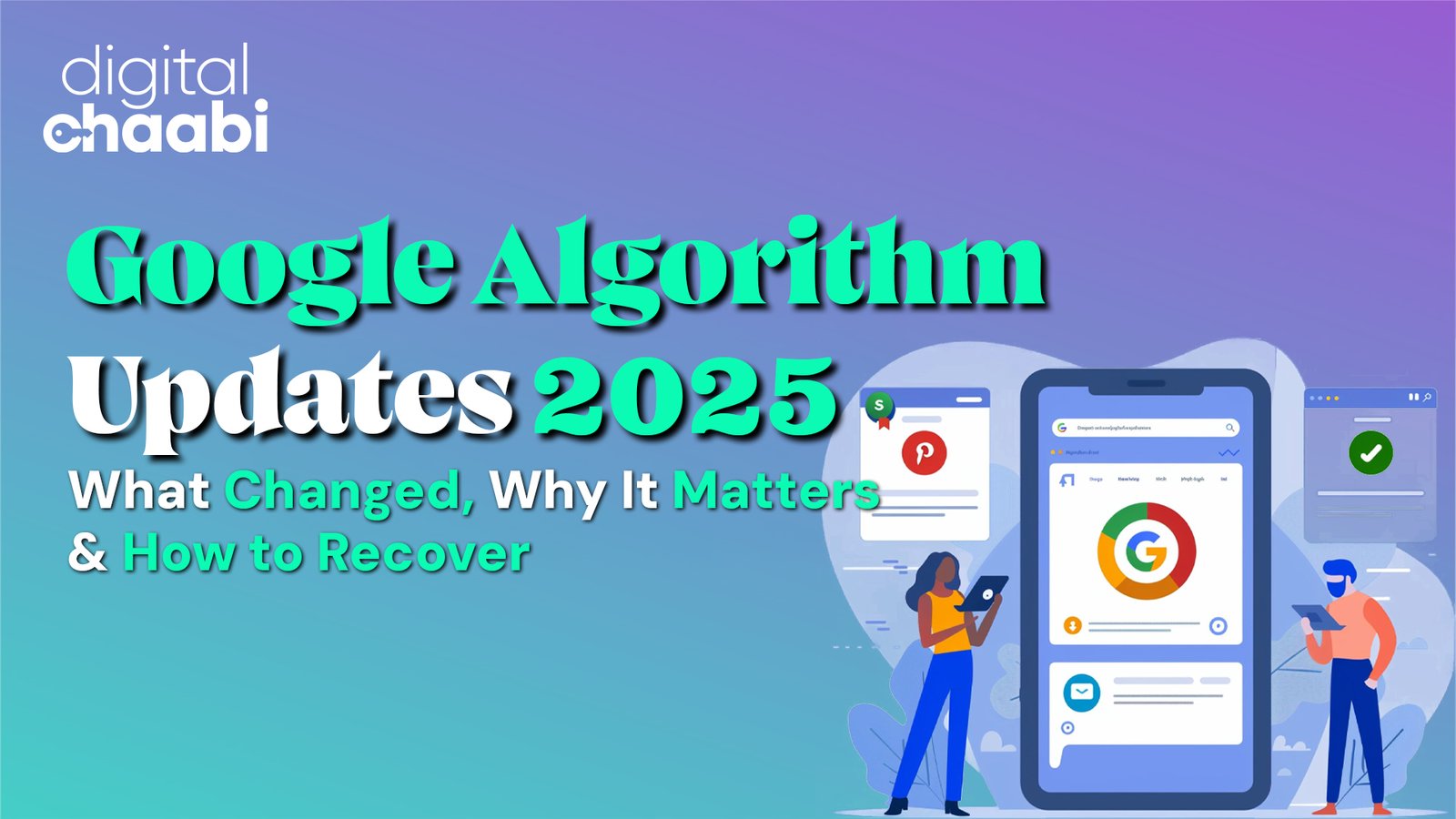
2025 has reshaped search not with a whisper, but through a series of google algorithm updates that altered how Google evaluates, surfaces, and ranks content. For site owners, marketers, bloggers, and businesses alike, the impact has been real: traffic fluctuations, shifts in visibility, and a growing sense that the old SEO playbook doesn’t apply anymore.
But this isn’t a death sentence. It’s a wake‑up call one that rewards quality, intent, authenticity, and user experience. Here’s your comprehensive guide to understanding 2026’s Google Algorithm Updates landscape and a recovery roadmap to help you build a stronger, more future‑proof site.

1. What Changed in 2025: Major Google Algorithm Updates That Reshaped Search
AI‑Driven Search & Generative Results Become Core
In early 2025, Google Algorithm Updates expanded its use of generative‑AI to power more search results, especially for informational queries. Instead of just listing links, search results began offering synthesized overviews answers generated by AI based on multiple sources.
Implications:
- Users sometimes get complete answers without clicking through.
- Pages that were thin but optimized for keywords see diminished click-through rates.
- Semantic relevance, clarity, and authority matter more than ever.
Helpful Content & Engagement Signals Reset Quality Threshold
Beyond AI overviews, Google Algorithm Updates redefined what “helpful content” means:
- It began valuing dwell time, scroll depth, and engagement behavior.
- Thin, generic, or templated content even if well-optimized lost rank.
- Content that offered real use: detailed guides, personal insights, case studies, unique data got boosted.
E‑E‑A‑T (Experience, Expertise, Authoritativeness, Trustworthiness) Got a Hard Upgrade
The bar rose for labeling content trustworthy. Sites that scantly cited sources or lacked author identities now faced more scrutiny. The algorithm began placing heavier weight on:
- Transparent author/creator information.
- Clear demonstration of knowledge, or original insight.
- Real‑world credentials, context, or experience.
- Reliable references, factual accuracy, and clarity over fluff.
Technical & UX Signals Became Gatekeepers
2026’s Google Algorithm Updates weren’t just about content. Google Algorithm Updates reinforced technical standards:
- Page speed, mobile performance, Core Web Vitals matters more.
- Sites with bloated code, slow loading, or mobile layout issues saw rank drops.
- Deprecated or misused schema markup no longer helped; in some cases, it harmed visibility.
Local & Review Signals Were Refined
For businesses with local presence: consistency, recency, and review authenticity rose in prominence.
- Inconsistent Name-Address-Phone (NAP) data across directories began causing penalties.
- Fresh, verified reviews replaced the old volume-based trust model.
- Local content relevance niche blogs, local context, community resonance began to positively impact local search.
2. Why So Many Sites Got Hit Underlying Patterns
- Many sites mass-produced short, SEO-optimized articles with little substance. Once engagement and helpfulness signals counted, those pages fell.
- Overreliance on thin templates, recycled content, and keyword stuffing no longer worked.
- Technical debt (slow servers, poor mobile layouts, broken links) quietly undermined otherwise decent content.
- Lack of real author identity, citations, or authenticity exposed many sites to E‑E‑A‑T penalties.
- SEO strategies that never considered user experience assumed that “optimization = success.” In 2025, user experience became the core metric.
What once worked clever keyword use, thin content, aggressive optimizations now hurts. What works now: authenticity, clarity, value, and real user-first perspectives.

3. How to Recover & Future-Proof Your Site A Practical Roadmap
Step 1: Audit Your Content Quality Over Quantity
- Identify pages with low engagement metrics (high bounce rate, low dwell time, low scroll depth).
- Consolidate, rewrite, or delete thin or outdated content.
- Focus on adding substance depth, data, original thought, practical insight.
- Mark or highlight older content for review (via editorial calendar).
Step 2: Strengthen E‑E‑A‑T & Author Transparency
- Google Algorithm Updatesauthor/creator bios with credentials or relevant background.
- Provide case studies, first-person experiences, real data or anecdotal evidence.
- Include citations, references, and external sourcing when making claims.
- Maintain your brand’s presence social, professional, or community footprints help reinforce authority.
Step 3: Optimize for AI-Driven Search & User Intent
- Use clear, well-structured headings and subheadings; answer likely questions early.
- Add concise summary or “key takeaways” blocks at the top of long-form articles.
- Use semantic, natural language writing for readers first, not bots.
- Anticipate user intent FAQs, how-to lists, problem–solution format, step-by-step guides.
Step 4: Clean Up Technical SEO Performance, Mobile, UX
- Test and improve page speed (images, scripts, caching, code optimization).
- Ensure mobile responsiveness and good layout for smaller screens.
- Google Algorithm Updates or remove outdated schema; validate structured data.
- Fix broken links, redirect loops, duplicate content, and crawl errors.
- Maintain clean site architecture and logical internal linking.
Step 5: Focus on Engagement & Value, Not Just Visibility
- Encourage comments, feedback, social sharing and engagement matters.
- Use multimedia: images, charts, infographics, short videos to explain complex topics.
- Run periodic content refreshes Google Algorithm Updates statistics, trends, references to stay relevant.
- Monitor analytics especially scroll depth, bounce behavior, return visits not just sessions.
Step 6: Build Community, Authority, and Real Trust
- Guest post on reputable sites, earn backlinks naturally.
- Engage with your audience: communities, comments, Q&A, feedback.
- Publish original research, unique experiences or experiments relevant to your niche.
- Transparently acknowledge sponsorships, ads, or affiliate links when necessary.
4. What Recovery Looks Like Realistic Expectations & Timeline
- Short Term (4–8 weeks): Revised pages begin to crawl up again when you improve content quality + user experience. Some rank volatility persists, but stabilization begins.
- Mid Term (3–6 months): With consistent quality and engagement focus, many sites regain and surpass old visibility especially niches with well-written evergreen content.
- Long Term (6–12 months and beyond): Sites that shift to user-first, authenticity-based publishing build resilience. Google Algorithm Updates impact them less. They grow in authority and readership rather than chasing traffic spikes.
Remember: this is not a quick fix. It’s a rebuild. But rebuilt the right way, your site becomes stronger more trusted, more reliable, more future-proof.
Conclusion
2025 wasn’t just another algorithmic shuffle. It was a turning point a recalibration for the entire web.
If your site survived untouched, it’s likely because it was already aligned with deeper principles: user value, authenticity, clarity, and clean technical foundation.
If your rankings dropped that’s okay. Think of it as pruning before growth.
SEO is no longer about tricking bots.
It’s about serving real people with real needs.
It’s about giving value before expecting clicks.
It’s about building trust, demonstrating expertise, and honoring your audience’s time.
Follow this roadmap. Invest in real content, honest optimization, user-first design.
Your site doesn’t just recover it evolves.
And in the 2026 search landscape, that evolution may be the biggest advantage.

FAQs
1. Is keyword-based SEO dead now?
Not dead but dramatically de-emphasized. Keywords still help define context, but content must also meet quality, intent, and user-experience criteria to rank well.
2. Should I delete all “old content” that lost traffic in 2025?
Not necessarily. Evaluate each page for usefulness: depth, engagement, relevance. If a page can be improved or merged with other content, do that. Delete only if it offers no value.
3. How important is site speed and technical optimization now?
Very important. Poor performance and poor mobile UX now strongly correlate with rank drops. Speed, responsiveness, and clean code are prerequisites not bonuses.
4. Do backlinks still matter after these Google Algorithm Updates?
Yes but quality matters more than quantity. A few authoritative, relevant links matter more than many low-value ones. Also, on-site expertise and user behavior now weigh heavily.
5. How soon can I expect results after implementing changes?
You might see early improvements in 4–8 weeks. Stable growth and sustained Google Algorithm Updates health generally take 3–6 months if you combine content improvements, technical fixes, and user-focused publishing.